[00:00:00] Intro
Christophe Douat: The first product which was developed by Teva has a huge commercial success. We are literally days from the potential approval of the second product with Teva, the jewel of the crown. Eli Lilly attempted to do a long-acting injectable of olanzapine, which failed commercially. The only people that attempted to solve this issue are a bunch of crazy people in the south of France.
One thing that biopharma gets wrong about drug delivery, in pharma, the prestige is in drug development. But to me, the delivery is as critical as the drug. We are seeing a shift in schizophrenia because of the success of the current long-acting injectables.
Philip Hemme: Welcome to a new episode. I’m your host Philippe, and on The Flood Bio Show, I’m interviewing the best Europeans in biotech to help you grow. There are three billion-dollar biotechs in France, and one of them is in the south of France, in Montpellier. The company MedinCell was founded in 2003, and now has one drug approved with impressive sales, and a second one that might be approved in the next few weeks.
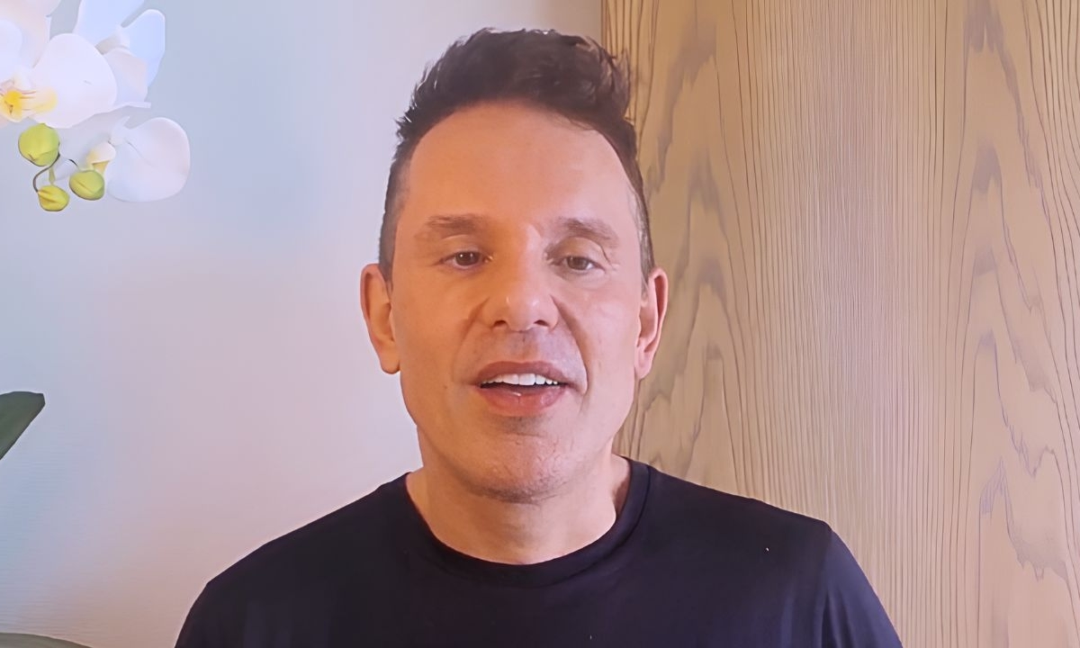
So I flew to Montpellier to meet with CEO Christophe Dois. I had never met Christophe, but I’ve heard many great things about him, especially from three previous guests on the show. We talked about why long-acting drugs can have such an impact on patients with psychiatric diseases. We also talked about financial success and why running a lodge in rural Canada helped him a lot for building MedinCell.
So here’s my conversation with Christophe, and please hit the like or follow button if you’re enjoying it.
Let me introduce you to today’s sponsor of the episode. It’s our own second product, the Float Bio Map. You can use it to discover the best biotech companies in Europe. For example, in one click, you can see the top 100 publicly listed biotechs in Europe ranked by market cap. You can try it for free, and you can use the following discount code to get 20% off your pro subscription.
Learn more at map.float.bio. The link is in the description below
Christophe Douat: Welcome to the
Philip Hemme: show, Christophe
Christophe Douat: Thank you Yeah. Great to be here in Montpellier. Yes. Thank you for coming, yeah. You met people, visited the lab.
Philip Hemme: Yeah. Yes. It’s, cool. It’s cool. And actually impressive that was a garage, and now it’s a really cool lab.
Christophe Douat: Yes. A- and before part of this was a, a huge open space-
Philip Hemme: Yeah
Christophe Douat: where the entire company was until we built the new building- Yeah … during the, pandemic.
Philip Hemme: Yeah. Oh, wow. Okay. That’s good.
[00:03:05] Jeito’s Pascal Touchon: a Mutual Friend
Philip Hemme: So I wanna start with a mutual connection of ours Pascal Touchon who was on the show a few months ago, and who is on your board. Yes. And he talked very highly of you and the company.
So maybe you can start just how he helped you, and where does MedinCell stand right now?
Christophe Douat: So Pascal joined us less than a year ago. Yeah. And we were looking for people with a deep pharma experience- Both in big pharma, biotech, both in Europe and the US, and the combination was very attractive to, join our board.
Plus Pascal is very bright w- well-mannered. And at, the board, the the the personal skills are always very important- To, make sure that the potential egos are contained, and there is constructive discussions. Yeah.
Philip Hemme: Okay. And and yeah, and where does MedinCell stand right now?
How does the, Where does MedinCell stand right now actually?
Christophe Douat: Well- Y- we– two years– a year ago I, told our shareholders we were entering the most transformative years of the company. We are right in the middle of it. Okay? And we are on plan. The first product which was developed by Teva, has a huge commercial success.
Philip Hemme: Yeah.
Christophe Douat: It’s, it is called Uzedi.
Philip Hemme: Uzedi, yeah.
Christophe Douat: We also during the period managed to define the lead formulation for the collaboration we have with AbbVie.
Philip Hemme: Yeah.
Christophe Douat: And third, we are days, literally days, from the potential approval of the second product-
Philip Hemme: Yeah …
Christophe Douat: We do with Teva.
Philip Hemme: Yeah.
Christophe Douat: It is often called the jewel of the crown. Some people even say that it it should be the most important news for Teva this year. Very important program, lots of potential. It was filed December 10 ’25.
Philip Hemme: Yeah.
Christophe Douat: So plus 10 months.
Philip Hemme: Yeah.
Christophe Douat: That takes us to to mid-October.
Philip Hemme: Yeah. Wow.
Christophe Douat: So lots of ex- Lots of excitement here. Yeah.
[00:05:35] Uzedy and Long-Acting Injectable Olanzapine: the Commercial Drive
Philip Hemme: We’ll, talk about– we can start with olanzapine instead of, Uzedi. But yeah, so the, the potential is, huge. You also have the, the EMA who act– who accepted the, new drug application or, what’s called. Yeah. How– like I saw, the data really strong, the phase three data.
You even just published, I think, in the last few days or, this week. Yes, there was
Christophe Douat: additional data.
Philip Hemme: Additional data in, the audience. Can you say a bit more, like in– and why would it be so much bigger than, Uzedi?
Christophe Douat: Okay.
Philip Hemme: What can you share? Because it’s-
Christophe Douat: Yeah. I share o-only public information.
But so olanzapine, first, is the most used antipsychotics- for schizophrenia patients. Yeah. More than risperidone, which is underlying the U-Uzedi long-acting injectable. Second, it is used for the most severe patients and the patients that are refractory to, to other treatments.
And all those patients are the ones that need the most compliance, obviously.
And therefore, that need a long-acting injectable the most. And third, most importantly olanzapine was a drug of Eli Lilly.
And Eli Lilly attempted to do a long-acting injectable of olanzapine.
Philip Hemme: Didn’t work out.
Christophe Douat: But they had technical issues and it failed commercially.
Okay. So there is no competition for our olanzapine
Philip Hemme: LAI.
Christophe Douat: And there won’t be any for a long time because the only people that attempted to solve this issue are a bunch of crazy people in the south of France.
[00:07:42] How MedinCell Could Succeed with Olanzapine LAI Where Eli Lilly Failed
Philip Hemme: I like it. W- why, is the long-acting part Or why is it so complicated compared to Eli Lilly when they tried it then?
Christophe Douat: Each molecule is different. So it has different chemical properties, different physical properties. So every time we start a new project, we start from scratch- because we have to see if we can adapt the polymers- to to the particular API. In this case, Eli Lilly used an older technology which needs to be injected intramuscularly. Okay. So inside the muscle.
Philip Hemme: Yeah.
Christophe Douat: Inside the muscle, you
Philip Hemme: have- You have a subcutaneous,
Christophe Douat: right? Yes.
Philip Hemme: Yeah.
Christophe Douat: In the muscle, you have blood vessels that can go up to one centimeter, maybe two sometimes- Yeah
wide. So if you inject inside those vessels, you get direct access to the blood system. When you have a subcutaneous product like ours-
Philip Hemme: Yeah …
Christophe Douat: You have only blood vessels in the skin that are 20 microns to 20 microns wide. So there is no risk of getting into the system except if by mistake you inject into a blood vessel.
Yeah. So first point. The second point is the product, the formulation from Lilly is highly soluble. There was a simple lab experiment that was done by Teva and MedinCell. When you inject into a glass of blood in a human plasma- The Lilly product, it gets released, the whole drug. So the monthly load-
Philip Hemme: Okay
Christophe Douat: gets released in one day.
Philip Hemme: That’s why the PDSS-
Christophe Douat: Yes …
Philip Hemme: overdose basically
Christophe Douat: like- Yes. Yeah. With our product, only 5 to 10% gets released- Okay … even in plain human plasma.
Philip Hemme: Okay.
Christophe Douat: So this issue called PDSS occurred during Eli Lilly’s clinical trials on a small number of injections. But still the patients obviously do not do well.
So by precaution, FDA imposed to Lilly a three-hour wait-
After each injection.
Try to imagine a clinician that is being told that he needs to keep his schizophrenia patient in the waiting room for three hours.
Philip Hemme: Sure.
Christophe Douat: So not fun.
And so it killed the product commercially. Okay. S- scientifically, we knew we could solve it.
It, it never I’d never lost any sleep on that. But obviously, FDA asked for a clinical proof- and they asked for 3,600 injections-
With no issue.
And we did even better- because at the end of the clinical trials 4,000 injections were done-
With not one single event of PDSS.
Philip Hemme: Oh.
Christophe Douat: Yes. So which explains why people are excited about this.
Enthusiastic clinicians are, really waiting for this product.
Philip Hemme: Yeah. And then we’ll talk about Uzedi, but one, one thing that really struck me, and actually what I talked with Pascal also made me realize, when you think long-acting, you think like optimization of the drug.
Yeah. But in your case and some other case of long-acting, like Camrez was another case where the fact that it’s long-acting enables the whole drug to basically function in the patient. Schizophrenia I, read also like basically the compliance is a major challenge. Yes. In opioid disorder or some others, it’s also.
So it’s pretty crazy how, yeah, the, the technology enables actually treatment with the same molecule. It’s really the compliance.
Christophe Douat: Yes. Yeah. Yeah. A- and the impact is huge. One of the best data I usually present i- is a, a comparison of Uzedi to oral- Yeah … last generation antipsychotics.
Yeah.
The impact is spectacular. Minus 50% in relapses, minus 50% in hospitalizations, minus 30% in total cost.
Philip Hemme: Yeah.
Christophe Douat: And it makes me say that sooner or later, all patients in schizophrenia will be under long-acting injectable. Now, you need the right long-acting injectables. You know- Yeah … the first generation that is on the market today, it’s intramuscular.
They don’t reach the therapeutic level right away.
And so it slows down adoption. And when I was– I was at the psych congress-
Philip Hemme: Yeah …
Christophe Douat: in New Orleans last week. First session was on UZEDY. It was called- Wow … A change of paradigm. You know- Wow … The, first of of the future of LAIs.
And mostly because right after injection, you reach therapeutic level, so the clinician does not have to worry about giving additional pills or a second injection within a week. The patient can be injected and go, and it’s fine.
Philip Hemme: Wow. Wow. Like the, Talking, yeah, UZEDY, w- that’s also what impressed me a lot is the, commercial uptake.
Yes. But I guess it, it trans– it translate what you j- we just said. I think I, I have the number, but from whatever approval 2023, and you grew right away to over 100 million 2024 and then-
Christophe Douat: Yeah.
Philip Hemme: Basically- … almost 100% per year …
Christophe Douat: 150.
Philip Hemme: Yeah.
Christophe Douat: A- and then this year,
Philip Hemme: The guidance 270 to
Christophe Douat: 290
the guidance is 270 to 290-
Philip Hemme: It’s impressive …
Christophe Douat: which makes analysts think it should be over 300. Yeah. 300 million. As we speak, there is over 20,000 patients in the US taking UZEDY.
Philip Hemme: Wow. Yeah. That’s super impressive. And I– yeah, and the– and I guess the peak sale is in the bil- it’s blockbuster status
Christophe Douat: basically.
The, the consensus of our analyst is a potential peak sales at 1.2 billion.
Philip Hemme: What’s your forecasting?
Christophe Douat: I- it’s an amazing product, right? Way better than competition.
Philip Hemme: Okay.
Christophe Douat: There’s no doubt. There was even additional data, which I will describe in a second. Yeah. At the end of the day you can see that this competition in the US does 3.5 billion.
Philip Hemme: Yeah. Well-
Christophe Douat: So the question- Long-acting adult … yes, the question is how much market share will it take? What price pressure there will be?
But it could be above the analyst consensus. Yeah. Of course, we’ll see. All the more that I believe that it will expand the number of patients that will be treated.
And, analysts market analysts think that in the States by 2030 we’ll go from about 13% of patients using long-acting injectable to 20%. Everybody knows it will increase. It’s increasing, yeah. UZD will be a key vector on that.
The question is how fast. But you know what?
I, must say that Teva has done an amazing job. Yeah. Awesome, yeah. They have probably the best sales force in the space in the States today. A- and i- in three years against very strong competition- Yeah … they managed to, build a very strong success for UZD.
Philip Hemme: Yeah.
Christophe Douat: And it’s not an easy job because every patient is different, every clinician is different.
You have to negotiate pricing in all the states.
But they did it, and they keep working on it, and this bodes well for the olanzapine LI because it’s the same sales force. For sales force. Yes.
[00:16:57] Camurus and MedinCell: European Champions in Long-Acting Injectables
Philip Hemme: Yeah. And we’ll talk about Teva a bit now, but first on the, competition of the, on the long, long-acting space, because I-I’m curious how, you look at it.
Because I asked Kamru’s CEO how he looks at it, and he said, “Yeah the other long-acting biotechs, we all are in different indication. Of course, we are compete-competing technology, but a bit different. They are based more lipid-based, I think. You guys are more polymer, so you are fit more for small molecules, they fit more for, others.”
But at the end of the day, I think you, you– I think Alkermes is a bigger one, a big one in the US. Alkermes? They’ve-
Christophe Douat: Alkermes- Yeah … used to be, yeah.
Philip Hemme: Used to be. Oh. I think I mentioned Ascendis in, in, in Denmark as well. But I think you all have a bit different indications, so I’m not sure how much you’re a direct competitor.
But then also a lot of big pharma, they have their own long-acting version to their, do their own technology. How do you look at this space yeah?
Christophe Douat: The field has really evolved a lot in the last 25 years. So I usually segment competition in three buckets. The older technologies, which are called microspheres.
Philip Hemme: Yeah.
Christophe Douat: And these technologies are behind Alkermes, which did the products of Johnson & Johnson- Okay … on risperidone.
Philip Hemme: Yeah.
Christophe Douat: This was the technology behind the olanzapine LAI Relprevv of Eli Lilly.
Philip Hemme: Yeah.
Christophe Douat: And now generic company use them, pharma company use them, but they are not satisfactory- Okay
And, they cannot do best-in-class products because-
Philip Hemme: So you even have long-acting generics as well? We can-
Christophe Douat: Yes. Yeah. Okay. Because they are intramuscular injections- Yeah … with long needles. They don’t reach therapeutic level right away.
Philip Hemme: Yeah.
Christophe Douat: A- and and that’s because the polymers they use are off the shelf.
Okay. In the second bucket of competition, there is early-stage companies technologies developed in academic settings-
And in which of course we keep scouting those. I have one person dedicated to scouting to see if one day some of those could be interesting to complement- what we do our technology called Depot.
Philip Hemme: Yeah.
Christophe Douat: A- and we do have some collaborations with, some of them, but they are far from, Commercial … being able to go into, humans. And then i- in the, I would say, best-in-class technologies, there’s Kamrus-
Philip Hemme: Yeah …
Christophe Douat: and MedinCell.
Philip Hemme: Okay.
Christophe Douat: Kamrus has chosen to do their own products-
Philip Hemme: Yeah
Christophe Douat: In a different space. It’s a very nice technology which has more limitations on the dose-
Philip Hemme: Okay …
Christophe Douat: that they can use, and on duration therefore.
Philip Hemme: Okay.
Christophe Douat: And so we have our own spaces- Which of course we, try to, expand. And, what is interesting as, as Frederick told you, is that we became leaders in, in our own spaces.
Yeah. And in CNS schizophrenia we have the reputation of being the best-positioned company.
Philip Hemme: Yeah. Wow. It’s amazing that the, the two best companies in that space are from Europe-
Christophe Douat: Yes … globally. Yes. Yes. Be- Europe has great research.
Philip Hemme: And great- And it gets commercialized
Christophe Douat: Yeah.
[00:20:51] Montpellier and the Foundation of MedinCell
Christophe Douat: Maybe I should tell you why we are in Montpellier. Yeah. ‘Cause we’re not here because of the sun. The science is not far. So first Montpellier is the third research and academic center in France with over seven or 8,000 researchers in, all fields.
Philip Hemme: After Lyon and Paris, or what’s…
Christophe Douat: Yes.
Philip Hemme: Yeah. Okay.
Christophe Douat: And there is a very old tradition of medicine and pharmacy.
The school of medicine in Montpellier is the oldest active medical school in the world.
Philip Hemme: That’s great.
I saw you were chair, or what, was the name that you are?
Christophe Douat: Yes. Patron or
Philip Hemme: what
Christophe Douat: is it? Yes. I, was a patron of, Oh, yeah, patron
the, this year’s masters at the university. But within the faculty of pharmacy, there is a lab which was led by and created by Professor Michel Vert-
Which was known as the pope of PLA polymers. And he started the field of PLA polymers. Okay. And the entire discipline worldwide was structured in his lab.
Philip Hemme: Wow.
Christophe Douat: And so MedInCell was one of the spin-off from the lab, was incubated in the incubation system of Montpellier, which is, which was nominated the best one in the world a few years back.
And then that incubator is 500 meters away from where we are.
Philip Hemme: Okay.
That’s also why you are here.
Christophe Douat: Yes. And so we moved 500 meters.
To, to a building close by- Yeah … and then to, to this one, which was a, a former Renault garage. And the owner clea- cleaned it up, added a, a f- a floor, and then it became too tight, so we put this extension-
Philip Hemme: Yeah …
Christophe Douat: At the end of the pandemic, so in 2022.
Philip Hemme: Yeah.
Christophe Douat: The the new offices, and we are building a new extension soon.
Okay. ‘Cause
Philip Hemme: we- And because you’re 150 people now.
Christophe Douat: Yes. Yeah. Yes.
Philip Hemme: Amazing. Yes.
Christophe Douat: We have 150 people. Th- believe it or not, 30 nationalities. Oh. Three-zero.
Philip Hemme: Oh.
Christophe Douat: We have people from China, Japan, Australia, the US South America Spain, North Africa- Wow … Sweden, Germany, England, a- and- Wow … and so on.
And we did that because first we wanted to be able to attract talent from all, all over the world.
Philip Hemme: Yeah.
Christophe Douat: And then we believe that when you bring different cultures we all have our own boundaries, barriers, mental barriers, and so if you bring people from different countries then you break those barriers, or at least extend them.
Philip Hemme: It’s amazing. I wanted to go in the story, but, and what’s amazing is that it’s more than 20 years ago, I think with 2003 officially founded.
Christophe Douat: Yes.
Philip Hemme: So it literally took… And the f- the first approval was 2023, so it took 20 years from lab to
Christophe Douat: approval- Yes … Which is- Yes, because Cambioris was even, I heard yesterday- Even longer
because I listened to the video from Frederic, that it was even ’92.
Philip Hemme: Yeah.
Christophe Douat: But so- I think they generated the whole company … The, the early start was with a couple of scientists and I used to be a, venture capitalist- so that’s how I discovered the MedinCell, and and and so it was founded by, a couple of scientists, and then a, a business angel which was a a serial entrepreneur in the US took control of the company.
We got along really well, and he was instrumental- In the first few years of the company to, to to, start it. And when I joined the company myself in 2009 there were eight people.
Philip Hemme: Okay. Wow.
Christophe Douat: And so it’s b- it’s been, That’s really when we started to to put the team together.
And the key patents were filed during that time as well.
[00:25:19] Teva Pharmaceuticals: an Agile Partner
Philip Hemme: Okay. Wow. That’s amazing. That’s impressive. I want to ask on the– actually on, on Teva itself, like, ’cause I feel– they’re just probably the strongest in generic, I think globally.
Christophe Douat: Yes.
Philip Hemme: Probably number one. But they tried to move more to innovative drugs.
Christophe Douat: Yes.
Philip Hemme: I think they struggled a bit there as well. How do you– like, how was it working with them?
Christophe Douat: Okay. So- Teva has been a great partner for us because they are a big pharma with maybe less of the drawbacks of big pharma because they have kept a very agile, you know- Yeah
entrepreneurial spirit.
Philip Hemme: Yeah.
Christophe Douat: And the company for a long time has had two legs generics-
Philip Hemme: Yeah …
Christophe Douat: and specialty pharma. S- And their lead product was Copaxone.
Philip Hemme: Yeah.
Christophe Douat: In 2012, ’13 their CEO and their team decided to move into what they called new therapeutic entities, which would ally the best of both worlds, you know- Yeah
doing specialty drugs with existing APIs- Yeah … like long-acting injectables.
Philip Hemme: Yeah.
Christophe Douat: So they looked for technologies all over the world. I, saw that they were– they had evaluated more than 140 technologies.
Philip Hemme: Wow.
Christophe Douat: They did one platform agreement, and it was with- MedinCell because the early data we had was really, spectacular.
Philip Hemme: Okay. Wow.
Christophe Douat: And and then Teva went through ups and down. They acquired Actavis in the States, the number two in generics.
Philip Hemme: Yeah.
Christophe Douat: Piled up like over 40 billion in debt at the time when the generic pricing was decreasing. So they had to restructure the number of people by 25%, R&D as well, but they kept our products- okay … which means that now our products are their lead products in their pipeline.
Philip Hemme: Yeah.
Christophe Douat: And I’ve gone through four CEOs- … At Teva since we executed the deal on November 28th, 2013.
Philip Hemme: Wow.
Christophe Douat: And, it’s great to see Teva being revived under the leadership of Richard Francis.
Philip Hemme: Yeah.
Christophe Douat: He’s been refocusing it on, on the important programs-
Philip Hemme: Yeah …
Christophe Douat: Especially- And the right programs. … UZD, the olanzapine. So of course I, think he’s great. And when you listen to him he will always talk about UZD and then olanzapine LAI. Yeah.
Philip Hemme: That’s cool. Side note that I’m c- just curious because Teva is, Israeli.
Actually I don’t know how much you’re into it, but with the war and everything, I don’t know how it impacts, and I’m asking because I met someone in Israel, biotech, I think it was a CRO and, they told me like it’s pretty amazing how resilient they are, that they managed to keep the whole business running The whole time was a crisis
Christophe Douat: Yes.
Philip Hemme: Yeah, I mean-
Christophe Douat: I, think they had a very good CEO Cor Schulz- Okay … before Richard Francis, that was more of a finance guy-
Philip Hemme: Yeah …
Christophe Douat: that restructured the company, Yeah … Brutally. He- Okay … but he had to do it. There was no choice. And so they closed a lot of plants optimizing the number of plants, you know- Yeah
restructured R&D. A- and then they had to do it for survival.
Philip Hemme: Yeah.
Christophe Douat: And then they started to really decrease the debt.
Philip Hemme: Okay.
Christophe Douat: And then when Richard came in he had more room to play with- Yeah … To think about growing the company again.
Philip Hemme: Okay. And then I guess they’re, quite global anyway.
It’s not- Yes … they’re not- Yes … super centralized then.
Christophe Douat: Yes. You know what? In the early days, we used to go to Tel Aviv a lot. Yeah. Not anymore.
Philip Hemme: Okay.
Christophe Douat: And the center of gravity has moved a lot towards the US.
Philip Hemme: Yeah.
Christophe Douat: But you can see that the last few CEOs, except the number two they were all outside Israel.
Philip Hemme: Okay. Yeah. Okay.
[00:30:08] Nanobiotix and France’s $1B Market Cap Club
Philip Hemme: Back to, huh, o- one thing about more financial parts, We talked with Laurent was on the show from Nanobiotix, which I think you,
Christophe Douat: yeah, I know Laurent just really well. I I, was involved, I believe in, in two of the three biotech success stories in France- Yeah
’cause I used to be the lead investor in Nanobiotix. Yeah. I helped them for a bit- You’re the first- … In, in business development
Philip Hemme: First deve- first investor, I think, or one
Christophe Douat: of the first, yeah. Yes, in 2016. And then no, in 2006. Sorry, 2006.
Philip Hemme: Yeah.
Christophe Douat: And then I was on their board as an independent board member for many years. Yeah. Yes, so I have a lot of respect for for what Laurent has done.
Philip Hemme: Yeah.
Christophe Douat: And, I love really the technology- Yeah … Behind the Nanobiotix. Yeah, it’s
Philip Hemme: amazing. I have to ask. Laurent, I know him quite well.
He told me, and he hasn’t– He told me, “I will send you my pitch deck from 2006, and you will laugh,” but he never sent it to
Christophe Douat: me. How was his pitch? When I first met them there were I think six people or so i- in a small apartment in Paris- … In, in what’s called the Sentier, you know- Yeah
center of Paris. And and he’s been very tenacious, you know- really believing in the technology and turning Nanobiotix in, in a great company. Oh, that’s fair.
Philip Hemme: Yeah, so when we recorded, it was– you just passed the billion-dollar mark. You guys passed it a bit after.
Christophe Douat: Yes, we were texting each other.
Philip Hemme: We made it.
Christophe Douat: Yes.
Philip Hemme: That’s amazing. And, then we had Mark from AbbVie Vax also passed. And now I think he’s even- Yes … 10 billion almost or nine.
Christophe Douat: Yes. I- You know- That was another story because there was a biotech CEO dinner and, we were waiting for a cab with Mark, the Gary Bell. Okay. And I told Mark my only goal in life is to beat your market cap.”
And we did for a while, and then what– when they got the data- Yeah … of course, they skyrocketed- Yeah … To the the nine-billion-dollar market cap.
Philip Hemme: Yeah, Oh, that’s cool. H- like how, did it feel to pass the, billion dollar? I guess it must feel great, but also from the company, the team, like-
Christophe Douat: There were two feelings.
First, of course, we were extremely proud-
Of what we have built of the impact of what we do on patients- and of course, being able to translate that into financial value. And also it really In a way, I built some pressure because you are a billion-dollar company.
I told the team you don’t behave when you’re a billion-dollar company and execute because the as, as when we were a smaller company five years ago because people have more expectations. You know- Yeah … the investors are bigger investors more demanding. And so i- it was a great motivator to- Yeah
to to keep transforming the company.
Philip Hemme: That’s good. And you also did it by being listed only in France, which is- Yes.
Christophe Douat: Yes …
Philip Hemme: even more –
Christophe Douat: Yes …
Philip Hemme: even harder.
Christophe Douat: Yes. I think one of the things we c- we can be proud of is we started to work systematically on US investors just three years ago.
Philip Hemme: Yeah.
Christophe Douat: And we managed to attract quite a few of them- Yeah … That invested directly on Euronext, which is very rare. Yeah. Usually they invest in capital raises-
Philip Hemme: Yeah …
Christophe Douat: but not directly on Euronext.
And it, started a, a virtual circle where we got new investors analysts in parallel for- US banks. We have more US or UK-based analysts than French now.
Philip Hemme: Oh, okay.
Christophe Douat: And so i- this effort was really instrumental in bringing US money, l- big firms- Yeah … and and really helped us go through that billion-dollar barrier.
Philip Hemme: And I guess also you can…
It, also a good ground to, to explore dual listing also.
Christophe Douat: Yes.
Philip Hemme: Yes. Yeah.
Christophe Douat: Yeah. Of course, we always think about it
Philip Hemme: oh, why not, actually? That’s more than-
Christophe Douat: Because w- we don’t need the… We don’t… We, on March 31st, we had over 80 million in cash.
And we don’t burn that much cash because we have revenues.
Our royalties- Yeah … are starting to increase, and so we don’t have the need for large amounts of capital raise that the nanobiotics or other companies have. And so we would have to find a rationale in other things like of course increasing liquidity. But then the liquidity is split on two exchanges if you do a dual listing.
So it is something that we always review. We have we are getting prepared- to go to Nasdaq i-if we need to. And I guess ’27 we’ll look at it again because the timing with Olozapin starting to ramp up would be ideal.
Philip Hemme: Yeah.
Christophe Douat: O-one, one thing of course, liquidity may have an impact getting access to more US investors ’cause we ha- we do have some US investors that are telling us I, I would like you to be on Nasdaq.”
Philip Hemme: Even global investors because-
Christophe Douat: Yes …
Philip Hemme: even not on US, but even-
Christophe Douat: Yes …
Philip Hemme: Asia, whatever
Christophe Douat: Yeah W-we go to visit Janus Henderson in Denver ev-e-every year. It’s like a $300 billion fund and, they would want us to be on Nasdaq. One day we, we’ll– the question is not whether we’ll go there, but when.
[00:36:39] Contraception, Malaria and Schizophrenia: the Human Factor
Philip Hemme: When, yeah. Okay. On, One thing that also Pascal told me, and you ha- you have that program in more like global health and public benefit. He told me you care a lot, and it translate also as a company you invested on– you care very focused on patients and also the patient you treat and also any kind of- Yes
global health. Yeah. Talk a bit more on this?
Christophe Douat: I often say that great companies have two things a vision- and values. And our vision when we founded the company and put the team together in 2009 was twofold. We wanted our technology to serve all populations of the world, not only wealthy countries.
And second, we wanted to have an enterprise model where everybody could be a shareholder. But let’s, focus on the first point. This was our vision, and we did it because we are working on several programs that will impact the developing world.
We have a program– two programs funded by the Gates Foundation.
One to do a best-in-class contraceptive-
That will be, again, a change of paradigms.
I, love changes of paradigm because if you want a product to be successful you have to be vastly superior to To competition. A-and that will be a six-month contraceptive which will not use NPA, which is used in a lot of contraceptive- which has a lot of bad side effects like- Okay … osteoporosis and- and some brain tumors, et cetera. So that’s number one, and it should go into phase one i-in the u-upcoming years. It’s, a long development because it’s a six-month delivery. Our team here in the lab managed to do a product that will release a drug for six months- It’s great
and then disappear.
Philip Hemme: It’s great.
Christophe Douat: Amazing, huh? Amazing. Second, the second program is in malaria.
Philip Hemme: Okay.
Christophe Douat: That’s– So the first one has a huge commercial potential, and we’ve kept all the commercial rights.
Philip Hemme: Okay.
Christophe Douat: Okay? It’s a multi-billion dollar potential because of the the qualities of, what we want to do.
But-
Philip Hemme: Only in the developing world or globally? Globally.
Christophe Douat: Okay. Yeah. There’s a big need in the US as well because, again the current injectables don’t have the proper drug. Okay. So the second one is in malaria. A few years back, there were clinical trials that showed that by injecting ivermectin there was a lot of talk, do you remember, during the pandemic about ivermectin?
It kills parasites.
Philip Hemme: Yeah.
Christophe Douat: And so they, have shown that by giving oral ivermectin to local populations- Yeah … in Africa during the rainy season, the mosquitoes that come and bite treated people will die. You kill mosquitoes, right? And, those mosquitoes are the one that that are the vector of malaria.
Yeah. And so by by… They showed that by using oral ivermectin, they could have a 26% decrease in malaria already. However, it’s very difficult to have compliance and to sync it with the, the rainy season- ’cause you have to take the pills right before the rain, and it’s- Yeah … very difficult to time.
And so we are developing a three-month ivermectin-
Philip Hemme: Yeah …
Christophe Douat: to not have to worry about the rainy season. And the modeling that was done by scientists show that we could maybe reach a 60% decrease in malaria. Wow. This is 700-
Philip Hemme: Yeah …
Christophe Douat: thousand lives a year-
Philip Hemme: Yeah …
Christophe Douat: mostly children.
Philip Hemme: Yeah. Wow.
Christophe Douat: Okay? It’s a very, exciting program, again, which is getting ready to to go into phase one. The third one is a, an early-stage evaluation for technology to, work on tuberculosis.
People with tuberculosis quite often are not stable very hard to monitor.
Yeah. So having a long-acting injectable can bring a lot of value, and we are working f- here with a small foundation in, Switzerland called IM for TB tuberculosis.
Philip Hemme: How do you make it work financially?
Christophe Douat: So it’s funded by by foundations.
Philip Hemme: Okay. Yeah.
Christophe Douat: And beyond that, because our technology has, has low COGS, you know, cost of goods sold- all our products could target the developing world. And we are analyzing the potential, for example, of UCD or olanzapine LI in, in the developing world in countries such as Indonesia, India, Brazil-
Where it could have a big impact because of low access to healthcare facilities.
And, we want to build data to, show Teva that it w- it would be worth going there. All the more that in those countries you have a middle class, which is now increasing fast with healthcare coverage. Yeah. It’s 4 or 500 million already in India. Yeah.
Philip Hemme: Yeah. Yeah. Okay. I wanna switch to a more personal question, but just to, finalize or to summarize, one thing I didn’t mention is like– we mentioned a bit, but on the patient impact on schizophrenia and, bipolar, I think Depakote is the one you type one you also approved.
And maybe a bit personal, but I have a form of, bipolar, actually not type one, but and it made me discover the, this whole world where it’s actually really prev- the prevalence is quite high. It’s 1%
Christophe Douat: of the population. Yes, it is.
Philip Hemme: And for me, it always felt like it’s something very far away and and actually seeing and, seeing the drugs, some drugs work really well, some has s- still some limitation.
So it’s amazing to see the, impact you have on, psychotic patients and that that it works so well. Like it’s- Yeah … it’s amazing. It- and the medical need is super high, I think.
Christophe Douat: It’s touching. Schizophrenia hits young men and young women in their late teens.
Philip Hemme: Yeah.
Christophe Douat: Like between 17 and 22.
Philip Hemme: Yeah.
Christophe Douat: You have kids that are perfectly normal-
Philip Hemme: Yeah …
Christophe Douat: and suddenly they develop schizophrenia.
Can you imagine the impact on their life, their families, their friends? It, changes everything.
Philip Hemme: Yeah.
Christophe Douat: And and of course, what we do can help compliance. A-and right now, long-acting injectables are mostly used for patients that have had schizophrenia for a while.
But when I was in New Orleans last week people are starting to talk more and more about treating people early- into the pathology. Because if you do, you prevent relapses.
And every single time you have a relapse, you have an irreversible damage on your- cognitive system. And so I really believe that long-acting injectables should be used early on.
Philip Hemme: Even with
Christophe Douat: a lot
Philip Hemme: of those, you could also-
Christophe Douat: Yes. Yeah. And then you could help people have a better life. Maybe a longer life as well. Maybe work- ’cause 80% of them cannot work today. And the societal impact the human impact of what we do is very significant.
Philip Hemme: Again, mental health it’s unfortunately it’s also increasing.
Christophe Douat: Yes. Yes. And there’s bipolar is– has even more prevalence.
Philip Hemme: I’ve bipolar type III, so it’s still a very light version, type III. A bit transparent on it, but, So it’s lighter, but
Christophe Douat: yeah, it’s, Yeah. A-and then there is Parkinson, Alzheimer all those CNS pathologies- in which long-acting injectables could have an impact.
[00:46:05] From a Fishing Lodge in Ontario to Biotech CEO
Philip Hemme: Awesome. Yeah. Okay. More to personal– You talked a bit personal on venture capital. One, one thing that struck me is you studied in, France, then you went– you finished in the US or in Canada, and then you were running what? A lodge in Canada with
Christophe Douat: no- Damn I can’t, hide it.
Philip Hemme: I have to say, on the 62 interviews, no one has done that.
Tell, a bit like how, like, how was that and how, do you look back at this now
Christophe Douat: okay. No, I, I’ve had a- an amazing life because I was able to live through incredible careers.
And I, think I, I feel lucky be- because I was able to adapt- I- in new settings on every single one of them.
So I graduated from one of the elite Grandes écoles French engineering schools. I did a master’s at the- In
Philip Hemme: general, actually was not medic- No … as in bioengineering or- No,
Christophe Douat: not at all. No … general I had not touched anything in medicine or pharmacy until I became a venture capitalist, yes.
That’s
Philip Hemme: crazy.
Christophe Douat: And then I, did work in numerical modeling-
Philip Hemme: Yeah …
Christophe Douat: at the University of Minnesota. A- and then decided to to… My, wife is English Canadian.
And so we lived in Western Canada for 10 years. And, there I was selected i- in a, a program for Lafarge the French- Okay
cement company, which is– which was a very prestigious company to work for in France. And worked in that plant for a few years. I even had got my blasters certificate. And then I left that job to take over a family business, which was a fly in a fami- fly in fishing lodge in, Northwest Ontario.
Philip Hemme: Wow.
Christophe Douat: And I love nature, and- Okay … and I love also freedom and being able to, decide. And this experience was invaluable business-wise because when you have a business like this, you have to do everything, the human resources logistics- How big was- … planning. 35 employees.
Philip Hemme: Yeah. Wow, okay.
Christophe Douat: We had 700 flights in five months.
Philip Hemme: Okay.
Christophe Douat: Really high-end, mostly American guests.
Philip Hemme: Yeah.
Christophe Douat: We had two airplanes on our own, so there I took– I had my certificate of water bases for airplanes. Wow. And, I did my MBA in finance and entrepreneurship- okay … At the same time in, Calgary. With I’ve always b- been able to do quite well academically and then I, joined BCG-
In the strategy consulting. Back in
Philip Hemme: France then?
Christophe Douat: Back in France. Worked a lot on internet, and then sta- became a, a venture capitalist, and that’s when I started to see the potential- with, you know, population aging to get into medical device- and anything related to, to aging of the population. And one of the first investments I did was in polymer stents coming from the lab of Michel Vert.
Philip Hemme: Oh, really? Okay.
Christophe Douat: And so I was walking through the hallway of his lab.
I I asked Michel “What are those curves here?” and they were drug release curves, PK curves.
Philip Hemme: Yeah.
Christophe Douat: And that was the beginning of MedinCell.
Philip Hemme: Wow. It’s a small world- Yes … really.
Christophe Douat: Yes.
Philip Hemme: And quickly, but the transition to therapeutics, how was that like in– for, med tech to more therapeutics, like-
Christophe Douat: It’s very different.
Yeah. I, went first in med tech because being an engineer- Yes … it’s easy to understand but the pharma world is really different. Yeah. And so especially because of the regulatory clinical things. I, had worked a bit on this at BCG. We had some investments when I was a venture capitalist.
Nanobiotics was in between- Yeah … because it’s, a physical. Nanobiotics has to follow, of course, drug development, but the the science, it’s physics. Yeah. It’s not chemistry. And so it was- People should check out the- Yeah, it was a great step for me to get into pharma.
Philip Hemme: Yeah.
Christophe Douat: And then, of course, with MedinCell in 17 years I had time to, Time to learn
to learn as we went and, we also surrounded ourselves with great experts.
[00:51:10] Quick-Fire Questions
Philip Hemme: Cool. Let’s finish with a just quick fire. So quick questions, quick quick answers. One thing that biopharma gets wrong about drug des- drug delivery. One thing.
Christophe Douat: I, think i-in pharma, they see the, the prestige is in drug development.
But to me, the delivery is as critical as the drug, ’cause you don’t- if you don’t have the proper vector to get that drug where you want, how you want during the time you want, your product is inferior.
And I think they don’t integrate drug deliver- delivery early enough. We are seeing a shift in schizophrenia-
Philip Hemme: Yeah …
Christophe Douat: because of the success of the current long-acting injectables. There is a wave of new companies in schizophrenia and bipolar, and every single company- Long-acting
wants to develop their long-acting injectable in parallel of the oral drugs, and that’s a big shift in in strategy.
Philip Hemme: One mistake you made in the past 12 months?
Christophe Douat: I never make mistakes.
Philip Hemme: Never
It’s an answer. Maybe one, one impactful drug that has been approved that especially stands out to you except your own drugs, like.
Christophe Douat: One that touches me personally is the drug on hepatitis C from Gilead- Gilead … Sovaldi, because my dad died of that.
Philip Hemme: Oh, wow.
Christophe Douat: And he died I think three or four years before the drug became available.
Philip Hemme: Wow.
Christophe Douat: And I, saw his decline and, how he suffered through this and it, it’s motivating to see that when you get drugs on the market and early enough you can really save life and change lives.
Philip Hemme: One advice to the Christophe of 10 years ago.
Christophe Douat: I would have to think a bit more on, this one. 10 years ago was 2016.
Philip Hemme: Around, yeah. I mean-
Christophe Douat: Yeah. Maybe I would have tried to, raise a bit more money earlier to invest more in, in own pro- in our own programs and, bring t- more talent ear- earlier.
Philip Hemme: Yeah.
Christophe Douat: Because we developed the company quite unusually with no outside money, no business angels, no VCs.
We grew the company as a commercial entity right away-
Philip Hemme: Oh. Oh …
Christophe Douat: By tightening our belt to the, the 10th degree- … By not spending money. Yeah.
Philip Hemme: A-
Christophe Douat: and we succeeded.
But I, think maybe we, could have raised some money a bit earlier especially to, bring talent, you know- more talent a bit earlier.
Philip Hemme: Yeah. Last one, one biotech hero or mentor of yours.
Christophe Douat: I brought to our board a lady called Sharon Mauds.
Okay? And Sharon started Intracellular Therapeutics in
2004 with work from a Nobel Prize. And this company went commercial, and then she went commercial against everybody’s advice in bipolar.
Philip Hemme: Yeah.
Christophe Douat: And that company was sold just last year, 10 … to J&J for 15 billion. Yeah.
And so I, spec- I went to, to see Sharon, which I, had met a couple of times to convince her to join our board because she had this amazing experience going through ups and downs- experience of CEOs. A- and and she accepted to, join our board a year ago. Wow.
A- and she’s very powerful incredible experience. She’s over 70 today. She’s starting a new company . And she swims 3K a day. Yes, Wow. Yes.
Philip Hemme: That’s cool.
Christophe Douat: Which is a, another good example because I, like exas- sports.
Philip Hemme: Yeah.
Christophe Douat: You may have seen that we have a gym at MedinCell. I
Philip Hemme: didn’t
Christophe Douat: see the- Yeah. Behind the lobby here- Okay … we have a gym because I encourage people to do sports. Yeah. And it’s, not free ideal. It’s because when people exercise, do sports-
Philip Hemme: Oh,
Christophe Douat: yeah
they perform better.
Philip Hemme: Yeah. Awesome. Awesome, Guy. Thanks a lot.
Christophe Douat: Okay. Thank you very much.
Philip Hemme: Great. Thank you.
I’m impressed by how Christophe grew the company into one of the world leaders for long-acting drugs. I’m also impressed by his south of France low-key mindset, and how much he cares for patients. As a patient with a mental health condition, I feel a personal connection to MedinCell and the impact it has on patients living with these very difficult conditions.
If you enjoyed this episode, please hit the like, follow, or review button. Any of these action help many more people discover the podcast. We have plenty more videos on our channel, so please feel free to check them out. I would also be curious to hear what you think, so if you could drop a comment wherever you are, or shoot me an email at philip@flot.bio.
That’s P-H-I-L-I-P @F-L-O-T.bio. All right. Thanks for staying to the end, and see you next episode.

![CEO Jean-François Brepson on Scaling a CRO, and Selling to Charles River | E59 [Sponsored]](https://flot.bio/wp-content/uploads/2026/06/Website-Thumbnail-PathoQuest-1080x648.avif)


