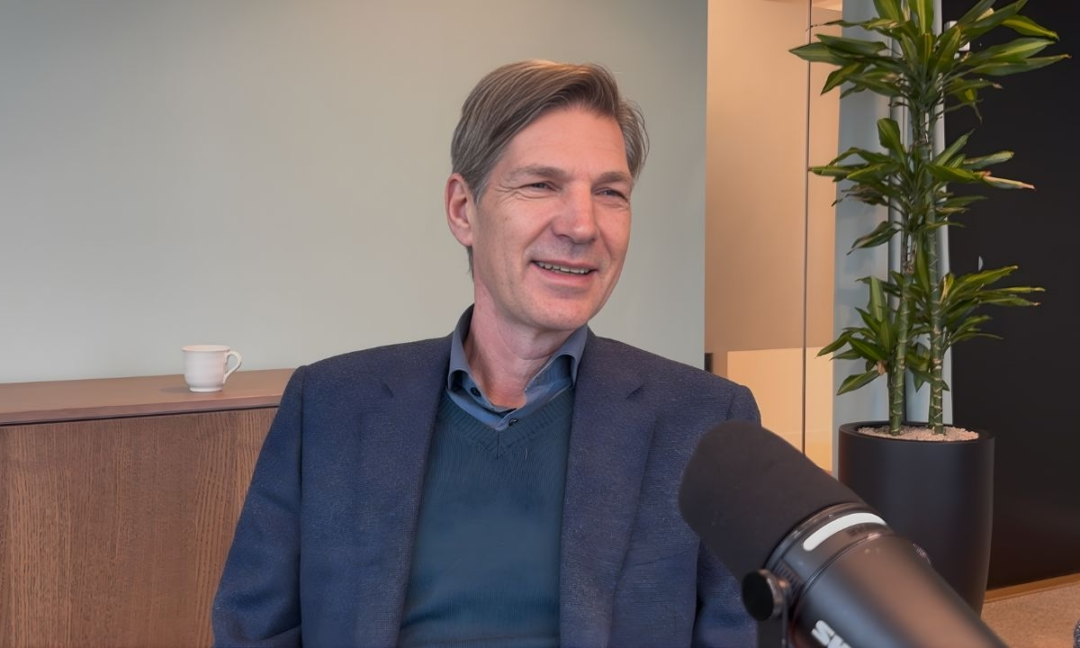
Why have early AI drug-discovery companies often overpromised but underdelivered? Biology is still complex and hard to solve, Werner told Philip in Vienna. We revisit Werner in Vienna after he left Evotec and went on a sabbatical in 2024. We talk about his new missions as FairJourney CEO and founder of WLAN Holdings, and discuss the global CDMO scene and Europe’s competitiveness in biotech. And while it’s still early days, we find that AI will transform the way we work in biopharma going forward, with new generations of companies shaping their business models around it.
⭐️ ABOUT THE SPEAKER
Werner is the new CEO of FairJourney Biologics and invests with his holding. He served as CEO of Evotec from 2009 to 2024, expanding the company’s revenues and workforce. Prior to this, he was the CFO of Intercell in Austria for nine years.
🔗 LINKS MENTIONED
- WLAN Holding’s website – [](https://tiltbio.com/)https://wlanholding.com/
- Werner Lanthaler, Evotec | Leading AI in Biotech | E02 — https://flot.bio/episode/werner-lanthaler-evotec-ai-in-biotech/
- Antoine Papiernik, Sofinnova | Billion Investing with Balance | E01 — https://flot.bio/episode/antoine-papiernik-sofinnova-ebillion-biotech-investing-with-balance/
- Alex Zhavoronkov, Insilico Medicine | AI Drug Development, Longevity | E39 — https://flot.bio/episode/alex-zhavoronkov-insilico-medicine-ai-drug-development-longevity/
Transcript
[00:00:00] Intro
Werner Lanthaler: My key goal in V Holding now is being the best coach possible for the companies where I’m either invested or where I’m on the board. And you can only do this when you take out the strengths, but also the weaknesses of your last 25 years in the industry. Honestly, I didn’t believe it when people told me you will.
In a few months, you will look back and think it was the best thing that ever happened to you to change your career, and now I think it was really the best thing that ever happened to me. What we see a little bit with AI in healthcare that we have over promised in the last five years because we promised that we will be so much faster in the clinic and we will be so much more efficient, and then we fail still in the clinic with AI predicted compounds, which is of course only a function of biology still being complex.
Philip Hemme: I’m your host Philip, and on this show I’m interviewing the best Europeans in biotech to have your Grow. Vena is quite a figure in the European biotech industry, so we caught up while I was in Vienna, which is his home turf, as you like to call it. He was actually on the show as guest number two when I went to Hamburg to record when you were still CEO of eTech, and it’s amazing to have him back.
We talked about his sabbatical and the surprising things. He has learned. We also talked about why AI in Biopharma has overpromised and underdelivered sometimes by quite a lot, and why nutrition could make much more sense than giving billions to Lily and Novo. So here’s my conversation with Vena, and please head the like of a lower button if you’re enjoying it.
So welcome to the show again, Bena.
Werner Lanthaler: Such a pleasure to be here. Such a pleasure to see you.
Philip Hemme: Glad to see. Thank you for the lunch and thank you for the amazing place. It’s
Werner Lanthaler: welcome to Vienna that brings us together because it’s Bio Europe in Vienna. And thank you for coming.
Philip Hemme: Yeah, you’re welcome.
[00:02:09] Werner Lanthaler: from Evotec to new roles
Philip Hemme: Amazing. I wanna start with basically your transition between eTech and now your new role. You can just start, like how was it?
Werner Lanthaler: I have today several roles. That’s the, yeah. First thing to, to reflect on that, building a portfolio after you left. A job, which was the only thing I focused on and concentrated on is one thing that is something that I take with me.
The other thing is I’m so happy and so glad that I was not only serious when I said I take it through break and I take a true sabbatical that I did it. Yeah, because I know many people who say, no, I now take a sabbatical, and then three weeks later they are back in the race. Yeah. So I, I had more than nine months of this completely off, I would say.
Completely off. Wow. Where I tried to not only reflect on the past 20 years of C EShip, but also where I asked myself the question, so what do you really want to do? Yeah. With the next phase of your life and using this off time. To educate yourself to go back to a classroom. To go back. You went to of too many.
Yeah. Yeah. Too many. And to go back to university and simply sit in a lecture of someone else listening to not only biology or quantum theory or ai. AI or, linguistics. Yeah. Or medieval history was just a gift and was just beautiful. And nevertheless, after. I would say six months, you then feel, yeah, this is great, but it starts in your finger tips to get a bit a bit crippling again and then you start to create a company here, and then you start to create a company there and then you.
Fall in love with the technology somewhere else. And that’s now basically what brought me to create VLAN Holding. Which brought, Great
Philip Hemme: name by the way. I love it. Thank you. And, but wifi in German d still say villain and not wifi, but
Werner Lanthaler: of course it’s Lance. Yeah. And that’s why the beauty of it is it’s everywhere.
Yeah. And so I was also happy about this. And then also creating LAN not only as a, company, but also as a mission. To say there are a few very specific rules that I follow that I only engage with people who are entrepreneurial, that are only engage where we really. Care and create a healthier, but also more sustainable environment that I expanded my, focus a bit into this world of sustainability and also into technologies that yeah, make a, better planet ultimately is great.
Great fun, but also great impact. And that’s what I think is now the last 24 months of my life. And honestly, I didn’t believe it when people told me, you will see in a few year. In a few months, you will look back and think it was the best thing that ever happened to you to change your career. And now I think it was really the best thing that ever happened to me.
[00:06:01] WLAN Holding and the benefits of a sabbatical
Philip Hemme: I was, when you talk about the tickling, it still gives me, because I had very I can feel the same sensation when I left lab biotech same, I took, I told I take up to one year off completely and after six months, I remember I was in Melbourne. And I was like, just, I again took, I took out my MacBook and I started working on those, and this was literally six months in one day.
And then I continued, but just, but I heard also the, and the opposite was also true, but for people who want to do sabbatical, maybe it’s not only for biotech, but what I heard, the truth is that I heard many people regretted the main thing they regretted in the sabbatical was not long enough.
It was always like three months and the time it takes to really disconnect. It took me also really three months to like, and feel really okay, now I’m more liberated. Really enjoy the time off. And then yeah, in my case
Werner Lanthaler: I also had to, close out to topics in the past where I said, okay, it doesn’t make sense to, for example.
Deal with open issues that I had in, in, in Nondisclosed directors deals with Germany. You cannot do this when you’re online. So I wanted to really make a clear cut there. Have done it, have solved all of this. And then. You can only think about the future if you have a clear mind. Yeah. So that’s why the recommendation is really, you have to have a clear mind and no shadows in your mind.
Otherwise the ideas will not flow. Your network will not come back, and you will simply not be engaging. You will not be, you will not be present in a discussion. Yeah. And gaining this presence back in a discussion that you feel. That when you say, I engage now in something, that’s what you have to do.
Otherwise it’s, not ready. Your sabbatical. And that’s why, of course, it’s a luxury if you can time it longer. But on the other hand, I would not give it a timeframe. I would just, I would give it an emotion or a feeling or a triggering point. You’re done when you’re done. And this can be in six months.
It can be in three months. Depends. Not everyone. It depends on the situation exactly where you stand. Yeah. Yeah.
Philip Hemme: I like that. But I like the, looking also the sabbatical, not on oh, I take holidays and I travel more on like actual the benefits, especially the business benefits of like clarity or figuring out what’s next and reflecting or learning.
So I think what you said, I think there is a lot of,
Werner Lanthaler: so for example, my, my key goal in V Land holding now is being. The best coach possible for the companies where I’m either invested or where I’m on the board. And you can only do this when you take out the strengths, but also the weaknesses of your last 25 years in the industry and say that’s what you want to coach you teams.
That’s what you want to focus on. That’s what you want to bring, and that’s where you have to. To not only write down where you’re good, you also have to write down where you’re not so good because that’s what people then simply cannot learn from you. And that’s, if that’s a goal going forward.
Then I think I’ve done here a lot of good recipes that I brought together where I hope my teams also enjoy working with me.
Philip Hemme: And how much of of, so it’s your personal family or it’s basically your personal family office basically?
Werner Lanthaler: Yes. Yeah. There are some people who involved, who are involved, but they’re very close to my family.
Okay. And how much do you invest in, in life sciences versus non-life sciences versus split? It’s I think 70 30, split at 70 Life sciences, it’s 70 life science, but if I look into the next 24 months, it could very well be that it’s more going. 50 50 because for example, I’m very excited about topics like CO2 reduction in building materials or in washing powders that are not polluting the sea.
Yeah. So there are topics out there which are technology-wise close. Yeah. To me and that I understand. And where I also get thanks God, deal flow. That is unique. For example, I’m involved in a, data storage company for offline storage on ceramic plates, which is just amazing. Purely because 90% of energy can be saved on data storage.
Yeah. So these are the topics. Having said that, my heart, my passion, my love is still in everything that is biotech and translate. Translation from academic science into companies and into CROs.
[00:10:58] Inside the Evotec departure
Philip Hemme: Yeah. The, you mentioned eTech. I think some people will probably be curious. I’m curious also to hear of like how much you want like what do you want to say?
How, like what, what really happened?
Werner Lanthaler: Like in every career there are ups and downs in the strategic vision of a company. Yeah. And at the end we simply had. Different visions of the company, and then if you have done your job it’s time to go. And, that’s a bit how I look at it today.
And for me, for example, it was always clear you can only create a company build on signs and innovation.
Philip Hemme: Yeah.
Werner Lanthaler: Otherwise, with European price points, you will never compete on a global scale. Yeah. And that’s why this permanent thrive for innovation can never go out of a company.
Philip Hemme: Yeah. And you put a huge focus on.
Growing this.
Werner Lanthaler: Yeah. And that’s what I, will still do because I still fully believe in it. And, of course I’m only a person and I’m only a manager. And of course, you don’t do everything right in your life. But I, on one thing, I am clear that I believe in science and innovation as value drivers, and I believe in co-owned business models as value drivers out of Europe.
And that’s where I wanted to go. And that’s where we’ll go.
Philip Hemme: Yeah.
Werner Lanthaler: Like it.
Philip Hemme: And how much was it the, this whole I heard that there maybe some trading, disclosing
Werner Lanthaler: things. How much was it connected? That, of course was something that was there. I reported it. I had to pay a fine for that. Okay.
But that’s closed off. What was it?
Philip Hemme: The German,
Werner Lanthaler: like the German Baffin basically had to find me for too late reporting certain traits that I did in evil tech stock. That was a mistake. And I declared it, and then you go on with it.
Philip Hemme: Okay. Yeah.
Werner Lanthaler: Yeah. Good.
Philip Hemme: It sounds like you moved on, oh, totally. It’s good.
[00:13:13] Joining FairJourney Biologics
Philip Hemme: Maybe a quick mention on your new role, also in Third Journey. I actually didn’t know it but I saw when you joined. I was a bit surprised also that you joined and you took back a CEO role. But you did. Can you, yeah. Just talk a bit about maybe the company itself and why you decided to join?
Werner Lanthaler: So there are a. Good platforms and there are amazing platforms. Their journey is when it comes to a complete offering for the translation of early target ideas into. Manufacturable Biologics is probably an amazing technology platform that will be globally make a lot of vibes. I was lucky enough to get to know the founder Antonio Barada a long time ago.
Followed the company over more than a decade, and then joined as the chairman of the board about a year ago. So after my sabbatical, and so that’s also where I got to know the company even, better. And now we were in the situation, what’s the best operational leadership situation that we can create?
And Antonio, the former CEO, decided to focus more on innovation and step into the board. And as I felt that I can really contribute when it comes to scaling a COO, I felt let’s do this. And I also felt like I’m the best guy to do this in the room and then you just cannot look out of the window.
But then you just do it and is great fun. Feels. Perfect. And is of course something which I can do in the portfolio of activities that I’m doing right now. That’s your major focus, I guess you were saying. Now it’s my major focus, but I sleep less than I did in the last 24 months because there’s also other things to do.
Having said that, when you’re well and rested, then you can also sleep less for a certain number of years.
Philip Hemme: I like that. I like that. I like them, but that actually Virginia, what’s, what I was quite impressed is like it’s almost a billion dollar valuation already with private equity. Buying in, I think was, what was it?
What I saw was like 900 mil, 900 million, I think a Euro. So
Werner Lanthaler: yeah, a billion dollars I guess. I cannot comment on valuation to the outside, so that’s not possible.
Philip Hemme: At least that’s what I found. Public information, whatever public information is out there, that’s July, 2024, GGHO sold, majority Stake to Partners Group valuing FG Bio at $900 million Euro.
So yeah, almost a billion dollar. USDI don’t know if it’s true, but that this is what I found. But
Werner Lanthaler: it’s an amazing company. Yeah. And it’s amazing shareholders and what I really is private equity backed platform where you have a long view on what you’re gonna do and where you can really think about how to build platforms.
On an efficiency degree that will be globally outstanding and you don’t have to do this on a quarter by quarter basis and report quarter by quarter. What’s your impact on an investment on a quarterly basis? Because the technologies that we are creating, especially when it comes to the use of data in.
Early stage discovery platforms. Yes, there will be quarterly impact, but you cannot measure it in, in, in quarters. So that’s why this takes a, I would say, two to three year view. And then we will have an amazing platform built and, we are starting with an amazing platform. So that’s, where we are going.
Philip Hemme: Yeah. Actually what I source about the platform is that it’s. To my understanding was already one of the like main platform for antibody discovery and, optimization globally. Not just,
Werner Lanthaler: yeah. And I think what I like about this is first I. The world of biologics is just starting. Yeah. Yeah.
Because it’s a modality where you have a higher probability of success, where we still have novel targets and we have many diseases where given cost of goods are coming down, you will be able to make discovery also for. Let’s say smaller size products, which are in the three to 500 million ranges. Yeah.
With new technologies going there on a cost efficient basis on a strategic outsourced co-owned, or not co-owned business model is something where I feel super comfortable that we can build this on top of that. We are present in the us, present in Europe, and with this, combining this access on a scientific stronghold, which is unique.
For example, we have a cryo platform out of the Scripps Institute, which is just amazing. We have technology out of Cambridge for our. Biologics, which is amazing. And we combine this with the founding platform out of portal, which is also really display. Exactly. Yeah. And we have recently also integrated a site out of San Francisco, so I think there is a global.
Starting footprint there, there is a network of ideas. There’s a network of partners and there is something where I think I just wanna invite everyone on the podcast to work with us, if that’s possible.
Philip Hemme: Sounds really good. And it’s, pretty cool that it’s in Port actually, ’cause. It’s a cool city, but there’s not too much biotech in Portugal in general.
So it’s, and it’s still, from my understanding, a lot of employees are still there and it’s running there, which is very cool.
Werner Lanthaler: So one, if you have the opportunity to. Live in a scientifically driven community in Porto that is doing this on a global quality level. You are in a good with, global s with a global salary.
You have a good spot on salary levels. That’s probably. When it comes to mission and what you wanna do, always a different discussion. I really just like the idea of combining best talent at the right places with the right impact for partners and, what people underestimate is the scientific.
Richness of countries like Portugal where there are simply not so many venture backed companies that are competing for talent. Like you would have this in, Boston, you like, you would have it in, in, in Paris right now. So that’s why staying close to home and at the same time working on a global impact driven platform, I think that’s a great combi pack.
And
[00:20:33] The job market in Europe
Philip Hemme: I guess also. Because I know, quite a few Portuguese in biotech, but they’re not working in Portugal, but they’re working in Europe and the us. But I guess if, and the main reason they would love to work in Portugal is just there’s no job at the same level. But I guess if you offer them a job at the civil level.
They would probably
Werner Lanthaler: be interested in
Philip Hemme: taking advice so you can
Werner Lanthaler: bring, yeah, who doesn’t want to go home when it comes to a place of work? And I think we, we also geo geopolitically live in a world where many people who today are in the US think about going back to Europe again. If you have the same.
Global. Yeah. Job opportunity. Yeah. Yeah. And, the salary especially because it’s, yeah. But of course, cost of goods are also different in i’s
Philip Hemme: say not just salary, but the power per quality of life. Quality of, yeah. Like power, like purchase parity or whatever, how you call it. Yeah. Yeah.
Werner Lanthaler: Yeah. But I think quality of life is a good a good KPI for an individual.
And here as we are in Vienna, that’s a high quality of life. I totally would always, no, always in the top five. We are always in the top two. Two, wow. At least for the last five years. I think the other, I think now Zurich has, taken has taken place number one but these rankings are never, are, never exact.
Philip Hemme: It’s a ranking fault. It’s not. That’s good. Actually. It’s makes you think, I was listening to podcasts with a tech founder. Quite four European, and he said something which is fully cool, like the entire world wants to live in Europe. There’s just not enough good jobs.
Werner Lanthaler: Yeah.
Philip Hemme: And I was like, it’s actually, eh.
It’s actually quite true. I know so many Europeans, they go in the US they would love to work in Europe, they prefer to work in Europe. They just not have good business opportunities. And then I know so many Americans who want to come to Europe, just the opportunity is not there. Similar to Asia
Werner Lanthaler: and like America actually, I don’t look at this at this, that way at all.
Okay. Because we live in an industry which is solving global problems. Yeah. And we have to do this in a global mindset, out of a global community. And therefore it doesn’t matter where you are if you are in the mission of solving one of the 4,000 unsolved diseases on this planet. Yeah. And if. If that’s your focus in your life, that you work in the healthcare industry, you can only think about the disease.
The disease is global and that’s why it doesn’t matter where you work on this. And that’s also why you have to go to the best place where people are fighting against that. And of course if you can combine this with a good cd, fine, but otherwise. The beauty of our industry is that you, feel it when you are up to something and you feel it when you are end of things going to your body when you see good data and when you can fight for good data to be progressed faster.
So that’s why I think that’s just there so much bigger value than Do we have good restaurants or not?
[00:23:49] CDMO competition and China
Philip Hemme: Yeah. Would agree, but one thing that. I would not challenge, but a bit. But it’s, there’s still a competition. There’s a global goal, but there’s still a competition. We talked during the, during lunch as well, and I think I saw your main competitor to my understanding is.
I dunno if it’s true whether this, that was my
Werner Lanthaler: understanding. I think there are, ’cause in the whole service industry it would be just not right if there would only be one person offering services. Yeah. And if you look at, for example, the consulting industry, and I used to work in the consulting industry in my life before, it wouldn’t feel good if there would only be one.
B, c, G one, McKinsey, one, Accenture, one, Bain, whatever. And the same is true for the accounting industry and for the Big five or big fours in the auditing industry. So I think that there is global competition. That’s, that will always be the case. Having said that, it comes down to the differentiation and trust that you build with your partners.
And I think and that’s also always how I look at it. If someone is trusting you with your target to be the best partner to progress that target, that’s where it starts. Yeah. Because they put. As a partner IP or the visibility of IP into your hands, and that’s where trust comes in. And that’s where I’m so convinced that building not only the fastest, the highest quality and the most cost effective company.
Yeah. But also the company that is the trusted partner of someone on the other side is key. Because when you are working on. On biologics or on small molecules or on cell therapies, you also have to trust someone who tells you I would not go down that path because that could be a dead end. Yeah, and that’s where I think the service quality of a of a.
Partnering. COO comes in. It’s more than just execution. It’s also, it’s totally more than execution. It’s taking this trust and then guiding each other. Where’s the best spend for money happening here? Yeah. And that’s also how I want to be, and as I said it before to the teams that I work with with the right partner.
In, creating, trust,
Philip Hemme: and how, much is trust also a competitive advantage, especially over Chinese CIOs. I heard from someone across not long ago who told me that. A lot of Sierras in China, a lot of biotechs, they send their projects to China and then they see a copy or like a company doing the same very closely after, which is a big problem.
Werner Lanthaler: Oh I could go on for three hours on this topic because I really think, yeah. That this is one of the big elephants or wide elephants in the rooms of the venture capital firms, but also pharma companies these days where we, have to understand what are we really doing when it comes to competitive world with competitive pipelines and who is financing these competitive pipelines under what trust levels and protection levels.
Yeah. Yeah. And for example, it doesn’t feel right or it can’t feel right if pharma companies have to. Buy back their own targets that they shipped to certain countries before because someone else was working on that ip. Yeah. So I think the anecdotes in the industry are unknown. The consequences of where and how to spend your money, I think have to be much better figured out.
The political guidance in the US is getting very strict. Yeah. And Europe has not fully. Endorsed that, that issue in simply, we cannot be the continent that is financing China. Yeah. With public money.
[00:28:07] Letting European biotech compete globally
Philip Hemme: That, that just feels on the the bigger picture of basically the European Central Bank and the national public banks who put money into the venture fund as limited partner.
This money goes into biotechs. The biotech buy services from China, and then they sell the assets to the us. It’s,
Werner Lanthaler: yeah, so that simply doesn’t feel right for the European and the American taxpayer. And there, I understand that a public debate is happening and the political debate, the
Philip Hemme: goal is to cure the global health.
You shouldn’t care too much. No, I’m teasing you.
Werner Lanthaler: No I’m, honestly I’m not a politician. I don’t wanna be a politician. At the same time, it’s our responsibility to flag these issues because it’s happening in, in, in the daily businesses. That’s one thing. And the other thing is I think when it comes to our missions as companies, we have the right.
To get the best regulatory environments that, that we deserve, because otherwise companies do what they’re supposed to do. They go to the best competitive place where they can go and markets, and that’s what I will always do for my shareholders. If the environment is somewhere else better for my shareholders, then I’ll go to that environment.
Philip Hemme: Yeah. It’s actually what. Yeah. Then a bit thinking also on the competition topic, also a bit from what we discussed for lunch is like, of course the ultimate good, I get it, but me, it’s not even just a politician thing. I, feel like me at a personal level. I want Europe to have a pretty solid biotech industry.
Maybe not number one, but not number. No, whatever and not like declining. Of course at the end you have the ultimate goal, but I want, because like I can work in it at the personal level because it creates wealth. In Europe, if you have wealth, you have amazing cities like Vienna. If you don’t have an industry in Vienna, it’s more complicated.
You see a lot of cities also in Europe where. Or let’s say whatever, some parts of Italy where you have less industry and there’s no more city. I went to, now Naples, there’s just no industry. There’s it’s a very nice city. Everything is super cool. But there’s no jobs, basically no industry.
So it’s, it becomes complicated. And I’m, yeah. Sorry. I’m, and I’m I’m just reflecting it because I, know. My wife is Chinese, so I’m also reflecting on the bit, a bit than Chinese mindset and on the American mindset, American’s clear we want to be number one in the world. We’ll do whatever it takes and that’s it.
We want any ultra competitive and they do it and they do it pretty well. But I like in and what’s, or like what’s in China is crazy is that they suppose the communist and quite socialist and they’re actually quite socialist. They say economies first, like whatever, we do economies first and they want to win.
Like at the crazy level I’ve rarely seen that. And then we are in Europe but we are all friends and, nah, nah and
Werner Lanthaler: like, sometimes also, but I dunno. Yeah, no, there has to be a competitive gene to start with. You have to. To create a culture to win. Yeah. To start with. And culture to win has nothing to do with the us, China, Europe.
That’s a culture to win in the. In the discipline that you’re in. Yeah. We are not in the discipline of geographies. We are in the discipline Yeah. Of solving healthcare problems. Yeah. So staying hungry and staying competitive in that is, that’s the only culture that we have to create. We have the right to get the best regulatory environments for that.
And then I think. We should always focus on our strengths. And in Europe, many countries have done an excellent job in creating a seed environment. Yeah Austria has done a great job in creating a seed environment. The UK has done not such a bad job in creating a seed environment. Denmark.
Denmark, exceptional. Yeah, an exceptional. Sweden. Really good. Yeah. Also Switzerland has done an exceptional drop there. I think it always comes down to a seed environment is not the whole, the seamless process for a product that we need to go to market. Yeah. But there is strengths, there is academic strengths without end in Europe, and then it’s really just this value of this that has been written about and talked about so often that we have to bridge faster and better and be just more.
Open about it and also here aligning the ideas with the right partners and discuss it. You will find solutions if the team is hungry, if the idea is competitive and if it’s really not something a me too, like that we are working on, but something where you say, yeah, here’s someone wants to do something.
And that’s of course. We are staying up at night is important. Yeah, because it’s not solved work. It’s calm as well. It’s not solved in seven hours a day and it’s not solved in only 200 working days a year. It is solved if your teams are hungry. Yeah, and that’s what you wanna feel. You support
Philip Hemme: 9, 9, 6 on.
Excuse me. 9,
Werner Lanthaler: 9, 6. You know that it’s, I support everything where I feel that people are hungry, stay hungry, and wanna be highly competitive and disciplined about that. Because the other thing is when you are in healthcare, it’s a marathon. Yeah. We are not in the industry where one data point creates a successful industry.
We are. When you make a product in a 10 year game you are not in one funding round game. You are in the game of creating three to $900 million before you will ever launch a product to the market. So that’s why the idea of discipline and staying long and staying here. On course for a long time.
If you don’t have this, then you’re not in the right industry. And that’s also, I think, again, where I wanna be the best partner for the people who working with me in just showing them that I’ve seen some of these situations and I’ve seen the bad sides of how people and how teams cannot be successful.
But I’ve also seen and had the privilege to work with many of the successful teams.
Philip Hemme: I like you mindset. It’s good. We need more in Europe. Yeah. Thank you.
[00:34:50] How AI has overpromised in biopharma
Philip Hemme: Maybe switching a bit topic, but it’s also very connected talking about ai. We talk quite a lot in the first episode about AI and actually people loved it.
And when you talk about efficiency, obviously AI is, a, could be a could, I mean is already and could be a major contributor to efficiencies. I am curious on Yeah. How I don’t know if you remember exactly what we discussed three years ago, but if you how do you look back at it? Like back to what we discussed compared to now?
How did you views, did something
Werner Lanthaler: change?
Philip Hemme: Did you
Werner Lanthaler: Yeah, so I just had the privilege of this weekend working on a, presentation that I will have to give in four weeks where I was. For five hours preparing a few slides on how to win the entrepreneurial AI world in healthcare in the future. And I’m more convinced than ever that for example, in diagnostics, in drug discovery, but also in clinical settings, things AI will dominate.
The way we work. Having said that, we have to get out of, over promising and under delivering what companies and data can do. So what we see a little bit with AI in healthcare. Yeah. That we have overpromised in the last five years. We promised that we will be so much faster in the clinic and we will be so much more efficient.
And then we fail still in the clinic with AI predicted compounds, which is of course only a function of biology still being complex and not a hundred percent solvable by ai. So I think also here we have to learn a bit from other industries where AI is truly taking off. Yeah. Because they simply didn’t promise so much.
And now everyone in these social medias is so happy and now everyone in this coding industry is so happy. And now everyone in this entertainment industry is so happy, I don’t know, but is at least they’re not happy, but they feel the impact. What they see is the flow of money. Via AI going into these industries and what in healthcare did not happen just as much as in the others?
Is that via AI In healthcare, the whole venture pool and the whole investment pool should have opened even bigger. Yeah, because we will be. The most data producing industry of all, and therefore we will be the most likely. Social media will still be big, but Sure. But TikTok is no, I understand. But from the meaningful industry we we make lives better and not only more entertained.
So that’s where I think we should have seen a much bigger inflow of money into biotech and into diagnostics and into healthcare. But also here, I think we are on the verge of more people understanding the power of ai. I think we are also in this world of forgiveness of overpromising, the first generation of companies now, the second generation of companies coming with.
Proper databases, proper application of ai, proper curated data. Yeah. And all of a sudden also coming with business models. That makes sense because that was the key question always for me. Okay, I understand what your algorithm is doing, but I don’t understand what you are. There creation and your business model is all about.
Yeah. And I think if we get this closer together and if we openly discuss, so what’s the business model on that? Yeah. Then I think we will go forward and what we already see is that many of the algorithms that have been created in healthcare are free now. Yeah. You can simply fold. You can simply use them.
Yeah. Not commercially
Philip Hemme: but
Werner Lanthaler: sure. But what we see is that, a huge change in our industry has come and the business model behind it Yeah. Is not that you have to pay something, subscribe something, but you can really access this at a very low cost of good level. Yeah. And with this. It comes down to, so where is my entrepreneurial niche?
Where do I create my business via AI into, this world? And again, I’m more optimistic than ever because the application cases for AI in so many of the situations that we will see. Just study in
Philip Hemme: he the potential value creation is in ai. AI plus healthcare is
Werner Lanthaler: just think about all the, you’re not even at the 1%.
It’s think about all the images that we have created. Think about all the, hospice that we will support with ai. Think about the drugs, the diagnostics that we will do. Think about precision medicine, but we have to now. Conceptualize this and create a proper, discrete job out of that or a proper, discrete service out of that.
Yeah, because we invest in it because it feels a bit like a ES of AI right now and structuring this commission to proper businesses. That will be the next phase, and then I think we will see that. True progress will be made also, when it comes to faster, more timely and more precise drugs coming into pipelines or better services provided to patients.
Philip Hemme: There are a lot of things I want to bounce off. In lot of things what you said I, a hundred percent agree with it, and I wanted almost to, ask them, one thing you said is like, there’s not enough investment coming into, let’s say, drug ai, drug development, but at the same time you said they overpromised under delivered.
So the returns were quite negative. When I see like the, so whatever the recursion, the, I don’t even remember the name, even the, big one. The returns don’t look good.
Werner Lanthaler: Yeah. You can go back and now go into every single, not even just the returns, like actual No. You can go back into every single company.
But that’s exactly my point. Yeah. My point is, for example, why don’t we together start at molecular patient databases that are not usable for one, that are usable for multiple people. Yeah. Why don’t we go back and curate data together and make it usable for more people and not one person. So I think,
Philip Hemme: but what’s the business model there?
Should the private company do it? Should the
Werner Lanthaler: you, basically. Find out, let’s take IN eye diseases and you find out molecular patient databases for INI or for oncology. If it’s only one company using a patient database, it’s never a good return. Yeah. But there won’t be any pipeline company that will be able to work on more than a hundred targets at the same time.
Yeah, the productivity of well created databases for multiple companies is absolutely doable. So you create at the beginning Yeah. Databases where you say that’s the business model of one company. Then you partner with multiple companies. Oing with a oing goes into this direction. eTech is going into this direction.
There will be omics going into this direction. Inmate going this direction. So I think also here, flat iron going into this direction, you have many of them. Yeah. So also here, it’s a bit of a gamish of starting points and it only comes down to, okay, why? Do not three or four CEOs sit together and say, how do we now flesh this out and make it a proper business model?
Don’t think they’ve tried. Or they, no, they will have to try even harder because the returns are not good enough so far. Yeah. Yeah. And if you wanna fulfill that mission, your shareholder will come and say, yeah, I get it, what you’re trying to do here. But if I have the choice to invest into the social media thing or into a human patient databases, I probably go for that bet that is out there for social media.
And that’s where. I think this next generation of AI business models that will come and the organization of data that will come here. For example, I’m working closely with a company called UC data in the US on that. That’s just starting. It makes sense and there are, some healthy cells coming together that will just create a better AI world for all of us.
It’s
Philip Hemme: 3 45, 3 46. You wanna continue a bit more? Yeah. Okay, let’s continue. A one thing I wanna say about AI, or actually it’s all, is a bit connected. One thing that I liked actually was with what I liked is Sophie Nova launching their AI bio fund. Art one was episode number one, actually just before you episode two, but he didn’t launch it at, the time, but we talked about it and I like, and I know as a partner, the team they hired and I think they’re really solid.
And it’s the first time I see like a biotech VC kind of understanding what AI actually is beyond Chad d pt. Which is good to see. The second thing that is pretty cool is, and I saw you on the panel with him, Alex? From Insco. He was on the show two episodes three weeks ago. Yeah. Three weeks ago.
Exactly. It’s pretty cool that it’s an area I generated drug, and I think it’s the first one, at least to my knowledge and to his knowledge, which has positive efficacy data, phase two, which I think is cool. Amazing. Amazing. And so it’s good. And the third thing, a bit connected, which I think maybe was last week, flagship, launching a maybe third AI company or flagship, like to overhype some of the things.
But on quite a few things. They’re also quite right and I find it, what’s surprising with them is that usually they launch things a bit early, but then they stopped completely. But now doing it like even three years later, relaunching AI company. Made me think, oh, maybe there’s a bit more, or there’s something that, and connecting these three dots, like actual data, actual value equation, VC funds, going into it.
On top of whatever the alpha falls, what of other things? I was like, okay, maybe you know, the value creation versus overpromising. It’s the curve is catching when you think
Werner Lanthaler: back 20 years or 30 years. When we started to understand the first antibodies or 40 years when we started to understand the first antibodies, yeah, it was like, here is a piece of information, here’s a piece of impression.
Or when we started to first. For the first time to understand T cells. Yeah. Here’s a piece of information, here’s a piece of information. And it takes many approaches to get it right. Yeah. And that’s why I think now in a world where data will make us be faster and better, seeing hundreds of attempts to get it right.
Makes total sense to me. Yeah. But what we have to do, we have to also learn and share the failures of this learning. Yeah. And that’s I think where the second generation of AI companies will get better. Anything from the first as well, because we are learn there’s a cost of failure, but there’s also benefits of failure ’cause we are learning.
Yeah. Yeah. And, that’s why I’m so really. Super excited about, for example, all the. Sequencing data that all of a sudden will be available. All the single cell data. Single cell data that will be available, all the omic collections that we will be able to read out and finding business models.
Yeah, because the technologies are now there. Yeah. Now it comes down to, okay, how do we organize ourselves to make this a properly applied technology in a business model? And that’s why the next three to five years will be very, good for AI driven, data driven biotechs. And there’s almost no way without it.
Yeah. Also to be clear. Yeah. Yeah.
Philip Hemme: Ultimately, yeah.
[00:48:09] Quick-fire questions
Philip Hemme: Lot of things I want to bounce off, but I want to finish on a more quick fire, more I. Quick, quick questions, quick answers. I don’t think we did it in the last episode, but I brought this in I think maybe episode 20 or something. And it’s working and I’m still optimizing the format, but working pretty well.
Okay, good. We talked enough about AI in biotech. I think. Let’s see, we are in Vienna, so about Austrian vertech what’s your favorite Austrian Vertech except Eva
Werner Lanthaler: Xigen in Salt Gate.
Philip Hemme: One sentence on each, what they’re doing.
Werner Lanthaler: Actually, I don’t know them actually. So GATE is a, is novel targets in, a novel target space.
Solid carriers where. It’s basically opening a new space for targets. Yeah. And one of the first companies going into that space and pro oxygen is a an E three Ligase molecular glue. Company where you have protein degradation at its best in the next generation coming. And how
Philip Hemme: advanced are both of them in the clinics?
Werner Lanthaler: Both of them are about to go into the clinic. Okay. Yeah. And both of them have amazing teams and are really, very dear to my heart. Having said that, there’s of course. That, there is for me the same thing because I try to get involved with the companies that I like, but then I have to name many others here as well.
For example, a tension life here in Austria will be the first omic driven readout for hypertension in a diagnostic setting. So it’s just a wonderful space for novel medicine. When will the biotech winter end? Yeah. It’s, I think it’ll be a selective ending. Yeah. The winter doesn’t end for everyone at the same time.
Yeah. That’s the difference to the seasons. It will end for those who understand that with, high competitive ideas, with high competitive teams, and with high competitive aspirations, you will win in a global. Ending of the winter faster and others will die. And that has always been the case and that will always be the case.
Not sure that the winter, will not end for everyone. Do you think self therapy is a winter or just a change? Self therapy is a difficult business model. Yeah. And I’m technology wise, completely convinced that there are applications where you can cure. We sell therapies and then there, there is of course in a world where even cure has a price tag, the question to be asked, what does this mean for business models of these companies?
That still has to be figured out. That still has to come to patient numbers. That makes sense. But I would absolutely see here a second and a third generation of cell therapies and technologies coming.
Philip Hemme: What, do you think about the, I don’t know if you saw the Gilead warning and what’s.
And what was crazy is the warning. It’s still a billion dollar drug, right? Still warning. But the other thing was that basically the wash bispecific is basically doing as well as a CAR T.
Werner Lanthaler: Yeah. Which I think is just telling us that people have. Potentially five modalities available for one disease.
Yeah. And of course, the modality that is the most efficient, the most cost efficient and the most easiest to access should win. Yeah. Yeah. Yeah. And, there was this thing
Philip Hemme: even like whatever, five, seven years ago for all car is the fridge. Okay. Cost of good is high, but we will scale and we’ll go down and 10 years later we’ll be 50 K, not 500 k.
And bispecific. Okay. Antibodies is there. The now is the next thing now. Yeah. It’s crazy. ADCs Bispecific, radiopharmaceuticals. The antibody drug radiopharmaceuticals. The game
Werner Lanthaler: of modalities has just started. Yeah. Yeah. And that’s also why it’s not a head on head race between two small molecules anymore.
It’s in all modalities. Who it is, small molecules who is bringing the best solution for a disease. And if I’m a patient, I don’t care what cures me. Yeah. A sales PA small molecule or a biologic, I take everything.
Philip Hemme: And as a government or a payer, you don’t care to, you care about the value and how much you pay.
Absolutely. Yeah. Is or GLP one becoming the best selling drug ever? A good thing? They just passed K two. Yeah. Yeah. And if you combine obesity and the diabetes, but they, yeah.
Werner Lanthaler: Yeah. They’re, it’s, it shouldn’t sound wrong as an answer for me, it’s more the question, what do we do with the 2 billion people who are still starving on this planet and not what are we doing with the 2 billion people who are obese on this planet?
Yeah. And that really is. It’s for me a more fundamental question that we are sometimes doing things where people are spending money, where at the same time we are not doing things on a planet that is when it comes to distribution of wealth. Yeah. And distribution of impact still. Definitely not the best stage where we could be.
Philip Hemme: And another form distribution. I challenge the vid for Novo on this like great sales of GP one is great. Wouldn’t be more cost efficient to just cut fast food and a lot of things, it’s like the health insurance thing where like offering a gym to everyone is basically much cheaper than any diabetic drug and whatever.
And I feel like we are just. Do don’t you feel like we are creating a problem and then we are putting money to fixing the problem versus
Werner Lanthaler: so food sovereignty is a big topic and when you think about that, the average education of people for nutrition Yeah. Yeah. Is less than 10 hours.
And if the required in the US if the required education on nutrition for medical doctors. Yeah. Is less than 15 hours. Yeah. Knowing lifetime or on what? On, in, in a curriculum of a curriculum, medical doctor’s, education. And if you, now think about the cause of diseases and the Yeah. Consequences of nutrition, then we say.
Here we maybe are really starting at the wrong end of the problem, that we are curing a symptom or that we are working on a symptom, but we really have to go down to the problem. And that’s why, sorry for not answering the question. I’m happy for everyone who is getting that drug, but that’s not how we should think about drugs.
Yeah. We have to go to the. Cure and to the problem, and not just to the, to treatment of the symptoms, but espec especially,
Philip Hemme: I think there are a lot of evidence that you could fix the problem early on in terms of nutrition, education activity. And we had as a, lot of society for a lot of reasons are literally not doing it.
Which, yeah, let’s see how it evolves, but yeah. Good. You agree? Actually, what’s pretty cool about Navid and Novo, which actually I was actually very surprised I about this 1% of course. Which I found. Yeah, Super. It’s pretty cool. For the audience, they give 1% of their revenues, I think, back to prevention, which I’m not sure it does it.
I don’t know, but at least Novo does it and it’s pretty cool. Yeah. Yeah. It was good to see. The last one was about maybe let’s finish on this one. Just if you have one advice for, let’s say 30-year-old
Werner Lanthaler: veer. The 30-year-old Vanna should care more about nutrition. And healthy diet.
For sure the 30-year-old Vana should be just as lucky as he was in creating a network of friends, partners, industry business partners who allowed him to. To be impactful in, creating companies. And the 30 30-year-old winner should absolutely focus on an industry where inequality is still probably the biggest topic that we all have to solve because when we think about the next 50 years, despite the fact that I’m.
Very engaged in longevity and aging population and all of this. It doesn’t feel right. Yeah, that, with certain conditions, we have the right or we can buy the right yeah, to live 25 years longer than other, people cannot. So taking one of these topics and trying to make a little mark on that one, that would be a great goal for the 30 year olda.
Having said that, the 57 year VEA takes the same goal because there’s no reason not to start the same topic at any moment in time.
Philip Hemme: Amazing. And we are. 4 0 1. Thank you so much. Thanks, vi. Amazing.
I’m impressed by Vienna’s sharpness and openness while being just so chilled and friend European biotech is lucky to have him. Vera, this episode, please hit the follow or review button. Any of these actions would help a lot more people discover the podcast. If you wanna support us even further, you can make a donation by clicking on the link in the description below.
If you wanna see similar videos, please feel free to check out our channel where we have many more. I would also be curious to hear what you think. So if you could drop a comment wherever you are, or shoot me an email@philipatflo.bio. That’s P-H-I-L-I-P at ft dot. Alright. Thanks for staying to the end and see you in the next episode.
![Sten R. Sörensen, Cereno Scientific 🇸🇪 | Drug Repurposing, Retail Investors | E52 [Sponsored]](https://flot.bio/wp-content/uploads/2026/02/Website-Thumbnail-Sten-Sorensen-1080x648.avif)