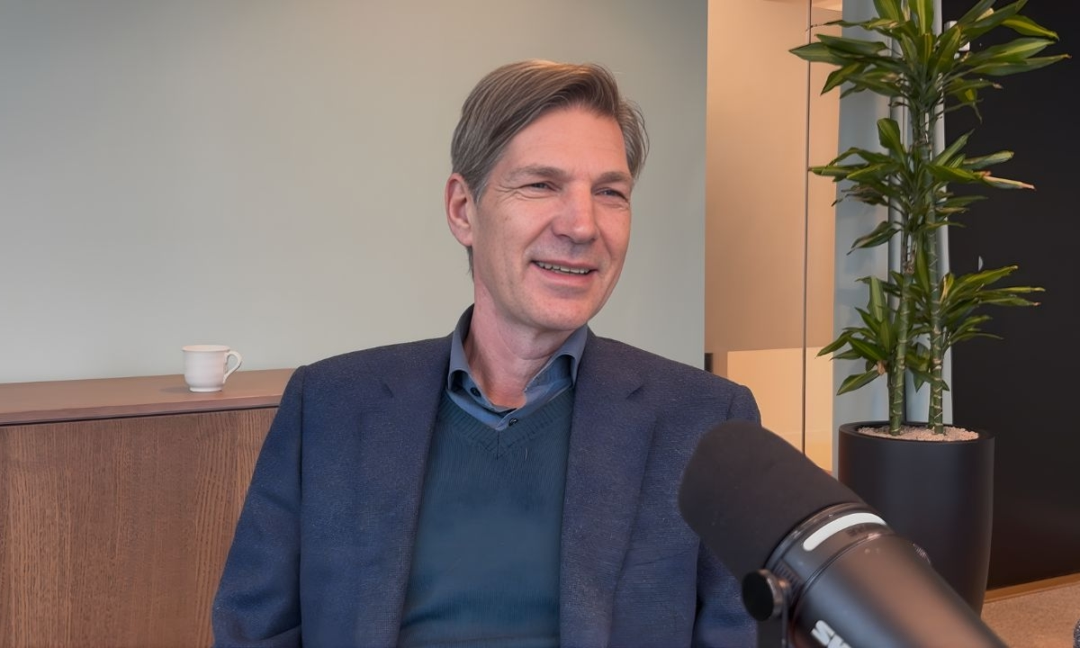
Pascal Touchon unpacks why the next CAR-T innovations, including allogeneic and in vivo therapies, are going to be so exciting. The cell therapy master outlines his central role in bringing two first‑in‑class cell therapies to patients: Kymriah, the first approved CAR‑T, and Ebvallo, the first approved allogeneic T‑cell therapy. We also explore his new position as an operating partner at Jeito and how we need to work harder to find Europe’s hidden biotech gems.
⭐️ ABOUT THE SPEAKER
With many years of experience in big pharma, Pascal had top-level positions at Novartis Oncology. He later served as CEO, and most recently Chairman, of Atara Biotherapeutics. Alongside his Jeito role, he sits on the boards of companies including Ipsen, Medincell, Catalym, Xylocor and CDR-Life.
——————-
Get expert legal advisory support for growing your biotech from Osborne Clarke at https://bit.ly/oc-flotbio
——————-
🔗 LINKS MENTIONED
- Jeito’s website – https://www.jeito.life/en/home/
- Stefano Portolano, Azafaros | Rare Diseases, Small Molecules Revival | E40 – https://www.youtube.com/watch?v=gdaPW7xg_qk
- Otello Stampacchia, Omega Funds 🇮🇹 | Competition, Boston & Pasta | E18 – https://flot.bio/episode/otello-stampacchia-omega-funds/
- Fabrice Chouraqui, Pharming 🇳🇱 | Transgenic Rabbits, Rare Diseases | E43 – https://flot.bio/episode/fabrice-chouraqui-pharming-transgenic-rabbit/
- Laurent Levy, Nanobiotix 🇫🇷 | Nanoparticles, Radiotherapy | E45 – https://flot.bio/episode/laurent-levy-nanobiotix-nanoparticles-radiotherapy/
- Marc de Garidel, Abivax | How to make two Billion-dollar exits (“smoothly”) | E09 – https://flot.bio/episode/marc-de-garidel-abivax-exit/
Transcript
[00:00:00] Intro
Pascal Touchon: It still very exciting today. It has taken some time to get to launches of product and blockbuster status of product, but now Yescarta and Kati have reached that stage. So I think this field has matured. I’ve known Rafael, the founder of Jto for a number of years, and I admire what she’s been able to create and do.
I had, for personal reason to move back to Europe, the FL say, oh, you should work more with us, because I was already an advisor of Jto and I, love the team. I jump and say yes. Probably the most frustrating case for European investors or Europe companies is a case of Met. Met was a company funded by Arch Venture and another fund from the US in 2022, sold in 2025, three years later for 10 billion Pfizer.
The real asset that created value came from London. There is a lot of gems in Europe. We have to go out and find them.
Philip Hemme: Yeah. New to a new episode. I’m your host Philip, and on the Flood Bio show, I’m talking to the best Europeans in biotech to help you grow. Cell therapy has changed many diseases, especially some cancers, but it came with a lot of challenges. Pascal is a veteran in the space. He has brought the first CAR T and also the first allogeneic cell therapy to the market, so I went to Paris to catch up with him while he was there.
I didn’t know him personally, but we have been introduced by a mutual contact from San Francisco. We talked about the beauty of cell therapy. We also talked about his transition to operating partner at major biotech investor Jato six months ago, and why global experience in biotech is so important. So here’s my conversation with Pascal, and please hit the or follow button if you’re enjoying it.
Today’s episode is supported by Osborne Clark, a legal provider of legal services to biotech and pharma companies. From r and d to commercialization, they help teams navigate regulation, IP licensing, and even high value transactions. If you are building a therapeutics company and need legal expertise that understands the industry inside out, feel free to check out the link, the description below to learn more about Osborne Clark.
Alright, welcome to show Baska. Thank you, Philip. Great pleasure to be here today. Yeah, it’s cool. And we have the Sun of Paris. Sunny Paris. Sunny Paris. It’s like June in December.
[00:02:40] The rise of Kymriah and Ebvallo
Philip Hemme: So yeah I want, to start with, cell therapy a bit at large. You’ve basically launched. Basically the first T approved in us, ware was Novartis, and then basically the first approved allogenic cell therapy with Atara.
So I’m just wondering, maybe starting with a bit large question, but how do you look at theft cell therapy? The field as of today?
Pascal Touchon: I think the field is still very exciting today. It has taken some time to get to launches of product and blockbuster status of product, but now Yescarta and Carti have reached that stage and there are some orders behind.
So I think this field has matured, but it’s still there as a huge promise for patient. The reason I jump into cell therapy many years ago now was for personal reason.
I
had a friend who had a daughter with leukemia and she was resistant to chemo initially and ultimately. She had no choice, so we were trying to find a solution.
That was 2012. Okay. It was just the beginning with, you may remember Ed Whitehead, the first young kid treated at Upen by Jun and his team that was saved by. First Kymriah, the starting point of Kymriah. And when I learned that I was trying to get that treatment for my friend’s daughter, fortunately enough for her, she fin ultimately responded to chemo who got into cr.
She had a donor, a brother, and she was saved by a transplant. That’s how I got interested in cell therapy because it was truly transformational and able to do something for patient and nothing else was able to do.
Philip Hemme: Yeah.
Pascal Touchon: And this is still the case today.
Philip Hemme: Yeah.
Pascal Touchon: This is still the case today. Now, the path to having many product develop, approved, registered and become really important revenue generator for companies has been much longer than expected.
And at the same time, there have been new technologies from Bispecifics to now in Vivo CAR T Yeah. That have challenged a little bit. The initial data and situation of this drug, the first CAR T being really transformative and bringing huge potential benefit for patients. Yeah. At the same time, there have been this amazing story about autoimmune disease and that’s something sometime when you look at something in science, think, oh, that’s obvious, but nobody thought about that before.
Dr. She and a few investigators in Germany had this idea, and there were a few in Asia as well, had this idea to. Test CD 19, CAR T in autoimmune patient to see whether B-cell depletion could impact on the disease development and chronicity. And that’s what it did. And ultimately, these treatment have shown that you can completely deplete the B-cell for a few months that allows to deplete the clonal cells that are responsible for two antibodies, which then do not go again.
So you have this amazing situation of drug-free, symptom free period for a couple of years, at least in many patients. Yeah. So the field is still extremely exciting for me and is moving forward.
[00:05:40] CAR-T: crazy innovations and valuations
Philip Hemme: Yeah. You’re touching a lot short of topics I wanted to jump on as well. Maybe, and one of the, you mentioned the conversation, which was tricky as than expected.
Can you, go, a bit more in details there. And, also I’m curious because Kim, we you, are basically first but the end, now you have, I think it generating, I mean you, it generating less revenues than Yescarta and, Kati. So I’m curious also of like. How yeah, how do you look at this one?
Pascal Touchon: I think at the end of the day it’s about data and clinical data that what makes a difference. These treatment were truly revolutionary in the sense that they were making huge progress for patient. They were curing leukemia in kids. They were having significant level of cr and prolonged CR in lymphoma.
In multiple myeloma. Multiple myeloma is now chronic disease by many aspects thanks to the CAR T that have been developed there. Now, commercialization was very challenging at the beginning indeed, because it was a very complex logistic supply and pricing reimbursement, and we were just to access, patient was complex.
I remember when we launched Kymriah, we had to certify the centers. Can you imagine, especially in the US when you have these big centers like Dana-Farber, like even New Penn was the origin of it. We had ourself at Novartis to certify the site so we could use Kymriah in a commercial setting. So that was very unique when you have a pharma company having to come with a team of people to a hospital in the us, very well known, very famous type of tertiary hospital to tell them, okay, we are here to certify you to confirm that you are able to use a product.
That was quite something I can tell you, but ultimately it was accepted. It went. Developed this number of certified centers, but I, you can imagine at the beginning there were just a few certified, so you could only treat patient in these certified centers across part of the approval we got from DFD. And it was the same for Yescarta.
So that was the beginning. That one example of the challenges you had to be able to circum convene at the beginning to be able to go into treating more patient, getting more patient access. Another aspect was that for many of these patient leukemia and lymphoma, they had to stay for several weeks, very close to the side of their treatment, to be able to be monitored for potential side effect or safety challenges there.
And that was challenging for the patients because some of these patients had to travel hundreds of miles to go to that particular site and then had to stay there for several weeks. So we had to find solution both ourself but also other companies. Kite and others. Yeah. To find solution for patient to all allow for better patient access.
Philip Hemme: Yeah. Yeah. That’s, and yeah. And on the technology side, you also mentioned like autologous versus the other ones, and now in vivo. Think it’s, quite an interesting evolution and I, started looking at CAR T like 2014, quite like in detail when I’m starting the my first, company.
And I remember it was over excitement, what autologous because the results were amazing. And then there was all even more excitement or as much excitement for autogenic because Okay, it was like the next generation and could come pretty quickly, but it took way long as expected. Still in oncology, it’s still quite far away from having allogeneic on the market, at least I think so.
And now there’s a huge excitement for InVivo CAR TI think just this year I looked up at some deals. It’s crazy. I think at least I wrote four, four years that are. 300 plus million in cash, some in the billion dollars from all the big players. So how, do you look at this from a technology point of view?
Pascal Touchon: I think hyper and excitement is certainly coming from the data and what. These data could mean for patients. And when coming back to the origin when Carl June and at UPEN, Michelle Sadler at M-S-K-C-C were really starting the first patient being treated and so on, the result they got were a little bit changing.
At the beginning. There were some safety aspect. You had to handle CRS and they have to learn how to handle CRS and so on. But progressively the data were so convincing, so exciting that this created a lot of excitement, not only from patients, from physicians, but also from the industry at large, biotech and pharma.
And that led to this first wave of biotech being created or being acquired, whether it’s Juno or Kite. Then you add allogeneic and allogeneic created a similar type of wave at the beginning of excitement. It took more longer than expected to be able to bring this to the market. We can come back to that in a minute.
And now it’s about in vivo cart and all this technology makes sense. All these technology are great technologies, all these technologies could make a big difference. Now it is about execution and the ability to transform a few patients, like what we have right now, invigo CAR T into a true development, a regulatory supported type of development that will lead to approval and launch.
So that’s still a long way, but I think, I’m personally very excited to see all of this development. And by the way, it’s not a situation where this development, the new development would just make obsolete everything before. This is additional type of opportunities for patient and also for business creation and value creation.
But still, you have to develop product by product, indication by indication, center by center. That’s going to take time.
Philip Hemme: Yeah. Now, and one thing I’m. But also it quite surprised me. And, you, can you talk even more in details? Obviously the data was surprising, but what was quite surprising is on the first that Novartis went very early and themself, it was Cal June versus the typical let’s wait, let’s do bio let’s, biotechs do that, the adrenal and kite, and then we acquire them later once they have really good data. Like, where I, I’m curious of like, the. Like how, like how come, but and why, did it work so well?
Pascal Touchon: Yeah. I think it, it’s interesting situation. It’s not often the case. Yeah. That it start in parallel in biotech and in pharma especially in a very new technology very, new technology. And I, we really have to pay tribute to a few people. Like David Epstein was at the time the head of pharma and was really the one that helped the creation of Novartis oncology.
And when he saw the data when they were first into, in fact, the New York Times article, if you believe it, in May, 2012, just a few weeks after M Emily Whitehead was saved by the first CAR T being used, CD 19, CAR T in a kid leukemia, and was able to really be completely cured. And now she’s been, that was.
13 years ago now she’s 13 years free of cancer. So that type of amazing data on one patient only created that interest. So that was the idea immediately to license that in within Novartis. But it was a challenging situation to bring such very unique technology coming from academia. And academia is amazing in terms of creating new ideas, new innovation, new technologies.
But by definition, they don’t have a process of manufacturing a process allotment that can make a product till the end line of approval and then commercialization. So there was huge work done by Novartis at the time, internally and different approach to the way to handle that. Initially it was more license in and try to develop.
Then there was a creation of a unit cell gene therapy unit within a big pharma within Novartis. And then that was dismantled. That’s where I came in myself. Took over all the activities across the different functions and enabling us to bring Aya to his first approval at the end of August, 2017.
And then the second one in 2018 in informal. Now in parallel, you had this biotech type of model with Kite, and that works very well as well to develop product till at least the pivotal studies. And they were acquired at the time, in Facebook it was 10 plus
Philip Hemme: billion acquisitions, not
Pascal Touchon: yeah.
One was 12 for 12 billion for ki 9 billion for genome, which I remember
Philip Hemme: was like excessive amounts at that time. At the time, yeah. Even in the biotech space. But then, yeah. But as you said, I think especially Gilead now, it’s in the billion dollar plus revenues, blockbuster status, probably they did.
Okay, return on the acquisition. Probably yeah, I would not
Pascal Touchon: comment on what’s the not investment there. But I think the, other interesting, in the early days of CAR T, the only in other interesting story is Carti, because that was. To my knowledge, the first global product originated from China that is now becoming a blockbuster because Kati started in China, the legend one or legend one.
Yes. Legend was a Chinese company, and I remember very well in June, 2017 at ASCO, where a Chinese doctor from Chen presented the first data on a bit more than 10 patients, 12 patients, I think with Carti. He had this spectacular a hundred percent response rate. And of course, nobody believed in that. How could you have a hundred percent response rate?
And it was a very challenging presentation for this particular physician because he had challenge to answer some of the questions there. But that was starting something, and I remember very well that I was there and immediately I jumped to a plane to go to China and meet with the people there that I met at the end of June.
Ultimately, j and j got the product. But that was very exciting time. And from the beginning there was of course a lot of skepticism about the type of data, the type of product, why does it have this type of efficacy and how come it could have that good safety and so on. It took a lot of guts and also a lot of time looking at the data in details for companies to license that, what JJ did, and develop that fully and kudos to them because what is happening now is a product that is going to be at least a 5 billion product, if not more.
Is having a huge impact on patients and that’s starting in China.
Philip Hemme: That’s great. Yeah. I think we’ll, come back to China. We’ll come back to China. The one thing I’m curious also on the allogenic ’cause I mean you bought basically the first allogenic drug at least was approved in, Europe. Not in the US From my understanding.
Still some delay in the us
Pascal Touchon: some delay on CMC. We’ll come back to that on the changes of making these drugs that occurs in patient post-transplant, when there is reactivation of the EBV infection that we all have, that is then created a proliferation of B cells infected by extended by virus.
Philip Hemme: Okay. Okay.
Okay. Okay. And, so what, was the, main challenge. To overcome and why, did it work at ATAR versus all allogenic? That seemed to work way less.
Pascal Touchon: Yeah. Again it works because of the data and clinical data because it really saves life. It’s a product that can get about half of the patient responding and once the patient are responding, they will have an overall survival at two years that is over 85%.
Whereas if you have that type of disease and you don’t respond first line treatment, which is rituximab, then we’ll have an overall survival in the median OS that is only a few weeks to a few months. So that’s a huge impact on patient. That’s first thing always the case, that the first and most important example of success is to be based on great clinical data That shows a huge impact in patients.
Philip Hemme: What, led to this great data, Eric?
Pascal Touchon: I think it was, again, an academic start at M-S-K-C-C with Dr. Riley. Starting that in patients starting to find a way to treat this patient that were kids in particular, that unfortunately were dying after having had a transplant from the EBV positive lymphoma that they had, that was extremely aggressive, and he was trying to find solution to that.
He developed the, precursor of a value today, the name of the product in Europe, it’s not yet approved in the us And Atara took that as a license from M-S-K-C-C and develop it as an industrial product from a manufacturing point of view. And that was a challenge, like it was with Autologous CAR T, but here the different type of regulatory authorities, whether it’s the FDA or DMA, had a very unique way to look at this type of product because these were, and this is still the first allogeneic TSET therapy ever approved.
Philip Hemme: Yeah.
Pascal Touchon: So it’s always new. For the regulators, and they need to find a way to create a kind of guidance that allows them to look at some aspect like CMC and quality in a way that is adapted to this new technology and not to what they were doing before.
Philip Hemme: Okay.
Pascal Touchon: But the CMC
Philip Hemme: should be a, I don’t know if it should be easier, but then.
At least that was the promise of the allogenic, that it’s a bit easier, a bit more standardized.
Pascal Touchon: It’s easier standardized. But the big difference with autologous that one batch can treat hundreds thousand, 10 of thousand of patients. Yeah. Okay. And therefore, you want to have the type of robustness in the process as well as the specification that ensure that every batch.
He’s going to behave in the same way in patients. Okay. Whereas in autologous is one batch, one patient. So in fact you have a particular risk around the quality, of course, of what is being manufactured. That’s just for one particular patient, another cell from that patient that are given back to him.
Whereas here, you take cells from Alfred donors or in some other technology from ipsc, and you transform that into a product that is given to many, patients. Okay. So the level of scrutiny is different, which is good thing. Yeah. At the same time there are some type of regulatory authorities that have a way to look at the.
Clinical data to justify the specifications, all that are a bit more rigid in sometimes to look at what is the level of variability that is acceptable for that type of leg. And cell therapy is always more variable than a small molecule, of course. Or even biologic. Yeah. In a cell you have 42 million proteins.
Yeah. That’s means that you have a lot of variability and you are trying to address that variability, especially when you are making these from healthy donors where you have also donor variability for the process that allows to have enough clarity and enough control of the specifications.
So they are within a range of different element, whether it’s on potency, on quality, on reproducibility, that allows you to have a product that could be commercialized. And we achieved that at with a value.
Philip Hemme: Yeah. Yeah. That’s, yeah, at the end it’s it’s, one of the promise and the benefit that you can scale the production and lower the cost of, good.
[00:20:35] Solid tumor challenges
Philip Hemme: But it’s also a, challenge. Yeah. Yeah. Yeah, talking about one, one thing also on, you haven’t mentioned it too much on solid tumor, but I think that was one thing where there’s quite high expectation as well, and I think where the reality and the data didn’t show or didn’t follow we had actually adapt adapt immune on the show before.
It’s went down quite a lot. And actually just after they got the first, I think it was basically approved for the first, I think they called it engineered cell therapy for solid tumors, at least in the us. It’s a niche tumor niche tumor, but they get the first approval, but then the cells didn’t, follow.
How do you look at, solid tumors? Like
Pascal Touchon: I think it’s still a lot of potential for cell therapy in solid tumor. You should not forget that. Solid tumors in general is a very challenging type of disease to address. And if you look across modalities, the number of success are relatively limited in solid tumors.
From, you have targeted therapies, you have ADCs, you have bispecific, you have radio ligan therapies, you have cell the, but if you look for all each of these modality, you cannot say that one particular modality has been able. Completely change the treatment of solid tumors. Now within cell therapy, one of the particular challenge is how to make sure that the cells you are making, be it allogeneic or autologous, are able to traffic to the tumor site to penetrate into the tumors, to expand into the tumors, to be able to target and destroy the tumor cells.
Then you have to also address the tumor heterogeneity because a CAR T or this type of cell therapy or even the TCRT will address one particular target. So you will have to ensure the t heterogeneity of the tumors is not going to be a, particular hurdle to the efficacy there. And then you have all these immunosuppressive environment of the tumor that is extremely, Powerful and impactful that is going to do anything to stop the activity of that particular T-cell that you’ve modified. So you think about all of these barriers, all of these issues and challenges to circumin is really something quite amazing to see. Some of the data, and we see some data now on some of the CAR T and the other aspect is the possibility to combine treatment and thinking about immunosuppressive environment.
If you could combine or sequence treatment in a way where you are going to diminish the ability for the tumor to defend itself against this CAR T that you’re bringing to the tumors, then you could have better efficacy. So that’s how it has been working for the last few years. A lot of changes, but we start to see some data Now.
What’s some of the, that are showing a difference?
[00:23:18] Cell therapy manufacturing and in vivo CAR-T
Philip Hemme: What’s some of the data or breakthrough that maybe one or two that you seen in the last 12 months that. That really I impressing, I
Pascal Touchon: think I’ve seen some GPC three CAR T data in hepatocellular carcinoma that looks really interesting. We saw also GD two in glioblastoma.
So there is really some interesting data now. Now this has to be confirmed in pivotal or phase two, three type of studies, which are under play right now. And hopefully they will give the type of data that we, will expect coming from cell therapy and in particular in, this solid tumor.
Philip Hemme: And will in vivo CAR T also enable more
Pascal Touchon: towards solid tumor or.
At this stage, most of the program that are getting some support excitement deals as you mentioned, are more addressing either the lymphoma or multiple myeloma leukemia space or the liquid tumors or the autoimmune disease where it’s relatively straightforward goal, which is you have to deplete the B cells.
Philip Hemme: Okay.
Pascal Touchon: Yeah. And very few targets that allow us to do that. And there is a kind of use of different targets, but the goal is the same deplete B cells and it’s easier to deplete B cells because they are in a periphery or in the nodes. And provided you have the right type of penetration in the lymph node and some tissues, you can really deplete that getting into the tumor in a solid tumor that has been there for some time where you have a lot of fibrosis and other aspect in immunosuppressive environment that are against the penetration of the T cells is a different challenge.
Whether it’s in vivo or by the way, it doesn’t change fundamentally, whether it’s in vivo, orgo, or allogeneic. You’ve gotta make ate the tumors. It can expand and persist long enough to be able to act accordingly.
Philip Hemme: Yeah. Okay. And, just curious on the in view I saw from afar I saw the companies like Zo Biotech and I think Gilead right?
Interest I’m reading the capstan from AbbVie and Orbital from BMS. I’m just curious on the on exactly what are the changing. I guess the CMC is much it’s easier in a way, or the manufacturing will be easier.
Pascal Touchon: Manufacturer is a gene therapy. The in vivo gap is a gene therapy that is targeting the, T cells and modify the T cells.
But you don’t need to extract. You don’t need to extract. So simpler as less costly, simpler. Now they, a lot of questions about the quality. The gene therapy, so the quality of what you make the safety and also the dose and how that dose is going to be clarified and defined and optimized in patients because you are relying upon the immune system of the patient to be able to make these modified T cells.
I think there will be some interesting new questions to ask, but I’m confident that ultimately there should be something out of this. But it’s going to take some time to refine the dose, the type of and especially depending on the patient because you rely again, on the immune system. And this patient have different type of immune system in the sense that they have been, many of them treated for many years with chemo and other treatment that have an impact on the immune system.
So how that is going to allow for particular dose to create a particular number of in vivo CAR T that will act accordingly. That’s still a question mark, but that seems to be moving at pace. And the first few patients that are there were some data present. Ash, it looks very excited. But it’s still in very early phase one.
Very, early phase one. Yeah.
Philip Hemme: Yeah. Okay. So we still take whatever, at least five years and ization something like this
Pascal Touchon: And, interestingly you have of course many biotech in China and elsewhere developing this in vivo CAR T, different type of technologies, but the goal is the same. And then you have either pharma companies that are already in autologous or even in allogeneic, like of course Gilead or AstraZeneca, and also new farmers like AbbVie that were not there, decided to jump ahead and try to see whether that could be the next big thing in terms of new modality for cancer.
So the racism, we’ll see who is winning at the end, and I hope the patient will be winning. Yeah.
Philip Hemme: Yeah.
Pascal Touchon: This type of new technologies is always interesting because it goes in waves. I was very lucky to be involved in the move of Novartis into radio therapy a number of years ago where was leading the team acquiring aaa, and then moving into the underside acquisition that created luta and proto, so real treatment of neuroendocrine tremors and now prostate cancer with radigan therapies.
And what was amazing that back then in the 2017, 18 time, we were the only one moving into that space, and that created the success of this product. The ability to deliver, again, complex product in terms of manufacturing, supply and delivery. But if you master that, you can treat a lot of patient. And the impact on patient is very significant following that first attempt to.
Really creates product that now are achieving a blockbuster status. So many companies went there, so many biotech were created. So it takes time, but once the technology has been proven by someone to be robust enough and impactful enough, robust enough on manufacturing and supply, impactful enough on patients, then there will be a wave of many other companies developing that.
Philip Hemme: Yeah, it’s good. We’ll talk about I think connected to that into with Jada as well of, how you bring all the whole expertise of what we discussed and also how you look at different modalities. But one last question on this, more on the modality because at the end of the day cell therapy has a lot of promises, but at the end of the day, you care about the data and how you reach the data.
Like I, not that you don’t care, but the data is what matters, whatever the modality. And I’m, thinking about one thing that I, saw recently, which what I think was. Was a bispecific, I think was from Rush. I’m not sure. Nothing think was the data from ASCO or ESMO where they with the best had basically the same result as I think I think with escar are very similar results and have complete response rate.
Yeah. But obviously the cost of goods is just like very different. Mean
Pascal Touchon: very specific are very back and very important. And they have made huge progress. It was many years ago I was trying to license when I was at SE Biab for Micro Met and intimately Amgen acquired Microbiome The Bite and and that was the first of its kind it was before CAR T at the time.
And the results were spectacular. But the complexity of manufacturing and delivery was very significant because you had this permanent infusion and you had to have a pump and so on. But now the bispecific and made huge prog progress. And I’m on the board of one of the jto company called CDL Life, which is developing bispecific and event three specific, the variety of T-cell engages.
And that’s a great way also to create that immune reaction is with T-cell engages, they’re challenging product to develop because of the, way to reach the right dose. And again, it’s very much dependent on how the immune system will react to that and how it’s going to allow the engagement of these T cells to be able to do whatever kidding they needs to do.
But that’s extremely effective and there have been amazing data now from different type of bispecific. Into the the lymphoma and leukemia space, and now we see TriSpecific as well. And for example, CDR life licensed to bo TriSpecific addressing autoimmune disease because here again, you can deplete B cells with an autologous car T you can deplete B cells with an allogeneic car T You could also try to deplete B cells with a bispecific, or in the case of CDR life, a TriSpecific that will allow to have a complete depletion in a tissue in a periphery, then allowing, hopefully the reset of the immune system that will allow the possibility to treat autoimmune patients with B-cell disease like lupus in particular and others like NNA gravis, and to allow these drug free, symptom free period for a certain period of time.
Philip Hemme: Yeah. Yeah, I like that.
[00:31:38] Catching the innovation wave at Jeito Capital
Philip Hemme: So I guess as now coming through to J two at the end of the day, especially as jta, you don’t want to be you want to be a bit quite agnostic on the modality. That’s right. But at the same time, if a modality has a lot of potential and there’s a big wave, you also want to be.
Early in the wave, hopefully, and then ca like catching the wave.
Pascal Touchon: I think one of the unique aspect of Jato is that we are very focused on early clinical stage. Yeah. And sometime late preclinical, but with a good possibility to have element of transoral aspect that allows you to have a good idea of what could happen in a clinic there.
So we really focus on that stage. So very often we take decision based on early clinical data. So whatever the modality, we are completely agnostic to the modality. We can see what type of data, this type of modality or this type of target is enable the product, the assets to achieve. And then based on that, we can take the decision to invest, to be able to support the early to late clinical development and phase one, phase two, sometime to phase three to be able to create more value for the patients and for the shareholders.
Philip Hemme: But you didn’t invest JTO didn’t invest too much in cell therapy. If, I, there
Pascal Touchon: were initially a couple of investment in cell therapy. Yeah. There was a company called Neogen that was acquired then by AstraZeneca. And there is still a company called Quell that is having very different approach Yeah.
On TX this time. So to address a different type of autoimmune disease from a modulation of TX for having modified TX and car TX basically, that will allow to have a different type of way to modulate an autoimmune disease. And that’s very exciting. They have a partnership with VA Seneca.
Philip Hemme: Yeah,
I’m actually talking to, the team and, to get the end on the Oh, yeah.
Pascal Touchon: That that’s, a very exciting program they’re doing there. Yeah.
Philip Hemme: That’s cool. And I actually I talked to Stefano from Uhhuh in, Basel, and that’s a small molecule. But it. The data seems very promising as well,
Pascal Touchon: that are exciting. And this is the type of investment we are doing sometime to invest into the funding of the phase three.
Philip Hemme: Yeah.
Pascal Touchon: So that’s, as I say, the sweet spot of J two is more the early clinical phase one, two, but sometime we are ready also to invest, we have sufficient funds to be able to support phase three when we think together with the other investors and the biotech, of course, that this is the best way to create more value for patient shareholders is to go into phase three.
And that’s the case of PHA is now embarking into very exciting phase three for lysosomal storage disease.
Philip Hemme: Yes. Like that. I, like the focus on I was able to ask you also on the differentiation of Jto as well compared to other VCs but, one thing I see from, the outside and from knowing with the team and, from following is that you’re ready to write pretty big checks.
But not necessarily on, on the platform or the, promise more on okay, we have a, there’s a, product quite like early or quite well defined and then with a pretty clear clinical milestones coming, a pretty clear, I think also passed through exit in quite some cases as well. That’s right. And.
Pascal Touchon: In fact, if you summarize it, it’s a mix of being focused on this early clinical late preclinical stage where we can have clinical data relatively soon that will create value.
Philip Hemme: Yeah.
Pascal Touchon: And there will be different type of exit windows, whether it’s m and a or IPOs or whatever, that will be based on data, on clinical data, because we strongly believe that what makes a difference is clinical data that are differentiated from whatever exists or whatever is being developed. Now, this being said, we’re able to invest sufficiently in the company to support that development into the clinic, but at the same time, to have a significant share of the company so we can sit at the table, at the board level and really help influence in a positive way the plan for value creation and development.
And, that’s another aspect that is very important at jato, that whether within jto or with our network of consultant, the ability to have to rely on expertise. Experience to help the company because whatever biotech, and I’ve led biotech myself for many years you don’t have all the competencies necessary within the company.
You need to have support there. And having an investor that is not only giving you money to develop your exciting and innovative asset, but also going to help you with either its network or if it’s on people. Within Jto we have, for example, most recently joining us was Karen Van Bellen with. The former head of regulatory affairs at j and j is now Chief Regulatory Advisor.
We have people like Bin as a partner or Xenia who are really very expert and experience in commercialization of products. We have an at Clancy with the former head of bd GSK, with working with us as well, myself, having different type of experience to support this kind of collaborative collegial approach to support the different companies of the portfolio, not only with funding, but also with the way to fine tune, to adapt, to optimize the strategies and execution on these strategies to be able to create value for patients and for shareholders.
Yeah.
Philip Hemme: Yeah. I like that. Yeah. I like that. And I’ve seen also I had Ello on the, show. Yes. Which I’ve seen you co-invest quite a lot.
Pascal Touchon: Oh yeah. Yeah. And we have a very exciting company together, a hotel called Catalina. I think this one is really to be, you’re on the board. Yeah. Yeah. It’s very exciting.
It’s, to me I’ve been invested or looking at investment or doing BD and m and a in the field of female oncology for many, years. Yeah. Yeah. And I remember very well when I started, that was 2015, and at the time, everybody was. Either trying to see, okay, do we need a PD one? Do we need a PD L one as a pharma company, and could it be better than the one that exists?
And then the same time, what else? And the what else has been there for 10 years now. Fortunately, so far, everything has been rather disappointing. The bispecific is a different story, but. Something you add to a PD one or PD L one has been relatively disappointing. Yeah. Whether it’s been ideal T lag, free, team free and some of them have reached the market, but nothing has really been able to transform, add, transform the level of efficacy.
Because what we all know that the checkpoint brokers have been amazing in terms of the impact on patient, but there is a, plateau limited threshold of efficacy. You have this 20% response, you have this 40% response in melanoma and nothing has been able to go over that. I strongly believe that CAT might be.
With the anti GDA 15, A way to go over that because it’s directly addressing the primary resistance and the acquired resistant to checkpoint blockers. Let’s see. We are now embarking on four phase two B. In parallel, the results from phase two way are very exciting. They’ve been presented at smo not only in terms of second line lung, second line HCC, where you have very deep response and very prolonged response, but also in a very nice study to look at contribution of components where we are combining umab, the anti GD 15 from CAT with nivolumab in neo driven bladder cancer, ensuring that the combination of the two will triple the response rate
Philip Hemme: Okay.
Pascal Touchon: In these patients. So that’s quite impressive and still early days. But we are very excited about this OT and myself and yeah, the other investors of course.
Philip Hemme: Oh, that’s cool. That’s cool. Yeah. We could come back together and I’m talking with them as well and should I had them on this, on the show soon.
[00:39:29] VC models and European biotech gems
Philip Hemme: And coming back to the, model and still bit curious on, on the similarity. I think Otello is definitely one of them. RA capital, I think you can West go that. And they’re also quite similar model of like quite big check, quite defined assets. I think Kate at SV also. Quite similar as well.
This was a question if you agree, but I think
Pascal Touchon: you,
quite agree. No, I mean that there, the idea to have significant support for companies and to be able to support companies over time because it’s a long road to success. Yeah. It’s a very challenging road. So you need to have an investor that is going to support you and help you to go from the twist and turn that allows to create value ultimately.
And you need a, of course, an investor with deep pocket. Yeah. And also a strong belief in what you’re doing, but also the possibility to work in a collaborative way. Yeah. With the entrepreneur, with the CEO and this team to be able to create value. And that’s what we are doing at j trying to do.
Philip Hemme: Yeah.
But I, a bit pro provocative question, but I’m wondering why. Why not more VC would, go after the same model? Is it just yeah. Why would not more people do that?
Pascal Touchon: I think everybody tries to do a bit of the same. It’s more about the execution and how you do it, and ultimately it’s about the people.
It’s about the quality of the people that you have in a team that allows to do the right type of work from a sourcing and selection of asset and companies you want to really invest in to the support, to the ability to help them over time and get to value creation. It’s a mix of the people from the fund, from the investors and the people from the company.
So we pay a lot of attention, for example, at Jto in the team because we invest as much in an asset as we invest in the team. And we’ve seen at least for myself, we’ve been there for some decades now, seen a lot of great product that we’re not developed in the right way because of the team. And I’m not criticizing an individual, it’s just that sometime, whether it’s a big pharma by the way, or with biotech just didn’t get the right people or didn’t get the right investment, or didn’t get both to be able to develop a great asset.
Philip Hemme: Yeah, and I think I’ve heard it several times on the show that execution is, a lot, is execution, is the team executing
Pascal Touchon: And yeah. I think another aspect of J two is our particular focus in Europe and we think there are amazing assets in Europe, amazing teams that need support for funding and also execution support to be able to succeed.
And that’s also something that some other funds are not doing. Of course in the US you have the funds around Boston and around the Bay Area and other areas of clusters that are very successful. But many of these funds don’t look at Europe and here to look at Europe and making sure that Europe asset technologies and a great entrepreneur could get the support they need to create great products.
Yeah,
Philip Hemme: I like that. Especially we talk with Otello about it, but I think also first the model. He was quite early in investing Europe. Obviously he has a European connection as well. But, I think getting access to some of the assets that were just at the U European discount compared to us a global assets and then closing the gap with the US and bringing the, finance more US financing and more bigger financing.
Seems to have worked well and. I think now more people look at maybe more vc. I think more people,
Pascal Touchon: they look at it. There was a very interesting case recently, probably the most frustrating case for European investors or European companies is a case of met. So probably know the story of Met Sarah Mets was a company funded by, Arch Venture and, another fund from the US in 2022, sold in 2025, three years later for 10 billion to Pfizer.
I’m not going to talk about the particular circumstances of this, fight, this m and a, what I’m talking about, the origin, because fundamentally this company was created to address a need, which is new product in obesity, metabolism, cardiovascular. And then they went shopping around and they went shopping where a few product in Korea.
Okay. But the real asset that created value came from London. Okay. Okay. It came from London, from Imperial College. Professor Bloom, that was one of the, and still is one of the key leader in the field of obesity and GLP one. He has been at the origin of GLP one Discovery and there was a particular spin out from Imperial that particular company was acquired in 2024 by mat.
And in that acquisition they got a number of peptide and one of them, way less than 10 billion, I guess exactly, but it was it’s public. They paid 34 million a front and 200 million up milestone for something that two years later, basically not, it was not the only product, but it was a mainly billion top product was sold for 10 billion.
Wow. So it’s a lesson for all of us that there is a lot of gems in Europe.
Philip Hemme: Yeah.
Pascal Touchon: We have to go out and find them.
Philip Hemme: Yeah. I like the, message of, optimism. Yeah I’m thinking on the, I had one thing on the model. I, feel like just from a, like a bit from a trend, but I feel like more and more VCs in the last phase try focus a bit more on assets.
But they still if, I look at the, if I categorize a bit roughly, but more like the platform VCs or size vc, flagship, I think you worked with flagship bit. Yes. They like to take very early sciences, but usually quite platform, quite large applications. Arch, I would say is just a bit in this bucket as well.
Versus more asset centric hotel are always quite asset centric. And then you even have the model of more like asset centric, but even more like virtual, very small teams or even like just pure asset execution, like Meine in, London. Like I, I don’t like more I feel like there’s more conversion towards assets in the recent years.
I dunno how, do you look at these like models? And
Pascal Touchon: I think it is been a lot to do also with the, market. Interestingly in private investment and building up companies, everybody’s still influenced by the public market some ways. And there was a number of years ago a lot of platform companies would get technology led platform that were able to go to IPOs.
As you remember, the year 2020 21 were amazing in terms of, I think it was like 80 to 90 IPOs a year. Now we are like, what? 16 last year, may eight so far this year. So it’s very small numbers, but there were a lot of platform companies being able to value at very high level. Yeah. And cell therapy is a good example.
Gene therapy is gene therapy and cell therapy. You had Lyle, you had this type of companies Sana that were just platform company at the beginning that were valued at very, high level. Now, this flopped many because then you need to have product and you need to have clinical data that justify the value of the platform, the value of the product coming from the platform.
And that just takes time.
Okay. And in the public market, the problem, if you don’t have any news, anything new and need data and so on, you start to be. Taken on the side and your value is just dwin. So that created a lack of interest recently in platform companies. I still think we need platform companies.
We need platform companies that make the right choice in terms of where they’re going to focus and invest.
And sometimes you have VCs, you mentioned flagship, that can invest for many, years in platform till there is something coming out of that. But others are a bit more impatient and wants to see something coming.
We’ve decided at J two to focus on this clinical stage asset because we think that’s where we can evaluate clearly the potential for success and we can support and help the companies to achieve success.
Philip Hemme: Yeah,
Pascal Touchon: And on the virtual model, like you, because.
Philip Hemme: Like
Pascal Touchon: virtual model is still something on
Philip Hemme: virtual
Pascal Touchon: or very small
Philip Hemme: team.
Yeah.
Pascal Touchon: There is still something that is being used in even within the, J two environment. We are not against that. I think it depends very much if was a particular take a spin out for pharma. I mean if you take a couple of product from pharma company that are on the shelves for strategic reasons, not for reasons linked with the absence of value there, and then you spin that out, you might want to create companies that are more bit virtual, where you’re going to use CO CDMOs and various consultant to get who.
We have one company that is doing amazing work. I’m on the board of that company called Xcor in the US in Philly, that is developing a gene therapy for coronary disease. And it’s very fascinating technology that has been initially developed at Cornell. And that technology is around injecting the VGF genes into the cells of a myocardium, enabling then revascularization coming from these cells, being able to form new vessels.
And there is different isoform of VGF that you need and particular product there. And it’s about then the injection into the myocardium through the procedure that use a catheter device. And that has done very great progress, shown very great progress in patients with advanced coronary disease and refractory angina in phase two study.
And now we are embarking on two phase two B studies versus sham. So that company is doing a very exciting program. There is only about 12 people in the company. Yeah. Okay. So it depends what you call virtual. It’s not virtual. There is a team there. They increasing slightly, now they’re probably going to be more like 20, but they rely on a lot of partners, a network of partners, consultant to be able to do studies.
But this small company is doing two phase two B studies right now in coronary disease in large number of patients, in a large number of sites across the US and Europe in a very successful way.
Philip Hemme: Yeah that’s, course. Maybe you you, mentioned. Some of the advantages of Jato, and I guess that’s some of the reason why you joined, but can you go a bit more into the, like your decision to join and also the timing.
You were US C Data and you transitioned to chairman and out, and then now you, I think you have a more active role in Jato. What, was the decision making there?
Pascal Touchon: It’s not a strategic decision. It’s more an opportunistic one, but I’ve known Rafael the founder of Jto for a number of years and I admire what she’s been able to create and do.
And I also admire awe to really have a. Gut feeling and intuition for great investment as this and, great asset for patients. The fact that she’s an MD PhD and she always think about the patient that she has also this amazing expense in investment she has, as we say in French, the nose for finding the right asset.
And I’ve seen that over many years. And when I decided that’s where the opportunistic part comes in, I had for personal reason to move back to Europe because of family health reasons. So I couldn’t stay in the US unfortunately, would’ve stayed. I was very happy in California, would’ve stayed for a number of years there, but I had to move back with my wife and then moving back.
I couldn’t take a CEO job at this stage because of his family situation. Okay. So I say, what can I do? And immediately Rafael say, oh, you should work more with us, because I was already an advisor of Jto and I, love the team, I love the way they work, and I think they going to be very, successful in the way they approach investment there.
So I jump and say yes. So that’s how I became operating partner Jto. And they’re happy to be.
Philip Hemme: Yeah. And how, what exactly you’re doing it operating partner? I mean you I guess helping more operate operationally the companies, but
Pascal Touchon: Yeah.
Philip Hemme: What,
Pascal Touchon: exactly. Yeah, in three ways. One is to be on the board of some companies I mentioned Ex Loc, M-C-D-R-I, for example.
The other way is to help proportionally other companies when a particular partner that is on the board of these companies ask some questions. Either because I have an expertise and experience there, like in cell therapy or because I could bring some other views like on BD and m and a aspect.
So operational support. And then of course, I’m part of the project review committee. So I’m, following and evaluating some of the potential investment of JO and I’m also an observer on the investment committee.
Philip Hemme: Okay. But then the operation that’s quite similar to more traditional partner or the operation is that you have more pharma experience or that’s the
Pascal Touchon: Yeah I bring more my pharma and biotech experience.
Okay. As a CEO of biotech, as a leader in pharma from commercialization to r and d portfolio management and to development of product into, the play. Yeah. So it’s, really the title in Jato do not mean much. What is more important is this approach that we bring together some different type of expertise and experience that works collectively in very casual way to be able to gain, make the right decision of fully in terms of investment.
And then once we invested into a company, support the company to achieve success.
Philip Hemme: I
Pascal Touchon: like
Philip Hemme: that.
[00:52:51] Biotech without borders
Philip Hemme: Yeah, no I was curious about this operating world. It’s, yeah on the, location really quickly. You, were basically in San Francisco I think for quite some time and Yes. Who introduced us Yes.
As far as you relation to, San Francisco. And now I think you’re mostly based in London, correct? Yes, I’m based in London now. Yeah. And but before you had some experience also in, in France? I think with
Pascal Touchon: with survey, in fact, spent 10 years in the us four years in New York and in New Jersey when I was at Novartis and then six years in the Bay Area.
Philip Hemme: Yeah. Okay.
Pascal Touchon: So basically 20 years in the US
Philip Hemme: and I guess roughly the same time in France, Europe, or similar. Yeah, I’ve been around. So how do you like, I dunno, how do you look at is there some, maybe some lessons for the audience? It’s, I guess you have many, lessons, but, some lessons in terms, especially biotech, pharma lessons.
If you, from your like specific connected to your three locations, like from West coast, east Coast, Europe
Pascal Touchon: yeah, I mean I’ve been lucky and I’m not sure it’s a lesson, it is just sometimes about opportunity and to be at the right place at the right time. And and like very early in my career, I spent three years and a half in Asia, in Taiwan, and all across Asia.
So that’s where I started to understand how Asia could be really the next big thing. Then I work a lot in Europe, but also with Canada and South Africa and Australia. Then I decided to go to the US because I want it really to be at the core of the main engine of innovation today. Even though now China is moving very fast and Europe is still having a, say there.
And that’s why I spent 10 years in the us I think the, most important lesson I’ve learned myself is you need to be adaptable and to be able to understand the culture enough of the country, the company, and the people you’re working with, to make sure you can create a team or work with in the team approach that will create value and not barriers and roadblocks.
And there are so many reason to fail that are not linked with what we’re trying to achieve, not linked with the asset, the product, the disease you’re working on. And you need to make sure you pay attention to that. And this adaptability and ability to understand how people can work better together as a team is probably the main thing I’ve learned over the many years is you need to find ways to work with people again, to avoid all these issues, roadblocks and time of obsolescence of ideas and innovation that comes if you don’t have a great team and great people working together.
Philip Hemme: It resonates. It resonates a bit a lot to me. Yeah. But in short I’m French German, kind of good European work with a lot of people across Europe. First company in today’s company. I think we were what, like 10 different nationalities. And then I finished my studies in us. My wife is Chinese.
I start to have quite an exposure. See and, I think I a hundred percent agree on that and this adaptability, but I think you cannot learn it by just listen to podcasts or that, but maybe listening you can realize it and maybe drive some decisions of getting some exposure and probably at least living a few years or months.
Pascal Touchon: Yeah. Think living region, in the region. ’cause you need to understand how people function and to make sure then you can work efficiently with people. Yeah. And
Philip Hemme: this adaptability? I think it’s tough, but I think it’s, key. Like when you, look at not just what’s best in every region, which I think is an asset, but once you also can adapt to the different working culture and within this within American people are very different, lot of different, when you can adapt and make it work with it’s, really powerful.
Pascal Touchon: I know in the US a lot, even when you move from New York and the East Coast to California, it’s a different world. And even within California, within Northern California and southern California is not exactly the same culture.
Philip Hemme: Yeah. And SF Silicon Valley is quite a specific mindset as well, so yeah.
That’s cool. That’s really good. Maybe on the, yeah. And, we maybe coming back to China. I think you, I mean you did quite some comments as well, like that it’s, I think there’s a lot of innovation coming. I think. It’s there’s a lot of data coming and now it seems more and more true.
I, feel like it’s, hard to exactly size it as in at least I feel like to really size it. In what way? Size it in terms of I feel like there’s some acceleration typically going from the US where I feel like some trends are always like extrapolated in some ways, as in oh, we are like, we will be bypassed and they, will level crashes soon versus at the same time there’s a lot of data and a lot of deals make done and products on the market as well.
At the same time, lot of opportunities at the same time. Pharma going like very active in terms of bd ’cause there are opportunities and maybe they can get it cheaper as well. It’s quite complex. I don’t know like how you like.
Pascal Touchon: First of all, I think it is just a balance, a balancing act of making clearly the investment for many years.
The level of science, the level of the brains that exist there and the energy to do things and be innovative and create things, makes it now very big because they’re very big and they put a lot of money, put a lot of brains at work there. It’s a balance between us and China that makes sense.
Now, Europe in the middle is a little bit challenge, mostly on the funding and, the way to get the, right team to work together, but also the typical European disparities and, differences between countries that are always not always as the best way to, to work together. But this being a partner is.
Think about that. I think they’re going to be still a need to be global in the way you manage innovation, which is contrarian to some of the geopolitical forces right now that are towards the end of globalization. But I think we could be global still because the patient are the same. And science, I strongly believe is the same when it is done in the same way, in the right way, in a quality way.
So how are you going to be able to leverage this ability to be global? In a world that is becoming less global. And to avoid the pitfall of geopolitics, that’s, to me is going to be $1 recipe for success. Give you an example, just not to be too contextual today. You could say, okay, we have amazing new innovative asset being developed in China, but they need to be globalized.
Yeah. And the Chinese companies of today are not yet ready to do that by themself. We’ll see in the future how it goes, but not yet. So they rely upon partnership. Whether it’s new companies being formed and we are looking a lot of opportunities like that. When you take some asset in China that you’re going to, with early clinical data, you’re going to globalize them with proper development in the US and in Europe and moving forwards to make them really product that could have an impact on the patients.
At the same time, you might also do, like the industry has done and had been addicted to for the last 15 years, which is doing things cheaper in China. Yeah. At A-C-O-C-D-M-O level. And there have been great success of companies that have established high quality Chinese work. Chinese made work on C-O-C-M-O level, whether it’s Hui or Gens Script and others there.
So this. Has been happening and we are leveraging that or self data with our companies on a daily basis there. Now you can go beyond that and you can try to really optimize every aspect of the global world, what’s happening in the us, what’s happening in Europe, what’s happening in China, or even some other countries like Australia that has very unique specificity for phase one that allows you when you, leverage that well to go faster and better there.
So Singapore is another case where there are also some interesting things. So how can you leverage all that global world with helping the small biotech that is based, whatever it doesn’t really matter, is based in Europe, is based in the US based somewhere else to leverage that with your network so they can accelerate innovation development, leveraging any type of way to go faster, to go better for the patients and for the value creation there.
Philip Hemme: I like that. Yeah. I think one, I mean it is good you also examples to be more, also more specific. And one example that I quite. Is quite striking to me was like the, amount of investments to compare region by like per region. And I think basically China is, I think even just in VC investment is higher than the total of Europe.
I think in the last year I think was a bit higher. I mean by a
Pascal Touchon: similar level. The numbers are big because the countries being the country is rich now and has a lot of money and the country has decided China that the pharma biotech is strategic. Yeah. Steady, which Europe has never decided US, has decided for a long time.
But Europe never decided that. And I think that’s a big, mistake that Europe is making of not saying this is strategic for the future and there is a need of proper development organization support for this type of industry. But that’s being put aside in China. Strategy is going very fast. But I think one colleague that is working a lot with China, not from Jto, told me recently that it’s been of Darwinism.
Pushed to the extreme in China because there’s so many money, so much money that, and so much pressure on the entrepreneur to succeed that it’s okay. You succeed, you failed, you disappeared, you succeed, you failed, you disappeared, and so on. That ultimately what we see as coming from China is the emergence is the top of the iceberg of a huge investment and sometime waste of energy and money that didn’t go through.
And you just see the success there. So in some ways the volume itself is paying off as usual in what we are doing in this industry where there is so much failures that if you do more, you hope that some would succeed. So whether it’s the the strongest and fastest that are succeeding in China, or whether there’s something else in the efficiency of the system to be said, clear today.
So the volume is there now, there is still a need to be able to. Help and work again collaboratively in a way that bring different views, different experience and expertise. And then ultimately there is a patient, because we should not forget that coming back to the patient is always the key for what we’re doing.
How do you get good clinical data? And to get good clinical data, you need to access patient. You need to access the right patient for the right type of product or the right type of protocol. And the good thing about China that you have so many patients that are in need of treatment, that they are ready to participate in clinical studies.
It’s so easier, faster to do phase one in oncology in China today compared to US cheaper. It’s cheaper. Cheaper. It’s about twice faster.
Philip Hemme: Yeah.
Pascal Touchon: Okay. Phase three is about the same. It’s really phase one, you know where, because many people in the US are either reluctant to participate in the studies or there is so much administrative burden around a phase one first in human.
For sometimes good reason come from the past issues experience, but it is a fact today that if you have access to patient faster in these countries, better to go there to at least de-risk your asset and understand better how does it perform in patients. And as there are many modalities where in vi the in vivo animal data doesn’t really say much.
You need to go to patients and patient, of course, that are willing to participate to studies because they want something new for their disease or their particular condition they have. And here you have so many patients available. Yeah, and that’s explained a lot. Why vi the faster and cheaper is related to that, whereas in the US or in Europe also in most countries is more challenging to get to this patient in first in human and therefore it’s coster.
It takes more time, it’s more complex and you don’t have always the right patient.
Philip Hemme: Yeah, I think that’s, we discussed, I don’t remember who said that, but I think one of the takeaway thing for Europe, which seems quite clear as to what this has to be done more at the European level was to facilitate patient access and running clinical trials.
Yes. It’s not the easy
Pascal Touchon: problem to solve the time to INDI mean when, you have pharma only biotech, when you have a new asset and you have good preclinical data, you look at the country and say, where do I go? And if you look at that, you have some countries going to take 18 months to get to the first patient.
Other countries going to be three months. That’s where do you go? Yeah. Yeah. Yeah.
Philip Hemme: Yeah.
[01:05:49] France’s rising pharma stars
Philip Hemme: Maybe a last, after I do a, before we do a quick fire, quick questions. The last one is. Europe and especially about France still on the, industry level because obviously you said, China is doing very well, but I think Europe actually recently has never been doing so well.
I think it’s fabrics, I guess you work with him. Fabrics. Yes. He said that I think Europe has never been doing so well and he is very optimistic about Europe as well, which I think was a good way to look at it. And I think France recently did really well as well. I think I had actually Mark on the show, which I think you’re on Yes.
On the board that Yeah. Yeah. Mark is amazing. Yeah. Abd
Pascal Touchon: AB is a great story. Great story. There will be many more stories like that in the future. There, there are a lot of gems in Europe.
Philip Hemme: Yeah. Yeah. And actually Lauren from Antibiotic, but also on the show. And, then I’ve seen that you’re on the board of, Mein Cell, which Yeah.
Very exciting company sell also. That’s the billion dollar. That’s right. Mark. How do you maybe a quick, comment on, especially on, the French biotech ecosystem where I remember, like I heard for several years, oh, there’s no billion dollar biotech in France. Whatever, the reasons.
But now you have basically three on top of very good biopharma still. So how do you like Yeah. How do you look at
Pascal Touchon: it? I think if you look at this particular example is about management a lot. Yeah. And and having the ability to have managers that have been around and have also crossed borders. Mark has spent a lot of time in the US Christophe Dewar, the CEO of Meel has also worked in different countries, has been an investor before and so on.
So it’s the quality of the management the quality of the asset is a question of selection of the right asset. And the way Menden cells managing his portfolio. I don’t know so much about Nano bio, but the way mark decided to, to take over the CEO hall at Aviva he, did a real diligence and he say, okay, there is an asset there, but it needs to be developed in the right way.
So we’re going to work in details to make sure that the studies are done in a way that could really optimize a chance of success in here a days. They’ve been very successful there. So management to me is a key. And I think this manager that have been around, that have done work in the us work in Europe and know how to handle different type of situations like that and now how to create value for patient and for shareholders has been a key difference.
And the other one has been money. The funding and the ability to get the funding. And that’s where Jto is playing a significant role to help these companies from France and, elsewhere in Europe to get the money they need to be able to create value. Yeah.
Philip Hemme: Yeah. That’s amazing. Yeah.
Pascal Touchon: Cool.
[01:08:30] Quick-fire questions
Philip Hemme: Last three, four minutes.
Just quicker. More shorter question. Shorter, shorter answers. Maybe one more optimistic one to, start with. Will, will 2026 be even better years for European biotech than 2025? I think so.
Pascal Touchon: Yeah. Yeah. Yeah. I’m very excited. If you just think about the Jto portfolio, we have number without coming next year.
Very exciting time. We have a lot of investment opportunities, so it’s going to be great year.
Philip Hemme: Should a young biotech professional go into cell therapy today, or rather ADCs or bispecifics,
Pascal Touchon: they should go where they’re really excited and passionate about. I think e excitement and passion is what makes a difference, especially when you are young, bio young in biotech, and you should follow your passion.
You should follow your intuition and you will learn for that.
Philip Hemme: Yeah. One mistake you made in the past three months. Past three months,
Pascal Touchon: how I, probably don’t know yet whether it was a mistake. ’cause three months is very short time in our industry to know whether it’s a mistake or not. I probably made a lot more mistake on the personal, but I’m not going to talk about it over the past three months, let’s
Philip Hemme: say in the past three years, then
Pascal Touchon: Past three years.
I think the particular mistake I think has been that we have had some changes at the time in Atara in manufacturing. And when you are in cell therapy, you need to have the right CDMO. And it’s, public because of course it’s been announced in January this year that there was a delay, a complete response letter due to CDMO or the CDMO that Atara was using at the time, not being not passing the inspection on just basic GMP things.
And that’s interesting because I recently joined the board of a very specialized cell therapy, CDMO, called Olin City, which is really trying to have a more agile collaborative way to work with biotech and pharma to make their product. They’re making casca for Vertex, for example and they are really working very closely.
And I think in cell therapy, the relationship between the biotech or the pharma and the CDMO is a different relationship. It’s not a transactional relationship. It is a partnership for the long term. Yeah. And if you have the right, manufacturing is part of the product. If you find the right CDMO where you can really establish a true, transparent partnership about working together, not only to pass through the inspection, but to make this drug on a robust and reliable way for the future, then you can achieve great things.
Philip Hemme: What do many people get wrong about your role at, JO?
Pascal Touchon: They might not understand what operating partner means,
Philip Hemme: like Jeff said. No, they do that. No, they do. Maybe what do many people get wrong about the role of VCs in biotech, maybe in general?
Pascal Touchon: I think many people think they’re short term oriented and they just there to get an exit.
Which I think especially in the case of J two, we are really long term oriented. Of course we are looking for an exit because we have, that’s part of the cycle of the fund. We raise funds to, for, with LPs to be able to create value and give that. Part of that value back to LPs. So there is of course a focus on return on investment and, exit and faster the better is what is one of the goal.
But we know also the changes for an entrepreneur and a CEO of biotech and a c-suite of biotech and all the team of biotech to create value. And how you need to be resilient. You need to be persistent. You need to be creative and hardworking to create that value. So very often people think that the VCs are not our only short term type focus.
We are not, we think long term, but at the same time, we want to make sure that we support with all the challenges, roadblocks, recent terms of the road value creation, the different biotech we are working with. Yeah.
Philip Hemme: Second last question. One of your biotech heroes or mentors.
Pascal Touchon: I think David Epstein has been one of my mentors.
He recruited me at Novartis and as I said, I was amazed by the be mate on CAR T on, Aya very early on. And how he tried to implement that into the company and he’s had a lot of success and changes as well is not hard on, in, in the innovation is not always full of success. One.
Amazing. It’s been amazing for me.
Philip Hemme: Cool. And the last one one, one advice to 40 years old Pascal.
Pascal Touchon: Take even more risk and enjoy what you’re doing every day. Great. Thanks Pascal.
Philip Hemme: Thank you. Thank you. Thank you,
Pascal Touchon: Philipp. A pleasure.
Philip Hemme: I’m impressed by Pascal’s clarity on cell therapy, but also on biotech investments. I’m also impressed by his views of the global biotech ecosystems and also his humility and friendliness. If you’ve enjoyed this episode, please hit the follow or review button. Any of his action would help a lot of new listeners discover the podcast.
And if you want to support us even further, you can make a donation by clicking on the link in the description below. If you wanna see similar videos, please feel free to check out our channels where we have many more. I would also be curious to hear what you think. So if you could comment wherever you are or shoot me an email@philipatflo.bio.
That’s P-H-I-L-I-P at ffl t Do bio. Alright, thanks for staying to the end and see you in the next episode.
![Sten R. Sörensen, Cereno Scientific 🇸🇪 | Drug Repurposing, Retail Investors | E52 [Sponsored]](https://flot.bio/wp-content/uploads/2026/02/Website-Thumbnail-Sten-Sorensen-1080x648.avif)