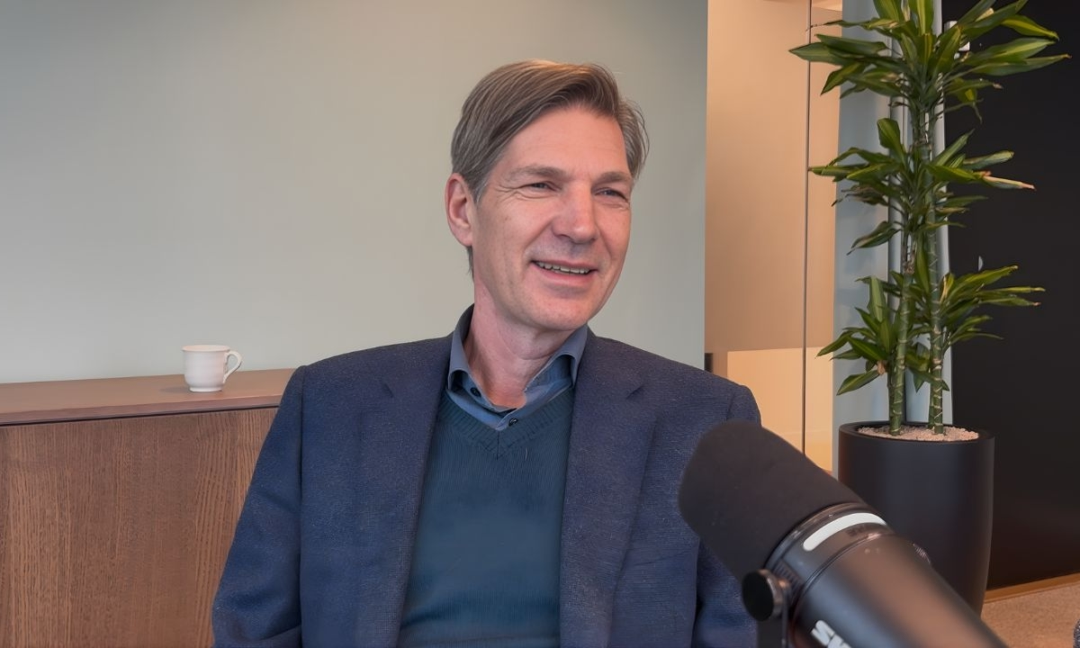
Novonesis arose from a 2023 merger of Novozymes and Chr Hansen, and is a highly profitable powerhouse. CSO Claus talks about the applications of Novonesis’ technology, its low profile among consumers, and how hard it is for biosolutions startups to scale up.
⭐️ ABOUT THE SPEAKER
Claus first joined Novozymes in 1993 and led its R&D both in Denmark and the US, with six years as CSO. He has a Master’s degree in biochemistry and an MBA.
🔗 LINKS MENTIONED
- Novonesis’ website — https://www.novonesis.com/en
- Merger of Novozymes and Chr Hansen — https://www.novonesis.com/en/news/novozymes-and-chr-hansen-announce-name-future-combined-company-novonesis
- Novonesis’ nine-month results in 2025 — https://backend.novonesis.com/sites/default/files/document/2025-11/2025_46_9M_Interim_report.pdf
- Novonesis and Benchling partnership in 2024 — https://www.benchling.com/news/novonesis-and-benchling-long-term-partnership-to-power-rd
- EU biosolutions — https://research-and-innovation.ec.europa.eu/research-area/environment/bioeconomy/bio-based-products-and-processes_en
Transcript
[00:00:00] Intro
Claus Crone Fuglsang: Most of our enzyme production is done in a genetically engineered microorganism and strains. It’s the same that another microorganism will be producing out nature, but we put it into this, let’s say, chassis. To enhance the productivity we have to run with several cycles of natural selection. It’s like horse breeding on steroids.
I think we are well known within the industry, even within academia, but the general consumer would not necessarily know If you had a yogurt this morning, there’s good chance that’s made with noesis technology.
Philip Hemme: Do you feel bio solution is a neglected market compared to pharmaceuticals?
Claus Crone Fuglsang: We are actually sensing a lot higher interests for BioSolutions as a key enabler of a greener transition, so we are always starting.
Philip Hemme: You have New 20 episode. I’m your host Philip, and on the Flood Bio Show I’m interviewing the best European biotech to help you grow bio solutions. Sometimes also called industrial biotech or synthetic biology. Symbio are major part of the biotech industry alongside therapeutics. Novos is the largest BioSolutions company in the world.
So I went to Copenhagen to talk with its CSO Klaus. I didn’t know him personally, but many people recommended him to me and I’ve actually tried to make this interview happen for the past two years. We discussed the $12 billion merger between Novozymes and Christian Hanson. Which led to the formation of the ti.
We also talked about the challenges that BioSolutions startups face and why it really matters to keep a childish excitement for technology. So here’s my conversation with Klaus, which was actually the first time on this podcast that we’ve recorded in the studio. If you’re enjoying it, please hit the and subscribe button.
Claus Crone Fuglsang: Welcome to show Carlos. Thank you. Thank you. Studio. Yes. We are becoming a big company in no Es and yes, we do have a facilities amazing. So to say. I told you it’s the first time I record a in the studio like this, but let’s make a request of it.
[00:02:19] Novonesis: the Novozymes and Chr Hansen merger
Philip Hemme: Yeah, let’s do it. So I wanna start with how, we got connected Keith.
So the chairman of doin helped us.
Claus Crone Fuglsang: Okay. Yep. Yep.
Philip Hemme: I saw that. And and actually met him in 2015 when he was CEO of Christian Hansen. I recorded a video with him, actually. And now Christian has merged with Novozyme, I think it was a $12 billion merger.
Claus Crone Fuglsang: Yes.
Philip Hemme: Became noesis.
Claus Crone Fuglsang: Yes.
Philip Hemme: I’m curious, maybe you can start there.
How did it go and. What did it enable?
Claus Crone Fuglsang: Sure. No and maybe bring a little history to it because it’s not the sort of first time it’s been thought about combining the two companies from a from, a, from, let’s say a research platform, technology perspective. Similar, not identical, but similar and with overlap and from a market perspective, very different.
So we’re operating in different markets. So we act, actually had collaborations before I would say the merger. But then came the opportunity and and I think yeah it was and regret it. What was opportunity specifically, but a more sort of balanced equity or valuation of the two companies that made it work out.
And the fact that we have a strategic owner. No holding helped as, as well.
Philip Hemme: That’d be good. They were already holding, I don’t know how much, but they have 20, 25%.
Claus Crone Fuglsang: Yeah. And then it’s been of course, as some, preparation getting into the merger and then execution of what we thought possible on the on on on synergies both leveraging cost synergies, but also and more importantly sales synergies because that’s, really for the future.
That’s also where the value really lies in, in, in combining such two entities that we actually gain from having a broader market presence. Yeah. A better distribution of our sales force being how do you say, complementary products into the businesses. And we are already seeing that.
Okay. And then of course, what I’m most excited about from an RD stance that’s a technology base that’s a technology base. Everything from the repository of strains Yeah. To what we can do and engineering those strains. Whether it be evolution, natural evolution or, even with the technologies like in Yeah.
Philip Hemme: Engineering.
Claus Crone Fuglsang: Yeah. And, then of course what these strange bacteria fungi are capable of doing in and producing.
Philip Hemme: But I guess there you must have. A bit of overlap on the text stack with, Christian Hanson,
Claus Crone Fuglsang: yes. Yes. But we can fully enable the capacity. This was not about bringing cost down on the research, it was actually to proliferate our pipeline and activities.
So we kept the merged cost ratio on research spending and actually have now programs that addresses you could say problems customer opportunities. Yeah. From an angle of two different complementary technologies.
Philip Hemme: Yeah, that’s correct.
Claus Crone Fuglsang: So you can start solving for something that that wasn’t possible with one or the other alone.
Does it make sense?
Philip Hemme: Yeah. And I guess also for the listeners, because the, two companies were very close. ’cause you’re both in company, I think the
Claus Crone Fuglsang: 10
Philip Hemme: minutes, 10 minutes from me. So I guess it helps also from a, especially from r and DI think most of r and d is here, so the teams are already are very close
Claus Crone Fuglsang: together.
Yeah. So the core and d what you say is the basic r and d is is mainly here. We have a as, as well facilities in, China and Japan and us. Yeah. And then applied RD is something you bring out in the world Yeah. Through the customers. So you’re near through the customers with how you apply the technologies in the different businesses.
Philip Hemme: Yeah. Yeah. We’ll talk about that because I think it’s one of the, especially for. From the novel design. No part, I think one of the spec specificity of you guys that you work very closely with the customers to do basically custom development of solutions. And I heard this from, a few publicly, that you’re pretty good at this.
Claus Crone Fuglsang: Yes. Yeah. Yes. It’s it’s very nice to have a very big and efficient tech and state-of-the-art technology stack.
Philip Hemme: Yeah.
Claus Crone Fuglsang: And we can talk more about that as well, but there’s other elements of course, to being a successful company.
Philip Hemme: Yes.
Claus Crone Fuglsang: Yeah. And, this piece of what we call customer centricity nearness to that is of course to understand.
How they operate.
Philip Hemme: Yeah.
Claus Crone Fuglsang: What are the key issues in operations? Yeah. How can we help enable maybe better, more efficient operations? What are the products doing with the consumers in the end? What, the quality parameters, performance parameters. So let’s say taste, if it’s the cheese you need to understand that.
You need to understand how you arrive at that. Then you can do the translational piece of, okay, so these are some of the opportunities issues to solve for. And then you can bring that back into the. Understanding the bi what’s the sort of biological nature of that problem? And can you measure it?
Philip Hemme: Yeah.
Claus Crone Fuglsang: And if you can measure that and make it a biological problem, then we can solve for it. And then of course you need to scale it.
And you see a lot of tech just
Philip Hemme: it,
Claus Crone Fuglsang: yeah. You see a lot of technology companies that have that isn’t a challenge also. Yeah. And here we, by the combination we are the biggest in, enzymes, in cultures, in microorganisms, probiotics, in terms of production.
Philip Hemme: Yeah.
Claus Crone Fuglsang: Both capacity, but also footprint around the globe. Yeah.
Philip Hemme: I want to unwrap a few things you said, but the, last thing you just said, I think what’s amazing the one is you, I think now the largest BioSolutions or industrial biotech company, I think even worldwide. ’cause you’re only doing this.
Claus Crone Fuglsang: Yeah.
Philip Hemme: Which is pretty amazing.
Claus Crone Fuglsang: Yeah. Yeah. No. So no. So yes we are, proud of our our, both our heritage and the technology base and what we do and then being, as we say, a pure play bio solutions company. And having biology as a premise of what we, how we produce and what we produce.
Philip Hemme: And how do you compare to, let’s say a large pharma large chemical company who has a BioSolutions, but let’s say A BSF for DuPont?
I guess they all have a bio solutions part as well.
Claus Crone Fuglsang: They, yes. They have a mix of technologies in yeah. But we leverage that in the sense that’s what we do. That’s what we do best. This is where we also invest true. Continue
Philip Hemme: to
Claus Crone Fuglsang: To, lead,
Philip Hemme: but So you guys are bigger than their BioSolutions departments?
Yes. Basically.
Claus Crone Fuglsang: Yeah. Yeah.
Philip Hemme: Okay. Wow, that’s good.
[00:09:51] Under the consumer radar
Philip Hemme: And we will talk also about yeah a lot of things you can, I think the, first thing I also want to talk about is what you said about the end customer. Because I think what’s really cool is with you guys, especially on the podcast, that most people have touched somehow in the not touched in thees product, but touched a product that has a noes.
Yeah. Ingredient or component in it, and often without knowing it.
Claus Crone Fuglsang: Yes. Yeah, that’s a little bit that in, in that sense, we are not that well known, right? To I, think we are well known within the industry. Yes. Even within academia as in, in the science part of course with our customers and, so on.
But the general consumer would not necessarily know. What they would know is that they there’s cultures in, for example. That cheese, they know the, this here
Philip Hemme: is
Claus Crone Fuglsang: high protein. Yeah. They know and they know that it needs that for cheese making. They might actually have read on the laundry package that it contains enzymes.
Yeah. They may not necessarily know Exactly. And they wouldn’t know that it was nesses. Yeah. Producing both the cultures for the cheese or the jargon or, the enzymes. For, the laundry. Yeah. But just imagine, so if you had a yogurt this morning, it’s probably 50% here, actually. Yeah.
You had a, okay, that’s good chance that, that’s made with, you could say noesis technology. Yeah. And the same when you wear a, cotton shirt the polishing, everything that goes into treating the cotton and avoiding chemicals is also enzymes in many cases actually have you.
From a company point of view, have we tried to
Philip Hemme: brand them a bit more to consumers and would it drive business or let’s say your intel with the chips and people know that there’s an intel processor
Claus Crone Fuglsang: sometimes especially in the probiotics business they would consumers that there’s something to be able for a customer of ours
Philip Hemme: Yeah.
Claus Crone Fuglsang: To be branding that it has BB 12 or LGG, which are very este well established probiotics. Yeah. But we only have limited examples where our sort of name is unpack as part of the brand. You remember ’cause it
Philip Hemme: doesn’t add value at the end of the day.
Claus Crone Fuglsang: Maybe it would to us, we would like to be known, but for our customers.
I, I think it’s about their products and their brands. For example, some of in, in, laundry it’s some of the world’s largest consumer goods companies like Proctor Gamble and Unilever. And they have their to share the grand, they have their billion dollar brands they protect and, the same with the food companies.
Yeah.
Philip Hemme: Makes sense.
[00:12:52] Business divisions and myriad applications
Philip Hemme: Thank on the application, you mentioned some examples, but actually one thing I was curious, preparing was to understand, I think you’re doing quite a lot in terms of application, like it’s pretty large. But to understand what, which, like how is the split in terms of business unit?
So from my understanding that food and health is basically the 45% of the business, I think within that food is a. Three quarter
Claus Crone Fuglsang: you and a
Philip Hemme: half, one quarter, something around there.
Claus Crone Fuglsang: Maybe even a little bigger on the food. Food. Okay. Food and dairy business. Okay. But approximately
Philip Hemme: somewhere there.
And then the second business unit or the second category is more planetary?
Claus Crone Fuglsang: Yes.
Philip Hemme: Which I think is 55% of the business around there. And household. That’s the historical, like the detergent, the origin of, I think of the biggest application for is originally and then agricultural energy.
Basically, I guess household, one thirds energy, two thirds, somewhere there.
Claus Crone Fuglsang: Yeah. Energy is somewhat a little smaller than than than than, household care. But we bit because some of the technologies all lab into the technical industry so, for example vegetable processing starch and grain processing, these sorts of things.
So we don’t have a clean bioenergy reporting. Okay But is yeah. But they are sizable businesses, all of these, yeah.
Philip Hemme: Okay. And, can you just talk a bit more about the, these businesses and what’s a key application maybe in, in each of the bucket? We talked about the detergent households.
Sure.
Claus Crone Fuglsang: No. So let’s, do that. But I maybe if I can Yeah. Inject a small thing on on, on, the first part of this, knowing your customers and the processes and what adds value to them and their customers, if you will. I, think sometimes it takes we sometimes go even beyond that in our innovation.
If you know them that well, you can also maybe. Point to solutions that bring them further than they sometimes imagined.
Philip Hemme: Yeah. I
Claus Crone Fuglsang: got because you know that it’s like the older Henry Ford, you don’t, sometimes they will ask for a faster horse and they would rather bring a car.
And but, and I think that’s the kind of level you need to be at on the application side.
Philip Hemme: Okay.
Claus Crone Fuglsang: To really. Make it matter. And then when we talk about what we then do and in the different industries, then of course in the, let’s say our, dairy business, we split in cheese and fresh dairy.
Philip Hemme: Okay.
Claus Crone Fuglsang: And the, some of the latest we are doing, of course in in, in fresh dairy is to accommodate. For much higher protein content. So consumers de demand or, wish for let’s say a more nutritional product. So we develop cultures in that direction. Then it also increases the value of the product.
So hence, can you preserve the product and this bio preservation solutions that we have that prevent mold. Or mold formation. So it actually also preserves the product of a fresh dairy beta. And, then again, you can put on top of that probiotic cultures.
Philip Hemme: Yeah.
Claus Crone Fuglsang: And that again, you said, okay you just put it in.
No, you need to make sure that it doesn’t do anything to change the profile of the product.
So you actually sometimes need to have it, let’s say, dormant. So that’s just one thing in, in Darien. And, then in the same way you can unfold the different applications, right? And in cheese making, it’s of course the whole sort of coagulation setting of the the protein in the cheese to begin with.
That’s one thing. How much lipids are you able to capture in that process?
Philip Hemme: And the strains, I guess
Claus Crone Fuglsang: also. Yeah. And then of course, the strains for the fabrication of the cheese. You take household
Philip Hemme: cheese? A function?
Claus Crone Fuglsang: Yeah. Yeah. No. Who doesn’t love cheese?
If you take household care normally, you would say as a consumer, it’s about cleaning. Yeah. But, for us and our customers it’s also for cleaning at less energy, less water. It might also be for more, let’s say fundamental than just removing spots, but providing a freshness. And then renew to the clothes so you can wear it for longer.
And doing it in shorter cycles. Yeah. So that has a whole sort of ben benefit for consumer to have a cleaning experience with much less say cost and effort into it in terms of water and energy. So what do you call cold quick? Yeah. So you have, I, how much do you want with jump ball?
Yeah, because I can continue.
Philip Hemme: Yeah. It’s amazing. One, one thing on what you just said, and I think that’s also remarkable in what you do. Sometimes I think you are. You’re replacing, you bringing bio solution, replacing something that was done. Basically petroleum chemistry I guess into the detergent.
That’s a typically example.
Claus Crone Fuglsang: Yep.
Philip Hemme: But I guess sometimes in the day you’re not replacing your, bringing something new that wouldn’t be, that was just not possible before and you need enzymes or probiotics
Claus Crone Fuglsang: to,
do it. Yeah. We say in, in, the bio preservation, you are replacing, you could say all the preserved okay.
Preservation A agents and cheese culture, you will not no. There you have to refine it for the taste and texture of the cheese. So the file quality
Philip Hemme: Yeah.
Claus Crone Fuglsang: For the consumer. But then also, again, putting speed into the process of the manufacturer
Philip Hemme: Yeah.
Claus Crone Fuglsang: Is you could say that is also an efficiency gain.
Yeah. Increasing yield. So you have less waste.
Philip Hemme: Yeah.
Claus Crone Fuglsang: That’s an efficiency gain that you could say have a sustainability impact versus a baseline
Philip Hemme: and value.
Claus Crone Fuglsang: Yeah,
Philip Hemme: Monetary value.
Claus Crone Fuglsang: Yes.
Philip Hemme: Yes. And how much of the, I dunno it’s probably hard question to exactly know, but how much of the applications are in the category of replacing chemicals or petrochemicals, and how much is more in the
Claus Crone Fuglsang: Oh, I I, wouldn’t have exact numbers on that.
I, do have a, number on, let’s say we look at how our products play into the UN sustainability targets. And you can point to six of these having relevance in terms of savings environmental impact health such and and nutrition and these.
And I believe more than 80% of our sales. Play into it. Ha has an enabler. And for most of our customers it will definitely have a an or for, many, most in the processing industry, it’s about efficiency gains. And you mentioned how care taking out polymer, taking out surf effects and adding in enzymes.
Of course there’s both a cost out, there’s a gain on performance and, there’s a, sustainability aspect to that. True. Yeah.
Philip Hemme: I like that.
[00:20:46] The scaling challenge in biosolutions
Philip Hemme: If we can also, not zoom out a bit, but talk about bio solution in the biotech as a field, because what you just mentioned is like you, you’re really delivering value to the customers.
But what I’m curious is about more like earlier stage companies, also startups, ’cause. On paper, it sounds good, but it’s very hard to execute. It’s also very hard to scale. And especially in Europe, I actually, I don’t know that many companies that started small, let’s say in the 10, 20 last years and who made it much bigger.
So I’m curious a bit on how and I know you are quite involved also with BII and on the show and a few others. How do you look at that? And Yeah
Claus Crone Fuglsang: The, I the thing is the innovation model from, let’s say startup to scale is very well laid out in pharmaceuticals.
Yes. You, know that you can almost put value to the different phasings in, in, in the development of a pharmaceutical that doesn’t exist in the same way in. Buy solutions but the scalability is a, I think the scalability is the hard one. Yeah. To actually get to high volume product at a cost that, in that, that is let’s say competitive.
Yeah. Because it’s to, to be fair there’s only so much you can demand in terms of a sustainability benefit. You can, it’s difficult still to put a value to that and you would find that many larger customers will ha. Gladly take that benefit.
Philip Hemme: Yeah.
Claus Crone Fuglsang: But not at a very high extra cost. Yeah. It has to come, it’s almost has to come as a, it’s all benefits.
Yeah. Yeah. Yeah. And so, scaling BioSolutions is a costly affair.
Philip Hemme: Yeah.
Claus Crone Fuglsang: And sometimes some of these companies have not thought through that process. Yeah. And maybe the, or invest in something that helped. Things help them in the beginning rather than seeking maybe the advice and help, let’s say of from companies like us on a scaling process.
We actually have examples where we collaborate with some that had a unique idea and maybe even the technology solution but, would suffer in the scaling of that. And sometimes we can help with that. And we have other companies that, that, that does that. But it’s a key parameter. And then getting of course, the value proposition of the product, right?
Philip Hemme: Yeah.
Claus Crone Fuglsang: Because many. Start out from a technology angle, you said it is a, yeah, to say mainly start out of a technology angle. They have the idea, they have the technology, and then, they may also have an idea on the application. And then everything it takes from there to putting a product out and, it surprisingly the goods we consume and use today, how cheap they actually are.
How much, when you buy a product in in in a supermarket when you break it down, what was actually the the, value of, let’s say the biotechnology in there. Yeah. Yeah. But that’s an amazing part actually, because.
Philip Hemme: There’s 2, 2, 2 things that comes to my mind is one thing is I think quite a few earlier stage companies think, ah, it’s like you can replace petrochemical or something has a huge value.
I guess they realize that it’s not necessarily the case that you just said, and then it’s also very hard to find the application where you are actually adding value compared to what’s existing and significant value to capture that value afterwards. But what I’m also thinking is that when as you said, when you know the, even the r and d budgets or in, in like industrial scale, let’s, in dairy, the margins are pretty low.
In general let’s say Ali, the margin I think is net, profit is whatever, a few percent is three 4%. So they probably look at cost like,
Claus Crone Fuglsang: oh, they
Very,
I’m telling you they, look at cost and you have to to be competitive. So if you are talking about exactly let’s say all chemistry Yeah.
Replacement. It, it, has to come. And you are saying identical.
Philip Hemme: Yeah.
Claus Crone Fuglsang: Let’s say you want to make a BDO in for po polymers and you have to compete it to hit with the audio chemical, BDO. There’s a, there might be a niche market that can take a little higher price, but that’s a niche market.
So the idea of identity is sometimes a hard task for a startup to be competing against while a adding value, doing something. Unique that couldn’t be obtained is a different story. That, that, that’s
Philip Hemme: so I guess you would recommend startups listening to go more for the unique solutions and the replacement.
Claus Crone Fuglsang: Yeah. are there are demands also on food ingredients and all, they become natural, so to say. There are demands for more fermented ingredients. So I wouldn’t say never go there and compete but seek but, be aware that you would have to be cost efficient.
Philip Hemme: Yeah.
Claus Crone Fuglsang: And that’s about the scalability.
It’s also about the choice of technology in which you choose to produce. And and we are very happy with our such as set production systems in the sense that they have been, evolved quite some more than what you usually find out of an academic setting. Yeah. An academic setting.
You would often work in coal and yeast.
Philip Hemme: Yeah.
Claus Crone Fuglsang: And and, we are moved to different organisms. Yeah. That has a, let’s say, a more efficient in, scaling and, productive productivity.
Philip Hemme: Yeah. Because what’s your high, the highest batch you do is whatever, 10,000 meter more.
Claus Crone Fuglsang: So we, run up to 200 cubic meters. 160, 200 cubic meters. Okay. Of ation.
Philip Hemme: That’s really,
Claus Crone Fuglsang: so they’re large. That’s and, it’s not one, it’s okay. So, yes. They’re large founders.
Philip Hemme: Yeah.
[00:27:39] Novonesis’ profitability and growth
Philip Hemme: So could on the capturing value, I want to, after we are going to a and d and the actual the bioengineering part and go a bit deeper.
But first I wanna talk about the value capturing and more about the finance of, Novo because I’ve, what I’ve seen from a revenue first it’s, high. But what struck me even more is the, profit or the net profit you get and the margins you manage to get out of it. Which, what was the number I got was whatever was, I think for the first nine months of 2025, I think you had 27% net profit somewhere around there, which seems very high.
Claus Crone Fuglsang: Yeah.
Philip Hemme: It’s basically more than LVMH or even some companies like this. What, how I don’t know how e especially giving for what we just discussed, that. It’s hard to add value. You’re serving industry with very low quite low margins. So how, come
Claus Crone Fuglsang: yeah,
Philip Hemme: I guess if unique technology and unique positioning, but
Claus Crone Fuglsang: sure.
No. So first it’s of course to have a efficient production.
And so it boils into what are our gross margins on, on, on what we sell versus cost of producing.
Philip Hemme: Yeah.
Claus Crone Fuglsang: We invest quite a bit in keeping cost out of production innovating also in the way we produce, in the strain that produces it.
So gaining productivity gains. So otherwise we would be even more capital intensive. We are ca you know, it’s not small plans, it is capital intensive. But, we have been able, optimized we are able to optimize it year on year. Yeah. And that’s an important contributor to keeping our.
Production cost. Then of course we add our RD cost. Many of our customers appreciate what we bring in terms of innovation. And that of course has a cost. The 10% we invest, I guess we charge on value and
Philip Hemme: then
Claus Crone Fuglsang: We, have to charge on value for the product. And yes, it’s a negotiation of course, with our customers.
They, we need to be able to show the value.
Philip Hemme: Yeah.
Claus Crone Fuglsang: Yeah. That is, if you are a farmer buying enzymes from nutrition,
Philip Hemme: yeah.
Claus Crone Fuglsang: You can monitor the value, right? And, you wanna see that?
Philip Hemme: Yeah.
Claus Crone Fuglsang: Because here we are also, when you’re talking low margins, then talk about agricultural systems, right?
And there you simply have to prove it. You have to have proven trials showing. How much weight gain will I, I ga give with this amount of food feed for my chickens? And what’s the cost of getting that technology that provides that weight gain? And then you can find a way of sharing that.
Very much the same in our biofuels business. It’s really about the productivity. Of the biofuels plants. And they can measure the output. They can measure the input, and of course they know the cost on the technology. And we have to show every time that we deliver added value and that you can then negotiate.
Philip Hemme: And how, did the profit margin evolve over the years
Claus Crone Fuglsang: in the history? It’s, it is been growing.
Philip Hemme: Yeah. Okay. Wow.
Claus Crone Fuglsang: It’s it is been, growing. It’s not we’ve had in the past high high, profitability Yeah. As well. And, we have as a target in know strategic period also to increase it further.
Philip Hemme: Okay.
Claus Crone Fuglsang: Our ebitda
Philip Hemme: Yeah.
Claus Crone Fuglsang: Where we project for 25, between 37 and 38. Wow. Then we have said that towards 2030 we’ll expand that to 39.
Philip Hemme: Wow. Okay.
Claus Crone Fuglsang: Yeah.
Philip Hemme: And then also Christian Sen was also. Quite profitable. Yeah. My sister worked there and she told me, yeah, very profitable.
Claus Crone Fuglsang: That seems that’s another sort of thing, good thing about the simulation business.
Similar. It’s like a similar in the way they we operated a fin and with the financial numbers and so on. It’s, I must say it’s been a. It’s been quite an amazing journey, I would say.
Philip Hemme: And you, we’ll talk about the person, but you have seen it from, I think you joined, what is it, 1993 or something?
Oh, yes. Yeah. You have seen the whole journey, like
Claus Crone Fuglsang: Yeah, I’ve seen
Philip Hemme: the
Claus Crone Fuglsang: journey, the whole, no. Get the merger to become news arms and now the mergers a, a combination with to become newness. So tried a lot
Philip Hemme: Must be very rewarding to look back in the achievements.
Claus Crone Fuglsang: Yes. It’s been it’s not I mean it’s not without bumps on the rope.
Yeah. And for which you learned a lot.
Philip Hemme: We’ll talk about the balance. Yeah. One thing also about the finance, and this is a good transition also to r and d, that you’re reinvesting a lot. I think what I had, the number I think was 10. Was it 10%? We, or was it 10% of sales invested in D? 10% of revenue.
Of revenues, yeah. Yeah. Goes back into r and d invested, which is higher. And I guess this is good for you ’cause you have a lot of budget to play with,
Claus Crone Fuglsang: yeah. See that’s, maybe the difference between academia and and and and a company play is probably not the word we would use.
No. We had to show a solid return. Yeah. And, that’s then you could say, that’s my challenge. Yeah. Yeah. That these 10% needs to convert to value every year. Yeah. And and we make it that it comes with the growth parts of our profitability gains.
Philip Hemme: Yeah.
Claus Crone Fuglsang: But it, that’s really on my agenda that, converting that.
True value. Yeah. And having fun on the way because that’s it is rewarding to be in an RD machine room that where you can actually see that what you do actually launches.
Philip Hemme: Yeah.
Claus Crone Fuglsang: And we launch more than 30 products a year.
Philip Hemme: That’s awesome.
Claus Crone Fuglsang: Yeah. And so, if you are an handy
Philip Hemme: Yes. Very new products.
Claus Crone Fuglsang: Yes.
Philip Hemme: On top of optimizing the
Claus Crone Fuglsang: Yeah.
Philip Hemme: The existing ones.
Claus Crone Fuglsang: I would say if we replace a next generation, that would count as a, launch as well. So it’s both the incremental and more transformative. But, you can see when you are an id, there’s good chance that what you work on will actually. Go out to a custom, and sometimes you get to see it in a final product that you can buy off the shelf in a supermarket.
That’s pretty cool. Ah, so that’s, but that’s, that, that’s so you could say if that’s that’s, what I really do. And consumer, you
Philip Hemme: managed to bring value in the past six years. You
Claus Crone Fuglsang: some, sometimes we’ve been accused of not
We had a time by whom? No But, you, we had a time in no times where we didn’t grow as much.
Philip Hemme: Okay.
Claus Crone Fuglsang: In, in, in the mid 10th 16, 17, 18, where we didn’t grow we, fell short on our growth targets. And then you wonder, and we were actually running at 12, 13 percent investment in r and d. And, but it didn’t convert to growth. And, that’s a problem.
The problem is actually that, that we did sell a lot of new products in the period we had the sales or new products to the tune of 30% of sales coming from new products. But you can imagine what we did was replace a lot in of our old, when you do, when you have that high not having growth, you are replacing yourself a lot.
Philip Hemme: Yeah.
Claus Crone Fuglsang: Okay. And, if you don’t manage to get that, but we did manage to get it at a higher profitability.
Philip Hemme: Okay?
Claus Crone Fuglsang: So you could say we created economic value for RD but this need to be a balance. There needs to be both a growth aspect and a profit aspect to that. It cannot be. Only one or the other.
And the 10% is the sweet spot of, that’s where we felt after the time we dialed back into all times. We, the 10% is a, result of the combination. Yeah. And we feel it’s a, good place to be it with what we are forecasting, we believe to have a solid return on investment there.
[00:36:34] Genetic engineering and cool patents
Philip Hemme: Let’s go more into the science as well. And I’ve seen that you are I think, what is it one of the company, at least in Denmark with the most patent applications per year. Something
Claus Crone Fuglsang: even
Philip Hemme: in
Claus Crone Fuglsang: Europe,
Philip Hemme: I think even in Europe
Claus Crone Fuglsang: When it comes in, our space.
Philip Hemme: In your space, yeah. Yeah. I’m curious on the, technology stack of I mean what you mentioned, but how much of it is like.
Strain optimization enzyme. How much is it like really into hardcore genetic engineering bioengineering
Claus Crone Fuglsang: yeah. So today you would say most of our inside production
Philip Hemme: Yeah.
Claus Crone Fuglsang: Is done in, in in a genetically engineered micro strains. That’s how you get to the productivity efficiency that allows for some of these applications to exist.
Philip Hemme: Yeah.
Claus Crone Fuglsang: Whether it’s in biofuels, in household care, wherever it is, even in, food and be mindful that the problem is not a living entity. It’s, not a genetic modified organism. Yeah. So we, we, produce contained, and then we take the. The ingredient or Ben enzyme or whatever that strain produced and put it in.
And that’s an as natural as its counterpart found in nature. When you have a protease that degrades protein, it’s what we have in our stomach, right? To digest our food. It’s the same that another microorganism will be producing out nature, but we put it into this, let’s say, chassis to enhance the productivity.
When it comes to cultures and microorganisms, it is e evolved from nature. By natural evolution. It’s selected, you could say, from a strain repository to do
Philip Hemme: A high throughput natural selection. I
Claus Crone Fuglsang: can imagine. Yes, We have to run in several cycles of natural selection, or can we find a, find an offspring, a natural offspring of that is better than the mother and so on. So it’s it’s a, it’s like horse breeding on steroids, but I guess, yeah, and it, I was able to say
Philip Hemme: like in even in plants. Instead of doing a GMO, they do like very rapid
Claus Crone Fuglsang: Yeah.
Philip Hemme: Strain selection or plan selection. But I guess in your case, even on the culture side, you the, iteration cycle is much, much faster.
Claus Crone Fuglsang: Oh, it’s much faster. And just the doubling rate of microbial culture, how they grow and, proliferate is much, much faster.
Philip Hemme: You’re not at the same speed as genetic engineering directly, but you’re. Pretty high speed, I guess from
Claus Crone Fuglsang: Oh, yes. No You will be able to run cycles through the laboratory to find, let’s say, a phage resistant offspring in a culture in, a few weeks.
Yeah. And
Philip Hemme: then you can really target what the what you want as a property. Yes. And you get it pretty up.
Claus Crone Fuglsang: But, again, this is part of what we do. We also try to understand the mechanisms in which we operate, so we can choose for that. So we can actually put some selective pressure.
Philip Hemme: Yeah.
Claus Crone Fuglsang: Exactly. We also, when it comes to enzymes we want, to stabilize them, may maybe make them more efficient Yeah.
For what they’re doing then and so on. So there goes a lot of advanced biotechnology. Yeah. Dealing with all this, is why we have 10% to understand all this and be able to handle it. And sometimes, even develop unique technologies that, that you would say you can’t find a buy to, do this.
So our toolbox keeps growing, expanding in terms of what we are able doing. Sorry.
Philip Hemme: Yeah, that’s amazing. What were some of the coolest patents you’ve done? The, in the last 12 months or something,
Claus Crone Fuglsang: istic some these last 12 months, maybe. I I wouldn’t like to talk about them before they publish.
Philip Hemme: No. Okay. Then.
Claus Crone Fuglsang: So
Philip Hemme: published patents or maybe the last one, some of them that were published.
Claus Crone Fuglsang: Yeah. Yeah. Yeah. I think we’ve had some some some very cool patterns on, on some of the bio preservation. Yeah. The technology. We’ve had the cool patterns on, on new technologies in, in a whole sort of new platform for what we call freshness of fresh of, clothes and this renewing of clothes CLO clothes.
Yeah. that that, that gives them a so you can use less perfume have deeper cleaning effects that you would not o otherwise have. We have some on new yeast technologies and now. There’s a caveat to where you use GMO or not.
Philip Hemme: Yeah.
Claus Crone Fuglsang: And when you talk about yeast for biofuels
Philip Hemme: Yeah.
Claus Crone Fuglsang: Which is again, a contained use of that Then use of advanced yeast engineered yeast that are capable of simply lifting the productivity to new norms because and, some, of the patents in that this is probably also why we have the largest sustainability impact that we can generate.
Philip Hemme: Yeah. We’ll talk about biofuels just on the science. I’m curious on the gentech engineering of I guess you must be using whatever is available from a. Whatever. Sure. Crisp. Any and of crisper multi, gene expression.
Claus Crone Fuglsang: No, you could say it goes way beyond. CRISPR is just one tool.
Philip Hemme: Yeah.
Claus Crone Fuglsang: For gene editing.
Philip Hemme: Yeah.
Claus Crone Fuglsang: And, you would have multiple tools for gene editing. And then of course you have normal GMO you take something from a different strain, puts it into this, and then enables this strain to produce that better. So we use all that. On, on the pro you, you probably heard about the use of ai machine learning to predict structural motives of proteins.
So, that, that is. You could say that becomes a Yeah. That becomes a new baseline for our research, right? That you have these alpha fold algorithms so we can go out and predict structures of, and even maybe identify novel functionalities that you couldn’t before. And and that, that’s pretty amazing.
Yeah. So you would go out and find completely new families
Philip Hemme: of,
enzymes. Of enzymes.
Claus Crone Fuglsang: Yeah. Yeah. And that happens in a computer today.
Philip Hemme: Yeah.
Claus Crone Fuglsang: Bioinformaticians saying, okay, we have this we know this type of structure motif does that.
Philip Hemme: Yeah.
Claus Crone Fuglsang: Let’s take, instead of searching the sequence, which soon titrates into something that is not the same.
Philip Hemme: Okay. Yeah.
Claus Crone Fuglsang: We can preserve this. Look at the structural motif and look which other proteins out there. Will have that structure, and then you would find something with a lot lower sequence homology. Okay. That has the same structure and function. That’s amazing. And that’s we get excited because that means, ooh, here’s a new wealth of opportunity to bring into play.
So, that becomes embedded in work cycles in RD today where,
Philip Hemme: and I guess your, genetically engineered strains are like very. Complex genetic I guess it’s layers of genetically engineered whatever, multiplexing, several kind of genes.
Claus Crone Fuglsang: Yes. Both that, but also a part of a natural evolution.
Philip Hemme: Yeah.
Claus Crone Fuglsang: So we do both. So we also continues to improve the strains simple by natural evolution. And then you can say, okay, now sometimes this happens with a lot of changes, and then maybe we can say, ah, we only need this, and this, and then go back and, do that. There, there’s other elements to that.
It actually creates safer strains.
Philip Hemme: Okay.
Claus Crone Fuglsang: Microorganisms you know, that there are some bacteria that are good.
Philip Hemme: Yeah.
Claus Crone Fuglsang: There’s also some that are bad and and, many of
Philip Hemme: sometimes the same. One like equal
Claus Crone Fuglsang: eye. Yeah. Yeah, exactly. Can it, depending on the circumstances, what you can do with many is remove the ability to become bad.
And that is what we do in, so our production strains. And that’s actually a good thing that, that you don’t bring into when you do products like enzyme for feed for animals or as a processing aid in food that let’s make sure that’s clean. Yeah. That that, what we deliver here is absolutely safe and clean.
Philip Hemme: Yeah.
Claus Crone Fuglsang: And you can better do that when you’re not looking for wild types strains that, that has it may not do it.
Philip Hemme: Yeah.
Claus Crone Fuglsang: But it has at least the ability if not controlled yeah. To you’ve heard of course of fermentation that goes wrong with people try to make alcohol. That’s that is what you don’t want.
Philip Hemme: Yeah. Yeah. That, and also that reminds me because I visited the former headquarter from, Novozymes I think was in. Actually, it was just after it’s 2015 or something. Yeah. And I remember you had also a huge collection of strains that you were collecting Yes. Around the world.
Claus Crone Fuglsang: Yeah.
Philip Hemme: How much does that play a a role,
Claus Crone Fuglsang: but that is still an inspiration of of innovation?
Yeah. There’s two elements to that. One is, of course, this is like a library. You can but if it is not a warehouse or string, it’s a library means that it’s ordered. Parts of it’s sequenced you can group it into families. You know what these family does, this and that. So it’s really like an index library where you go in and say, I am going to look for this.
Let me look in in, in my database on do we have, so let’s say it was books I want to book on cars. And I wrote a book that talks about the engine. Engine, yeah. Fast cars or the engine of cars. Yeah. And then I can go in and do that. So we don’t start from a warehouse and have to pull all the draws and so on.
But, that has been an inspiration. But I would also say now, from that you can build via if you combine that knowledge with the silico screening as we talked about before, then you have a real strong. Then you get a really strong repository for new innovation, and I
[00:47:57] Novonesis’ growing AI use
Philip Hemme: guess that’s where ai you mentioned we can go a bit deeper.
That’s where it plays a huge role as well because you have a lot of structured data. And now with advances and now you like protein structures and you can bring everything together.
Claus Crone Fuglsang: It’s, a yes. It is actually a little interesting that now everybody’s talking about it. Data and importance of data and structured data and learning from data and so on.
It’s a journey. We started back in the zeros because then data became a you, actually began already at that point of time with the next generation of sequencing, the high throughput screening that was all in the zeros. And that. Created a data richness that you had to deal with.
So we started unfortunately at that time, we had to do it ourselves because you couldn’t buy bespoke models to handle all that. So we had to build some of it from scratch. Yeah. Now, fortunately you can collaborate with large companies like Benchling or Seamen, so whoever we, work with Benchling to do a data repository.
Yeah. From end to end and having, you would say. Everything from idea to product linked and, you can monitor what went on with that. When you have that then you can start putting your machine learning. And then with machine learning algorithms, AI on to do more predictiveness built, let’s say digital twin for production, then you can optimize in the digital twin before you actually implement it in a plant.
So you can actually move the parameters in SCO and see, okay, no, that, that was not a good idea. Okay, we do this instead. Yep, that was better. Okay. And that, would narrow say the variability that comes out in our production and improve it.
Philip Hemme: And how much the advances in machine learning in the last whatever.
Three, five years and Gen ai, how much does it have an impact on, everything you just mentioned?
Claus Crone Fuglsang: Yeah. But so as I said, we don’t do x-ray crystallography anymore.
Philip Hemme: Yeah.
Claus Crone Fuglsang: For structures. Yeah. It’s ai. It’s alpha fold.
Philip Hemme: Yeah.
Claus Crone Fuglsang: And it takes we are expanding our numbers of structures to more than 20 million.
Philip Hemme: Wow.
Claus Crone Fuglsang: Over a period of let’s say in the first, in the beginning, it was slowly built up. And we had maybe 6 million last year in the spring. Yeah. Then we implemented a new service in Nvidia GPU. So it got a lot more calculation power, and then now it’s going from over a year from, a few millions to more than 20
Philip Hemme: and alpha, I guess you have a commercial license with
Claus Crone Fuglsang: deep mine, actually, that some of it is freeware that you can you, you can actually take and then you can evolve on that for our purpose.
So, some of it’s freeware or for other things more advanced? They, it’s commercial licenses but some you can simply it’s free.
Philip Hemme: You still need to adapt it to use case.
Claus Crone Fuglsang: Oh yes. You always have to re eat, really adapt it a little bit and adapt it.
Philip Hemme: Okay.
Claus Crone Fuglsang: And then the other thing we would like to keep it.
Our data for us. I can imagine that’s usually how a company sees it, right? So our data is our data. And that’s an interesting perspective in this, because normally when you do research you’ll be, hypothesizing and looking for specific outcome. Yeah. And then you would design your workflow towards that, so you have less interest on the variation around it.
And with, what we know today, you actually have to create more variability in your experimentation because that will enrich your, algorithm and machine learning.
Philip Hemme: The, algorithm can manage more complexity Exactly. Can
Claus Crone Fuglsang: handle that very, it actually needs a variation to be trained proper.
That’s why you see this, the large language models they have the whole internet
Philip Hemme: Yeah.
Claus Crone Fuglsang: As a data foundation. So in, in the future, some of the capacity that you get from downscaling and more automation faster high throughput assays need to be used also to create more variation so you can Yeah.
Yeah.
Philip Hemme: And the, I guess also on, on that topic, the digital trend and, the, in silicon commoditization, I guess it’s in your case. A bit easier than in a pharma in a, pharma setting where I think modeling the human body is still now
Claus Crone Fuglsang: very complex. There’s a lot of complex, there’s a reason why it starts in a place now it’s a large language model.
Where do we have enough that you can teach there’s protein models now there’s a lot. And now with alpha fold and everything, there’s a lot of AI on protein models and, the predictability of interaction with molecules with protein, interaction and so on. So I think in pharma, you will see a great benefit of this in, especially for antibody receptor or receptor binding and so on.
You can start modeling in a whole different way than you were able to. So there, I think, but then. The translation, let’s say for DNA model into productivity.
Philip Hemme: Yeah.
Claus Crone Fuglsang: Highly complex still. Yeah. Also in our world, modeling,
Philip Hemme: modeling like a yeast or strain manufacturing. Yeah. That’s complicated. But
Claus Crone Fuglsang: I guess though, yes.
Taking the whole niche of a, if you take a microorganisms, it has all the functions you’d say of one hour our cells, right? Yeah. And it really is a complicated and can small changes in will make potentially huge changes in the metabolic output of, and that is still, there’s no such thing as a, good AI model yet on even, a microorganism.
As you said. Doing this on a human body where you have different types of, a let’s say specialized cell functions and having that speed together is even worse. It’s enough. But I do think that pharma will benefit a lot from machine because of the it variation in data. And, what we’ve learned is that some of this will be able to find the art how do you say, interdependencies?
Philip Hemme: Oh
Claus Crone Fuglsang: I, have a
Philip Hemme: story. A human would not even think about them. Yeah.
Claus Crone Fuglsang: I have a funny story I keep telling is that, we hired a mathemat mathematician from a from a from a, how to say, insurance company.
Philip Hemme: Okay.
Claus Crone Fuglsang: And he had no idea of biology, right? But he went and looked at the at, parameters from a production of a certain product and looked at all the variability of what went into this records of everything from substrates when you did what to the strain and in the ation and this and that.
I said there’s, no correlation except between this thing, which I don’t know what is and output here. And then somebody looked at it and says, ah, but that is when we shift dosing profile from a certain carbohydrate to another. If you do that, at that stage, it has detrimental effect. If we do it here, it’s better.
Good. Let’s do it.
Philip Hemme: So data scientists,
Claus Crone Fuglsang: looking at it it’s a small stupid example maybe, but it just tells you that, some of these technologies will take us to new places.
[00:56:34] Claus Crone Fuglsang’s enthusiasm for his work
Philip Hemme: Yeah. We haven’t talked too much about very few, but maybe in another piece. Yeah. I wanna move a bit more to the, a bit personal aspect.
What struck me, you seem to have a lot of fun in, what you do, right?
Claus Crone Fuglsang: Oh, yeah. I’m. I say I, I get excited about what we do. I, must say I also do it. I get excited by the fact that it’s used for something.
Philip Hemme: Yeah.
Claus Crone Fuglsang: Because when, if you’re gonna talk me talk ask me a personal question, why I ended the industry
Philip Hemme: Yeah.
Claus Crone Fuglsang: Is because I couldn’t see myself in academia.
Philip Hemme: Okay.
Claus Crone Fuglsang: It I was there. I started there and and but it was slow and it’s okay to try to make sense of things and so on. But, it, most of it was not very useful. That’s just, and I’m not saying that academia is not useful, that’s not what I’m saying.
It’s just there’s no
Philip Hemme: direct application.
Claus Crone Fuglsang: No and I, liked to see that, I like to see it become something that matters. Science at university does that, but it does it as a foundation for which companies like us and others can build solutions, innovations yeah.
Yeah.
Philip Hemme: And how did you manage to to, sustain this enthusiasm and fund over the menu, you think,
Claus Crone Fuglsang: ah. It’s never it’s never status school in biotech. When I started, I guess some of the first products were out five years earlier, the first GMO derived. Production Yeah. Was in the late eighties.
The, whole idea about protein engineering was almost new. And as I said then, came high throughput automation technologies, DNA sequences, the human genome was sequenced in the early zeros. And finalized that, and everybody thought it would now re, re revolutionize disease treatment and so on.
And, it just peeled an all layer of the onion. And then now it’s about in understanding the intercomp complexities of whatever SNPs and whatever else happens in a from a human genome to the translation of, to the human being. But it comes in this, and there’s always something new.
There’s. Things we couldn’t do 20 years ago, that all of a sudden becomes an opportunity because you can do it now.
Philip Hemme: Yeah. And I guess for everything we just discussed also you, are able to take the new technology and really test it, apply it Yeah. Right away, like what you said is AI and you can directly see if there’s a, it translates to value, into value for your customer and for the end, user as well.
And you can do that at scale. Yeah. I guess must be pretty,
Claus Crone Fuglsang: it is a very, it’s a rewarding, yeah. And sometimes I feel that our team is like a the, top champs right. In the, in in the soccer league of of BioSolutions. And that’s fun. That’s correct.
[01:00:09] Industrial biotech globally
Philip Hemme: The last personal question before a bit more quick fire, quick question, quick answers.
I think you lived in the US Yes. For a bit.
Claus Crone Fuglsang: Yeah.
Philip Hemme: And no one, this is a very global company. H how important was that? How, it fitted in the picture with your current role?
Claus Crone Fuglsang: I think it’s imp i, important the idea that the world from sitting in Copenhagen is wrong. The idea that it takes realization.
You understand that we are a global company. You get that sense when you go out in the world, when you start understanding that some of our businesses are a lot bigger. Outside Europe. And when you talk about household care, we talk about bioenergy. There’s almost nothing in Europe. So what brought me to the US was bioenergy at the time.
And and you get a sense of different cultures, different work way ways of working. Yeah. But it’s also paramount for learning new technologies. Talent attraction. When we started in California, for example it was to. Tap in, and that was already back in the early nineties tap into the whole wealth in molecular biology that took place on the eastern west coast of the US and so
Philip Hemme: genetic factor, Genentech.
Claus Crone Fuglsang: Yes So you need to have that, and you need to have that outlook in the world. And you can’t look out from copen. Then you need
Philip Hemme: How much you travel into the different
Claus Crone Fuglsang: every year I have to go us, China, Japan where where and also where customers takes us.
But, it’s not, I would it depends on the function. I’m okay. It’s been worse, I would say for what it is today. But it’s part of it.
Philip Hemme: Yeah. And I didn’t ask, but how, much. Is China playing a role? Because right now in, in the pharma world is it’s very not just in pharma, in, but in pharma world, it’s quite hard that.
China is, growing and bringing a lot of innovation. How much is it true in industrial biotech?
Claus Crone Fuglsang: They also within industrial biotech they actually are the largest on some fermentation products. So bulk citric acid, vitamins, these sorts of fermentation products, which you would also call BioSolutions.
But these are more bulk productions.
Philip Hemme: Yeah. Okay.
Claus Crone Fuglsang: And a bit commoditized, yes, in some places. Yes. Yes. We’ve been in China with production since the early nineties.
Philip Hemme: Wow.
Claus Crone Fuglsang: Yeah. We’ve had RD in China since 90. We built the RD headquarter for China in Beijing in 97. Wow. A state essence.
So, in that sense I think. We have good sort of relationship with the with the Chinese innovation scene.
Philip Hemme: Yeah.
Claus Crone Fuglsang: In the beginning it was not very I’m not being honest here. It has advanced some since the nineties. But it’s an advanced and a completely different pace than in Europe and the US to an extent that now you probably have as much activity in China on, as you said, pharmaceuticals.
Yeah. I would say also in parts of BioSolutions in China, as in many places in Europe and the us. So they advances, and you can start now collecting innovation from the outside in China, collaborating with Chinese Institute for novel technology. We also do that.
Philip Hemme: That’s cool.
Claus Crone Fuglsang: And we can only do that by having a presence and being trusted as an entity in, in, in China.
[01:04:15] Quick-fire questions
Philip Hemme: That’s cool. Yeah. So quick fire, quick answer. Less than five minutes. Do you feel bio solution is a neglected market compared to pharmaceuticals?
Claus Crone Fuglsang: I wouldn’t say neglected. I, think we are actually sensing a lot higher interest for BioSolutions as a, key enabler of a greener transition.
And that goes across agricultural systems, food systems, what we do and how we produce. So there’s even in the EU a recognition that bio solutions is a thing. Actually across us, China, Europe, biotechnology has been. Spilled out as a as a key critical technology for and, that is not only for pharma diagnostics vaccines.
It’s also for, bio, for BioSolutions, for cleaner and more efficient agricultural systems for the whole foods manufacturing systems for everything. You, do, right? Yeah. Yeah. So I’m not saying neglect, but there’s a lot more to go for. Yeah. That I would say it’s so, we are only starting
Philip Hemme: understand multi more personal question.
One mistake you made in the past 12 months, ah, the past 12 months. Let’s see. They’ve not been so dramatic.
Claus Crone Fuglsang: I’m sure
Philip Hemme: I’m I if you take decisions, you take wrong decisions.
Claus Crone Fuglsang: Let’s say that I’m sorry. It’s not a, it’s not the question I made. I’ve made bigger mistakes some years back.
Philip Hemme: Oh, an example. Yeah. If you have one example
Claus Crone Fuglsang: I, think you know, the belief that you can I worked on biomass is enzymes for converting
Philip Hemme: Yeah.
Claus Crone Fuglsang: Biomass not, grains but waste.
Philip Hemme: Waste, yeah.
Claus Crone Fuglsang: Waste to fuels. And we kept added refining, you would say the biotechnology around it.
Philip Hemme: Yeah.
Claus Crone Fuglsang: And not realizing that the problem is elsewhere. It’s in the infrastructure collection and treatment prior. To our technology coming into play. And we we invested then into something at the point of time that we didn’t understand well, and that cost a lot of money and it didn’t move us.
Now the industry has moved since because it took engineers from companies like rising in Brazil you could say a sort of a fuels, chemicals, ac company with heritage in in, let’s say even in from the oil business to take an engineer such, yeah, that’s not for a newness to do.
And if there’s something to watch out for, it’s also for now we, still look at these more transformative opportunities and then you I have to be careful of dosing the RD to a level and then maybe something else need to happen. Yeah, Before we can really. Does it make sense? Yeah, Because value chain, a wrong decision would then be to continue to hammer at something that you are not in control of. When, what you have is good enough.
Philip Hemme: Yeah.
Last one one advice to 40 years old Klau.
Claus Crone Fuglsang: I’m older than 40, right? So I’m 40, I’m going back in time.
Exactly. Yeah. I’m going back 18 years in time to 40-year-old Klaus, I would say I keep your, sort of a childish love. For what technology can do. Yeah. But but maybe focus as much on the people that are doing it. The, I don’t know what, if that makes sense to you. Yeah.
But because you can get all involved with, the outcome, the impact the, what the technology can do. But maybe it’s a, it’s as much about how you how, people. Yes. But, yeah. Seeking the talent you often, you would, as I said, replace a molecular biologist with a molecular biologist.
And, that’s but sometimes you need to go in different ways to get something new.
That means nursing. Yeah. Also art. Ways of looking at things a little more than I, I maybe have done because that would maybe have moved some of our, technologies even further.
Philip Hemme: I like it. I think you have kept the childish yeah, I can feel the childish love for te computer. Great. Thanks, stars. Amazing conversation.
Claus Crone Fuglsang: Thank you.
Philip Hemme: Yeah, thanks a lot.
I’m impressed by how Klaus is so enthusiastic about the technology and product you developed even after doing it for over 30 years. I’m also impressed by the impressive financial results of Novos. That he contributed to. If you enjoyed this episode, please hit the subscribe, or review button. Any of these actions, help many more people discover the podcast.
We also have plenty of similar videos on our channel, so please free to check it out. I would also love to hear what you think. So if you could leave a comment wherever you are or shoot me an email@philipatflo.bio. P-H-I-L-I-P at FT Bio. Alright, thanks so much for watching and see you in the next episode.
![Sten R. Sörensen, Cereno Scientific 🇸🇪 | Drug Repurposing, Retail Investors | E52 [Sponsored]](https://flot.bio/wp-content/uploads/2026/02/Website-Thumbnail-Sten-Sorensen-1080x648.avif)