
Founded in 1979, Transgene has transformed itself into a leading personalized cancer vaccine player. Alessandro talks about the transformation, his history in cell therapy and how Europe’s biotech space can rival those of the US and China.
—
Learn more about Transgene: https://bit.ly/tg_flotbio
—
⭐️ ABOUT THE SPEAKER
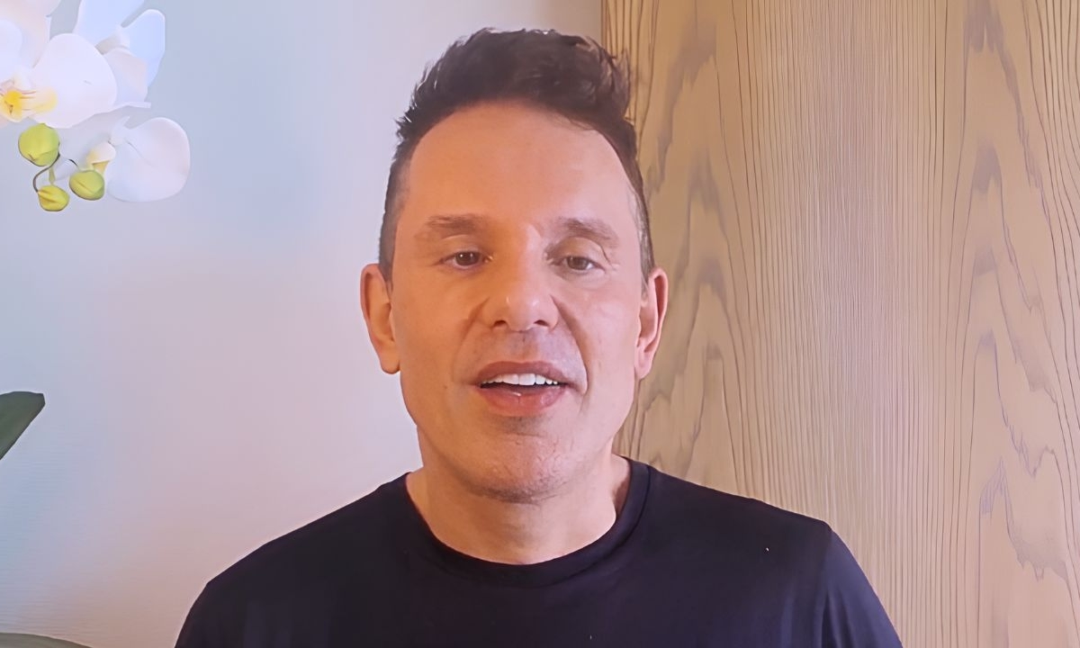
Alessandro became Transgene’s CEO in 2023 after joining in 2022 as Chairman of the Board of Directors. He also played a key role in Gilead Sciences’ acquisition of Kite Pharma and the regulatory approval of the CAR-T therapy Yescarta.
🔗 LINKS MENTIONED
- Transgene’s website – https://www.transgene.fr/
- Transgene’s €105 million fundraising – https://www.globenewswire.com/news-release/2025/11/26/3195422/0/en/Transgene-Successfully-Completes-a-Fundraising-of-c-105-Million.html
- FDA approves neoadjuvant and adjuvant pembrolizumab for resectable locally advanced head and neck squamous cell carcinoma – https://www.fda.gov/drugs/resources-information-approved-drugs/fda-approves-neoadjuvant-and-adjuvant-pembrolizumab-resectable-locally-advanced-head-and-neck
- Gilead Sciences’ acquisition of Kite Pharma for $11.9 billion – https://www.gilead.com/news/news-details/2017/gilead-sciences-to-acquire-kite-pharma-for-119-billion
- Johnson & Johnson’s collaboration and license deal with Legend Biotech – https://www.jnj.com/media-center/press-releases/janssen-enters-worldwide-collaboration-and-license-agreement-with-chinese-company-legend-biotech-to-develop-investigational-car-t-anti-cancer-therapy
📖 SHORT BLOGS BASED ON THIS EPISODE:
- Personalized Cancer Vaccines and Oncolytic Viruses: The Next Generation of Cancer Immunotherapy: https://flot.bio/personalized-cancer-vaccine-oncolytic-viruses/
Transcript
[00:00:00] Intro
Philip Hemme: What’s the most common misconceptions that investors have about cancer vaccines?
Alessandro Riva: That’s actually, they have never worked. Our approach now is totally different. The target is a specific individualized target that is a significant difference from what has been done in the past.
Philip Hemme: I’m curious on the head and neck, what’s your differentiation there?
Alessandro Riva: In the early setting, essentially the innovation comes from a checkpoint inhibitor. In the absence of a checkpoint inhibitor, we are able to again, delay the, our approach can be the next innovation in this field as a CEO of a biotech company, you’re doing everything I Novartis or at Gilead, where actually I was in charge of one function.
This was not my full director responsibility, and it’s very rewarding. I’m learning every single day. A lot.
Philip Hemme: You have new, in your episode, I’m your host, Philip. And on the Flood Bio Show, I’m interviewing the best Europeans in biotech to help to grow solid tumors present a big challenge for immunotherapy, but cancer vaccines could help significantly. Transgene is one of the leading biotech in this space. So I caught up with Transgene, CEO, Alessandro, while in Paris.
I didn’t know him personally, but I’ve known transgene for over a decade. We talked about the potential and challenges of cancer vaccine. We also discussed transgene, recent 105 million Euros. Fundraising and why. Looking at the big picture for patients matters a lot. For transparency, this episode has been sponsored by Transi.
So here’s my conversation with Alessandro, and please hit the and follow a button if you’re enjoying it.
All right. Welcome to Show Sand.
Alessandro Riva: Welcome. Welcome to Paris.
Philip Hemme: Philip. Thank you. Yeah. First recorder of the year, just five days into in the new year.
Alessandro Riva: That’s
Philip Hemme: it. Yeah, that’s correct.
[00:02:02] Transgene, the French biotech heavyweight
Philip Hemme: I, want to start with the, basically the story of transgene until you joined in, in 2023. So I think the company has quite a rich story.
Was founded like 19. 79 or at least
Alessandro Riva: Yeah, that’s correct.
Philip Hemme: Quite a while. And was financing mostly by the Maria family. So could you just walk through the big milestones until today
Alessandro Riva: actually transgene as, you say, was founded almost 40 years ago. In terms of milestones, I would say that the company was able to build up a very strong know-how in ology and in integration of payloads into the vectors.
So they went through different reation and permutation of drug developing from infectious disease to oncology. And essentially in oncology they focus on the off the shelf neoantigens. And unfortunately the, company was not able to demonstrate strong efficacy across the vaccines that they have developed up until now.
So now since I joined the company we have changed significantly the portfolio of the organization. And actually we have leveraged the significant know-how on ology and also the evolving knowledge in the field of immune oncology, specifically the individualized neoantigen therapeutic vaccine.
And we have started to develop what we consider to be today a potential next generation of immune oncology based on the know-how that transgender build up during the last, I would say, 40 years. And as it’s not very easy to to have the expertise in ology and the expertise in integrating whatever you want to integrate into the viral vector.
Now, I think that transgene, transgene is one of the most significant company in ology based on virus.
Philip Hemme: Yeah. Cool. Actually, I actually visited. The office of Trans Strasberg
Alessandro Riva: in str in downtown.
Philip Hemme: In the,
Alessandro Riva: because str because Transgene started in Strasbourg downtown.
Philip Hemme: Okay.
Alessandro Riva: And then we move to Ike.
Philip Hemme: Yeah.
Alessandro Riva: Where now we we are based and we have full manufacturing facilities, full research facility, full development facility, and we have around 160 people database in that is just 10 minutes driving from a burg.
Philip Hemme: Yeah. I actually visited in 2013. Was good. I started my first company.
Yeah.
[00:04:55] Standout personalized cancer vaccine
Philip Hemme: And so I, and I remember really quite impressive GMP, like the whole facility was pretty impressive at the time. Can you, talk a bit on the platform itself? And, how do you differentiate with existing on oncolytic viruses and what’s coming in, development?
Alessandro Riva: So we have two platforms.
Philip Hemme: Yeah.
Alessandro Riva: The first one is what we call the, my A platform that is not an oncolytic virus, but is it is an individualized neoantigen therapeutic vaccine platform. So that’s the my a and then we have the Oncotic virus platform that is significantly different from the mvac.
Yes. So perhaps
Philip Hemme: inve second.
Alessandro Riva: Yes, exactly. Yeah, exactly. So, starting from perhaps Mvac. Yes. What we do actually with this platform is to prepare a vaccine that is specific to certain mutations that the patient has in his or tumor. And then we integrated these mutations into a viral vector and ultimately we administer the the vaccine to the patient, the objective and the scope being.
To induce an immuno response against the predefined neo antigens that are the mutations against those mutations that are present anti-tumor. So that’s the demy VA platform. So it’s rather complicated we can enter into details later on. And then. We have the oncology virus platform that essentially is based on the capacity of certain virus that we have engineered to to recognize the tumor cells and to replicate into the tumor cells.
And by replicating, that can kill the tumor cell. And also liberating certain payload proteins that we integrated into the virus that are very useful in terms of further announcing the killing of the tumor cell. So there are two different platform with ultimately a kind of a unique unique objective that is stimulated immuno response against the tumor.
So throughout two different approaches,
Philip Hemme: yeah. Okay. And because on, yeah, on cancer vaccine as well. I remember there’s, been quite a lot of hopes. Yeah. There’s been some setbacks as well.
Alessandro Riva: That’s what I was referring in the beginning discussing very briefly on, transgene background. You are referring to what we call the off the shelf. Yes. Therapeutic vaccines. In other words there are vaccine that have been built up against targets that are present across the the patients or in a subgroup of patients, but are not specific to one individual patient.
So this type of object shell vaccine so far have not yet demonstrated the impact in terms of killing the tumor and ultimately prolonging the progression-free survival and the survival in patients. On the other hand, the new chapter of therapeutic vaccine based on individualized mutations, not share of mutations, but individualized mutations.
So those vaccines start to demonstrate. That could have a significant impact in the treatment of cancer patients, solid tumor cancer patients, and specifically in the treatment of early setting cancer patients, where we think that the immune system, the patient is more prone, right? So to be activated throughout the vaccine.
I would say this new generation of, individualize Neo antigen. Neo antigen because it’s based on a specific mutation. Therapeutic because actually the objective is to cure and not to prevent Yes. Vaccine. So this new generation is starting to demonstrate very interesting data.
For example, transgene, right? So I just presented at the American Society of Clinical Oncology, a randomized phase one study in early setting head and neck cancer patients showing that patients that received our vaccine after the standard therapy those patients did not experience any relapses despite the fact that we have already 30 months median follow up and all patients have been followed for at least two years.
On the other hand, the patients that did not receive the vaccine, remember this is a randomized trial. We have observed already three relapses among the 16 patients that we have randomized. So this is important approval principle for us. So first of all of course is in a randomized setting.
He’s in a tumor that is very cold from an immuno response point of view. And from an immunological feature point of view is a tumor where the lymphocytes, the T lymphocytes do not penetrate very well. Therefore the tumor is not very prone to, is
Philip Hemme: a very
Alessandro Riva: challeng, very challenging tumor.
So despite that so we are observing in this kind of small sample size, 32 patients extremely system. Yeah. But in a randomized phase one study that there is a proof principle. In addition beyond the efficacy data that we showed at asco we have also showed at the C3 conference the society for immuno-oncology of cancer that the the patients develop a specific immune response against the predefined.
Neoantigen that we have integrated into the viral vector. So we have demonstrated that in more than 70% of patients there is a de novo immunogenic response. We have also showed that this immunogenic response last over time, so we have a follow up of two years and we are showing that after two years they’re still the T-cell against the predefined neoantigen that are present, which is also very important.
And also we have characterized the immuno phenotype of this T-cell. And we have seen that this T cell are. What we call a factor. So there are cells that t cells that can maintain the memory of what they have seen in their journey. In this case, of course, we’re talking about the predefined neo anti that we have assessed in the tumor.
This is for us a proven principle from a clinical point of view where we showed that there, there are no relapses in patient treated with the vaccine and also from immunological point of view, because we are showing that we have a profound immune response against deifying neo antigen. So now what we are doing is to continue the development in a randomized phase two study.
So we are very close to complete the, phase two part of the, randomized trial. And we expect to do it in this quarter, in 2026. And and at the end of the day by then finish
Philip Hemme: the enrollment.
Alessandro Riva: Yes, additional enrollment. So remember we recruited 32 patients into the randomized phase one study.
And we plan to recruit around 44 0 patients in the randomized two study. And then we are going to analyze the two patient population together, so the 32 and the 40. So we’re going to have around 70, 72 ish patients that will represent for us a potential Provo concept because of course the patient population is is is larger.
We are going to address also the heterogeneity of the tumor, and hopefully we’re going to confirm in a larger sample size what we have observed in the phase one study.
Philip Hemme: Okay, that’s fine. I’m curious on the, and. I wanna switch to the finance afterwards, but on the still on this, how do you differentiate, because I think on the cancer vaccines, like how do you look at your closest competitors?
Is it another head and neck therapy, or is it you’re comparing to other cancer vaccines? I know like for Moderna has a Right for the advanced one, so BioNTech is a few as well
Alessandro Riva: yeah. So the, I would say the field started to be very interest. So of course we are not the only one working in the individualized neuro anti therapy vaccine.
And essentially there are companies that are working with a vector that is based on mRNA, like Moderna and BioNTech, their company that are working with a vector based on DNA, like for example, a vaccine and their company working on the viral vector like transgene. And we say that from a viral vector point of view, transgene is the most advanced.
So we are the only one being randomized phase one now randomized phase two exit. So the first differentiation I would say from a, from a biotech, I prefer, say biotech, they’re competitors because we’re all together against the cancer. And and we respect each other by the way.
And I think that each company bring some specificity and some innovation and the field, this field is so complex complicated that we need a different players. But I think that the first differentiation really is around the vector. And we can discuss forever whether it’s better to have a viral vector or an RNA vector or a DNA vector.
Certainly what we can say is that the the data coming from transgene, as I mentioned is rather I say more than positive, the data coming from Moderna in the randomized phase two study in melanoma, not in the neck is positive. Yeah. And the data coming from BioNTech in pancreatic cancer, although BioNTech did not do randomized trial when you look at the data and you compare their data with the literature, it looks, the data looks promising.
So what we can say is that this type of approach across a different vector. Is working. Yeah. The field start to be de-risked. Yes. So transgene differentiator versus I would say modern and BioNTech and also the other, a vaccine avac in other companies because the vector,
Philip Hemme: yeah,
Alessandro Riva: because the indication, so we are the only one in this space working in the head and neck and of course we, we decided to to, move to head and neck because at the time there was a significant medical need.
Immuno-oncology immunotherapy did not work very well. And we took the challenge, right? So to, test this approach in this type of patient risk. So we are the only one in the head and neck indication that is also a differentiation. And the third aspect is that we have, specific algorithms. Yeah. Based on in artificial intelligence, machine learning that is by design different from modern, from bioTE and from other companies. So these are the three differentiation factor. And I say ultimately what is important is to advance together this field because the upside of this therapy if it continues to show positive data, is that it can be valid for all early setting solid tumor patients.
So you can imagine that you cannot have only one company serving the needs of all community from a solid tumor point of view. So if this field continues to. Be de-risked. Yeah, and if you know we have more and more the evidence that this approach actually is transformative for patients in early setting, solid tumor in terms of delaying or avoiding the relapse after the standard therapy.
You can imagine that we are introducing a new generation of immunotherapy and also we are introducing a significant response to a medical need, and therefore multiple players are more than welcome.
Philip Hemme: Yeah, That’s good. Yeah. I’m curious also on the, because I was about to say on the, bioinformatic or let’s say AI part of either the bio and which kind of neo intelligence to select.
I was wondering how important is that? I think at least, I think this is very important compared to which vector you use. Because at the end of the day, if you have the right neuro intelligence. So Vector played it plays a role, but maybe a less significant role. And I also know that mRNA is very quick to generate.
So I can imagine also if you want to personalize, you can be, have a very quick cycle also to generate the MNA and deliver to patients versus the virus and,
Alessandro Riva: so of, and I agree that the identification of the neoantigen in the tumor of the patients is critical
Philip Hemme: Yeah.
Alessandro Riva: To determine the success of the therapy. And as I mentioned, I saw different companies are using different technologies to do that. And because this type of approach is covered by the trace secrecy we don’t have access to what modern is doing, to what BioNTech is doing, and they don’t have access to what we are doing.
So it’s difficult to elaborate on the differentiation. Yeah. But certainly what we know is that at the end of the day all these companies are able to stimulate the immune system against the predefined new anti that they have determined based on their own approach as we have done and also as we have demonstrated.
I also think that the vector. And the way you integrate these proteins, these neoantigen into the vector, can be also important in terms of the potency of immune response, but also we say more important the durability of this response, and also the type of immune response that you induce into the patient.
So of course, the jury is still out, of course, more. Exactly. But but I will say that it is a kind of combination of the vector and the platform based on artificial intelligence and machine learning that makes the the difference, right? And again, more data will tell us whether everything is similar is identical or there is a potential differentiation.
Philip, even in the worst case scenario, the right to come back to what. I would say a few minutes ago, even if all these platforms are similar, again, the medical leader will be significant. Take the example of checkpoints, inhibitors, of course you are falling this field.
Yes. So look at the number of companies that have developed checkpoints, inhibitors and those checkpoints inhibitor available to patients. And that there is a business case for all this s this is the worst case scenario. Of course, the best case scenario is that there is a differentiation and is what we believe and is what we are creating.
And therefore, around this differentiation, there will be prioritization in terms of prescription of this type of approaches for patients.
Philip Hemme: Yeah. Okay. Makes sense.
Alessandro Riva: Yeah.
Philip Hemme: And curious on the, head and neck, where you differentiate on the head and neck, because. There’s a few companies working there, but at the same time, what I see is that it’s a very, tricky cancer to treat.
I don’t know exactly which specific I guess there’s many specific head index as well. But are you are you like, how do you differ? What’s your differentiation there or what are you like competing against directly? Is it new treatment or you are already working in combination for the read up?
Yeah. Yeah.
Alessandro Riva: I mean it depends on whether we talk about the early setting at the neck we’re talking about squamous squamous cell at the neck or the advanced metastatic setting. Let’s say focus for a second on the early setting because that’s our area, but we can also discuss the metastatic, right?
So, in the early setting essentially the innovation comes from a checkpoint three inhibitor, right? The standard therapy up until last year. Was a surgery for patients that are amenable to surgery. Yeah. Followed by radiotherapy and chemotherapy. And just recently, last year in 20 25, 2 large phase three trial showed that the addition of a checkpoint inhibitor, pembro and nivo is Ebola to prolong the disease, disease free survival, inoperable, squamous and neck cancer patients.
In our study we show independently of the addition of checkpoint inhibitor. Remember we started the trial before? Yeah. We knew about the the efficacy of checkpoint inhibitor. So in our trial, we are showing that in the absence of a checkpoint inhibitor, we are able to again, delay the so as you can imagine, the potential next step.
Is to combine. Yes. The two approaches, the checkpoints inhibitor with a vaccine, and you need utilize neoantigen therapeutic vaccine. That’s what we are discussing with a network of investigators in Europe and United States of America. The objective being to find the best trial design.
Yeah. Given the innovation that is happening is occurring in ed and neck to prepare a potential pivotal phase three trial for our vaccine in ed and neck indication. So I, would say that in the short term after checkpoints inhibitor, our approach can be the next innovation in this field and talk about the early setting.
And if you go to the metastatic setting essentially what is interesting, of course, checkpoints, inhibitors. Plays a role, although it’s not very significant unfortunately. But what we are seeing specifically after ASCO and the a CR last year in 2025, that there are the bispecific approach that start to be very important for the treatment of advanced head and neck cancer patients.
Of course the next step would be to see how this company developing bispecific, in metastatic setting will translate the, knowledge into the early setting. And then of course we’ll have to adapt accordingly. So that’s a little bit in, in nutshell the landscape of innovation of already neck cancer.
Philip Hemme: Yeah, that makes sense. Yeah.
Alessandro Riva: Yeah.
[00:25:33] Transgene’s €105 million fundraising
Philip Hemme: And talking about more the financial side. I, saw that you very nice round or you raised 105 billion, I think in Euros in November. I think a big part was still coming from the EU Foundation. But some of it was also from the public markets. Can you talk about, that as well?
Of how, yeah, how, I dunno, easy. It’s never easy, but how, did it go and and what would it finance?
Alessandro Riva: As it is never easy to raise to raise funds. And specifically in the contest that is ours for biotech in Europe, but also in the United States of America.
And of course we are in a kind of unique, situation because we have me institute Yeah. That owns the majority of the company. And when we started the, fundraising they were owning 68 century company, right? What what was easy in this kind of challenging contest essentially was the fact that we had a very strong data, right?
On TG 40 50 coming from my platform in Aden Neck cancer phase one data, the phase two study that was very well advanced and as I say, plan is planned to be completed in this quarter. And also the fact that we were able to clearly spell out the. The next steps, the next catalyst for for transgene around specifically my VAC and around the individualized neuro antigen therapeutic vaccine.
So I think that this is something that was very important for us to establish, I would say good dialogue with investors beyond our major investor ti And by the way, we had also to convince them, right? So because they’re, they are investors, right? And and then we went through the process, right?
To discuss with them, to have meetings with them and the, of course, to, to help them on board for the next steps of of our our plan and our organization. But then what was good also is that this kind of story that we build up and the next catalyst enable us to meet with the main investors, right?
In Europe and the United States of America, and to create exposure, right? So that, for us, I would say is important, will remain important moving forward. So at the end of the day we succeeded to, to raise as you say, the 105 million euros, which for us represented a good senior, yeah.
That there are external investors that start to understand our story in the short term. And more importantly, because that’s that’s it’s what we do. We work for the long term the next step for our organization. Hundred 5 million will give us the the coverage from a financial point of view until the first quarter, 2028.
Okay. And and with that, we will be able to accelerate significantly the vac program TG 40 50 the, vaccine that is now in head and neck, but also a new program that we will announce very soon in a different indication from head and neck. So it’s an indication that we think being very important to to to have this proof of concept that an inized therapy is not only for one indication, but can work across the early setting.
And we have chosen an indication that is significantly different from a biological point of view from a DA can. And we’ll announce the indication this year.
Philip Hemme: Okay. That’s course. Yeah. It’s convincing to other investors. I guess the platform is as, you present from the beginning, it’s there, there was a lot of investing into the platform itself, and there’s a lot of
Alessandro Riva: Yeah, there knowhow
Philip Hemme: and, value.
Alessandro Riva: So that’s you cannot build up a, an individualized neo antigen therapeutic vaccine company from scratch.
Philip Hemme: Yeah.
Alessandro Riva: You need to have a stam complicated. Moderna, as has the knowhow. BioTE better and other companies that are in this field as a kind of long investment before getting to patients.
Philip Hemme: Yeah.
Alessandro Riva: And as I said at the beginning so we have been able to leverage. So that’s the beauty, right? So the leverage, the know-how, the expertise, et cetera, around the viral vector integration of payload into the vector and really refocus the organization. On the field that can be transformative.
Philip Hemme: Yeah.
Alessandro Riva: So that’s the, that’s this profound interest that all scientists in our company has that I have. Because again, it’s an individualized approach. We are just assessing what. Patient has from a cancer mutation point of view, and around that we are building up a medicine.
Yeah. So it’s so you follow the CAR T therapy in hematological mal disease. So I’ve been involved at Novartis and Gilead. This is a very similar model. Of course we are in a different disease, different technology, but it is an individualized approach, which could make the difference.
In hematological or maligns. CAR T is making a profound difference. At the ASH meeting just a few weeks ago in December, I saw clearly companies and and physicians have demonstrated that specifically multiple myeloma. This type of approach can be really transformed.
Philip Hemme: Actually, I had a Pascal.
Alessandro Riva: Yeah. Of course.
Philip Hemme: No artist. I recorded, we him two weeks ago.
Alessandro Riva: We worked it together. Know
Philip Hemme: we talk quite a lot about self-help. And it’s pretty impressive.
Alessandro Riva: Yeah,
Philip Hemme: it’s very impressive.
[00:32:05] Catalysts and oncolytic viruses
Philip Hemme: Okay, cool. And then you said. Finance center Q1 2028 and milestones, I guess their involvement is now.
And what, are the all other major catalyst expected?
Alessandro Riva: Essentially for my vac we wanted to completely randomized phase two in the neck. We plan to deliver the immunogenicity data of the randomized phase two by the end of this year.
Philip Hemme: Okay.
Alessandro Riva: We plan to deliver the efficacy data in terms of relapses.
This is free survival by the end of 27, beginning of 28. So in that window that is covered by the the fundraising, we’re going to initiate a new trial in a new indication, and we are going to show the immunogenicity data in that new indication. The efficacy data will occur after 20 20 eight, and we’re going to continue to update the community.
On the randomized phase one study. And we are going to deliver the three years follow up data at in, during the second semester, 20 26, 24 years, during the second semester, 2027. That’s essentially the main catalyst. In parallel we are preparing the organization to run a pivotal phase three trial.
So what, does, it mean
Philip Hemme: is efficacy is positive?
Alessandro Riva: Is efficacy part if we confirm everything, so we will like to be ready to start a phase three trial. So in order to do that, of course we need to make sure that the manufacturing. Is ready for a phase three trial. So we are now discussing with the health authorities to make sure that we implement everything that is needed to be on the starting block to start the phase three trial.
From a production point of view as we are already producing the individualized neo therapeutic vaccine. But when you go to phase three, of course the situation start to be a little bit different. So we need to be prepared. And we, are, so this a hundred, 105 million Euros are also very useful for us to prepare all the manufacturing for the phase three study.
And in parallel, as I mentioned, we are discussing with the health authorities and also we will discuss with the health authorities, and we are now preparing with investigators the, phase three trial. So we would like to. Prepare the organization for the next step. This is also a major catalyst for us because assuming that we have a positive phase two data and everything goes to the right direction, that we also start to show that our approach is working in another indication.
Everything, of course will be ready then for a acceleration towards a phase three trial.
Philip Hemme: Okay. Yeah. Got it. And from my understanding as well on the platforms you focus really on the neuro antigen, the cancer vaccine more than the oncolytic virus.
Alessandro Riva: Yeah. Yeah, because we cannot do everything right.
So however for the oncolytic virus we, still continue developing, right? So of our BT 0 0 1 that is an oncology virus with two payloads in there that are the CTL four and the G-M-C-S-F. So this the name of the virus, the oncology virus is BT 0 0 1 is co-developed with by Invent.
Yeah. And it’s a kind 50 50 collaboration and based on the phase one study data that we have presented at Desmo just last year in Berlin. So we have decided to to allow yes, thanks. We dec we decide to to allow an investigator that reach out to us to run what we call an investigator sponsor trial in a specific indication that we can disclose.
We will disclose this very soon, this year, right? So to actually leverage the data that we’re seeing in phase one and to understand in a, larger scale, whether. This oncology virus is really able to transform the tumor microenvironment from cold to hot. So from a tumor that does not have a significant T-cell infiltration to a tumor that has a lot of T-cell infiltration in a specific cancer type where the medical need is significant.
And again, we will announce the tumor indication and the investigator this year and hopefully right. So we can, confirm the interest in data that we have shown at ESMO meeting last last year.
Philip Hemme: Yeah, it was in September. Yeah. Okay. I see it, Tim.
Alessandro Riva: So therefore the vir, the oncology virus platform is still under development at transgene.
So we are BT 0 0 1. That is I would say our leading on quality virus. And we would like to see this prove of concept from this investigator initiative trial that will announce already soon. And then we are we are thinking about also the next step for TG 60 50.
That’s another oncology virus that has been tested in phase one study in advanced non-small cell lung cancer patients. So we are still brainstorming on the what is the next step for this oncology virus. And then in research we have a couple of projects on the oncology virus that will be assessed during the year 2026.
And of course, the next step will be decided based on the preclinical data that we’ll generate. So the oncology virus platform is still still alive. We still have some hope of a potential. Impact on the treatment of some tumor some specific tumor and don’t want to enter the details now.
And again, more to come.
Philip Hemme: Yeah. Okay.
Alessandro Riva: That’s what I say. Yeah.
Philip Hemme: Okay. And I’m curious maybe to to wrap up on Transgen as well. What’s the like mid slash longer term vision or end goal of the company? Is there, are you keeping all the options open, like running the phase three, maybe commercializing one day?
Or is it more exit maybe from financing for 40 years? Okay. Maybe exit is also good. Or what’s the, what do
Alessandro Riva: Philippe, I think that being a CEO of a biotech company, so our priority, I believe is to create value. And then of course by creating value.
You create interest, right? So in the community, in the pharmaceutical companies and then you’re open to potential opportunities, right? So of course the dream that I have as a CEO, right? Is to see transgene launching vac in head and neck in Europe. We are a European company, of course we are proud to, to be a European biotech, right?
And and that’s that’s a dream, right? And that’s what I would like to keep. However I’m I’m very realistic, right? So that’s a phase three trial will require a significant investment. And and of course having a pharmaceutical company. Collaborating with us and we have to define the modality, right?
So will be perhaps the best case scenario to continue to accelerate our program. So what is important for us is to. Continue to create value to prepare the organization to the next step. Investing in the clinical trials, investing in manufacturing, because this is, as we discussed, is critical. And then being open, right?
So to the dialogue with the industry, with investors, and then I’m sure that if the data continues to go to the right direction, the best will happen for transgene.
Philip Hemme: Okay. Yeah. And and then curious specifically to, to JPM it’s coming next week. What’s your what’s the main goal there?
Alessandro Riva: The main goal is to continue the dialogue.
Philip Hemme: Yeah.
Alessandro Riva: With most
Philip Hemme: there pharma partners
Alessandro Riva: for the pharma with the investors, yeah. Continue. We, of course, now we’re not yet in the kind of fundraising model because we just finished. But despite that what is important for us is to continue to discuss, to present transgene, to enlarge the exposure of our organization to everyone is interested to, to hear about transgene, to meet the leadership team, to understand our priorities.
So that’s will be for us essentially the objective of JP Morgan. Yeah. Yeah.
Philip Hemme: Yeah, that’s
Alessandro Riva: good. Which is important, right?
Philip Hemme: Yeah.
Alessandro Riva: Yeah.
Philip Hemme: No, that’s good.
[00:42:08] A transformed biotech company
Philip Hemme: And the second side of the question was more, more personal for you of what led you to join Transgene? What was the decision making there?
Alessandro Riva: The individualize therapy. I had the. The opportunity in my journey, right? So as a physician, as a doctor, hematologist, oncologist first of all in the hospital, then in large ster company to go through different innovative steps in cancer therapy. So up including up until I, Novartis and then Gilead.
Yeah. I, was involved in the individualized therapy with CAR T in hematologic and maligns. Then of course in my brain, in my heart, the next step is really to translate this individualized approach for solid tumor. So when I saw transgene doing individualized therapeutic approach for solid tumor I just connected the dots, right?
So that this is a, personally for me as a scientist a great opportunity. To be involved, right? So in a field that can be transformative in solid tumor as it was in entities in hematologic and analysis. And then everything related to the biology of somatic mutations. So I had the privilege to work with Dr.
Rosenberger when I was at at at Gilead and Novartis, Gilead, around all these hypothesis of the importance of this specific somatic mutation in solid tumor. And that’s another translation for, me as a scientist in what we are doing, of all the science that Dr. Rosenberg I saw many years ago published and he was talking about.
It is for me, a profound scientific interest. It is for me as a scientist, the opportunity to be involved in what could be potentially the next step for immunotherapy, for solid tumor. And it is also an opportunity to, be with people, with my colleagues to around something that can be really new.
Philip Hemme: Yeah.
Alessandro Riva: So it’s very difficult. It is very challenging. It’s lab or intense the, I would say the journey is not straightforward, right? But what I say to my team, right? So we’re guided by science, we’re guided by data, and we have to be able to, to change the trajectory accordingly because that’s the way we operate in the biotech.
[00:45:02] Alessandro Riva’s journey to Transgene
Philip Hemme: And how attractive was it for you to come from that, from Gilead, from a big organization and more like running a smaller organization?
Alessandro Riva: It’s different, right? At Gilead and Novartis, I was the head of oncology developing, right? So Avar my team had around 2000 people more, right?
I geared 500, 600, right? Yeah. It’s different because as a CEO you do everything.
Philip Hemme: Yeah,
Alessandro Riva: As a CEO of a biotech company, you’re doing everything. You are 40 people in your organization with the people Of course. For the best of patients. And you you are exposed.
To all problems, issues, and you resolve them together. So it’s different from being a a Novartis or at Gilead where actually I was in charge of one function. Yeah. But I didn’t, of course I was a member of the executive committee. I saw the other colleagues but this was not my full direct responsibility.
So the beauty of being a CO in a biotech company that as innovation as a kind of a passport and is a kind of very small biotech company, we are 160 persons, is that you are involved with people for the innovation on a single day. And you take the risk and you, own your company with your colleagues.
Yeah. I think that’s a significant difference. Yeah. And very rewarding, I would say. And like I had to say that, I’m learning every single day a lot. Finance and manufacturing. And
Philip Hemme: were you expecting this when you joined?
Alessandro Riva: I wanted something different.
Philip Hemme: Yeah. Yeah.
Alessandro Riva: And I came to you, I found it.
Philip Hemme: Okay.
Alessandro Riva: And of course it’s, there is a risk associated to but ultimately the risk is also in a large pharmaceutical company. And again, ultimately is what you do, the data that you generate and then your ability, so to to, monitor everything that is happening.
And at times, as I say, also to change trajectory because that’s important.
Philip Hemme: Yeah. Yeah. I like that. Yeah. I’m curious also on, on your world, because I think at Gilead you work. Quite you’re quite involved also in the acquisition of Kites, right?
Alessandro Riva: Yes. Yeah,
Philip Hemme: How was that? And it was a massive requisition.
Alessandro Riva: Yeah. This is confidential process, which you can
Philip Hemme: share what you
Alessandro Riva: can say. No mean, what is, we share what is in a public domain, right? Yeah, I joined Gilead and and I thought that Gilead needed something that something in oncology that was an is transformative as it is what they have done for HIV patients.
So they needed something that you know, really. Was Inno innovative that were was able to create a senior tool for Gilead as an oncology company, and therefore we discussed a lot, right? So we discussed with the board and the chairman, et cetera and we invited opinion leaders in the CAR T field, et cetera, and we assess the opportunities, and then ultimately we did what we did in the public domain, right?
And then the beauty is that we decided, Gilead decided to keep the kite organization separated, right? And this I think was a great decision from the CEO of the company, right? Because of course, he spoke and he speak that decision about the importance of this field, the uniqueness of this field of inized therapy and the also the operating model that has to be really different from the classic of the shelf approach.
That’s what we were discussing at the beginning of the conversation. And then then you know what’s going on and and and Kite continues to to do a good job and thinking about the next step. So we created altogether an important pillar for Gilead by just also respecting the senior for this company.
I saw that is, as unbelievable.
Philip Hemme: You must be happy also to see the sales number, I think, what was it?
Alessandro Riva: Yeah, 1.5
Philip Hemme: billion now annual revenue or something?
Alessandro Riva: No. They’re doing well. And of course, they’re. There is always something more to do. But it was a remarkable experience.
Philip Hemme: Yeah.
Alessandro Riva: Yeah.
Philip Hemme: It’s amazing. I’m curious on the, let’s a bit about European biotech, because I think there has been, I think it has never been as good as now obviously if you compare to now with China or the us it’s still us definitely lagging a bit behind with China, probably like on a similar, at least on a fundraising and a similar trajectory.
Like how, like, how do you look at it? Like from now being a European biotech, CEO how do you look at it?
Alessandro Riva: I think that the European biotech is not yet at the level. That we can be.
Philip Hemme: Yeah.
Alessandro Riva: So I think there is still work to do to, expose ourself to the North America
Philip Hemme: Yeah.
Alessandro Riva: Community and investors and and all these kind of dynamics, right? I think that we’re making progresses. There are companies of course, I mean that they are demonstrating that. But the dream for me, I’m a European so is that the European biotech can become the very a similar level as the US and perhaps very soon is going to be also you mentioned Chinese biotech.
Yeah. So it is about, again, the the investment in, Europe. And it is about the talent that we have to retain. And it is about ideas that we have to continue to develop. But it’s true that the American biotech are, still considered a different level than the European one.
And also when you discuss with the investors, and I’m talking about the North American investors they are still in assessing mode, right? They’re not as straightforward as they are for, the US company, right? So still work to be done. And again, I’m convinced that automated innovation, we will make that that change, right? So the more we continue to invest in Europe and to innovate, et cetera, the more, of course we’re going to be a similar level as the US biotech and perhaps tomorrow the Chinese biotech, which is a different story, by the way.
Philip Hemme: Yeah,
Alessandro Riva: it’s a different story.
Yeah.
Philip Hemme: Okay. And how much for you, for the, because you said you wanted approval in Europe, but I guess a big part of your market is also more in the US Yes. Tele reimbursement, et cetera.
Alessandro Riva: Yeah we we plan to have, a pivotal trial in North America and the so it’s going to be an international trial.
And we have already initiated a discussion with the health authorities in Europe and United States of America specifically related to manufacturing. Our objective really is to have US, Canada, north America, and Europe involved in the large phase three trial in order to give the opportunity to my wife G 40 50 ultimately to be approved in both side of the Atlantic.
Philip Hemme: Makes sense. And I’m curious on the Europe still ’cause being in Strasburg with. You’re basically on the border with Germany and quite an essential as still
Alessandro Riva: in Germany
Philip Hemme: and Basel is like whatever, one hour, one hour train from Basel. How does it help you in, terms of, especially in terms of talents
Alessandro Riva: it helps significantly, right?
So we have we have a talents coming not from Germany and from Switzerland in our leadership team. Actually we have two executive member coming from from Switzerland. Yeah. I’m, Italian, right? But that’s, it is not very useful.
And and also we, have other talents not in executive committee coming from different part of Europe. So we are more and more expanding our search to the European Union. And and it’s very feasible to work from Strasbourg and then going back for the weekend I mean doing back and forth.
So that’s something that is doable.
Philip Hemme: Yeah. That’s good. Yeah. Good.
[00:55:11] How Europe’s biotech space could rival the US
Philip Hemme: The last question, a bit more personal and then a more like a quick fire, quick question, but the last question, I think you’re on the board of B one or Beijing as well?
Alessandro Riva: Yes.
Philip Hemme: Beijing. Now B one, Just curious on, on how is this.
I feel like, yeah, I feel like the company’s growing pretty strong.
Alessandro Riva: It’s a, B one is a fantastic company. Yeah. Of course the the focus at the beginning in China I saw was was very important for the company, right? And nobody knew at that time that China was so important, right?
But they saw the funders saw that opportunities and what is impressive is the significant growth in a very limited time period. And the focus, right? So at the beginning on the innovation he hematological maligns and then they’re expanding also to solid tumors.
It’s really for for me it is a remarkable experience and to be the witness of people working in this company, able to make great things for the community, innovating a lot for patients and and remaining focusing focused on on oncology. So they have established them.
They are establishing themself as a, very important company in the oncology field. A lot of dynamics a lot of new ideas. It’s it’s a lot of confidential information that they cannot disclose. I can’t imagine. But this kind of model that started from China then went to the United States of America, Europe, and all the other countries by keeping. China as an important source of innovation because if you go to China to, to their resource center, you should see what they have. It’s unbelievable, right? So it’s a kind of unique model. They are saying to us that it’s not only about United States of America it is also about other continent or other countries that can deliver innovation for patients.
And that’s the big message from B one, right?
[00:57:48] BeOne Medicines and Chinese biotech
Philip Hemme: Yeah. Yeah. Maybe on, on side note to that one, because I, guess being on, the board also gave you quite a good exposure to what’s going on with the Chinese biotech.
Alessandro Riva: Totally.
Philip Hemme: We
Alessandro Riva: could talk about it for
Philip Hemme: forever. Forever,
Alessandro Riva: but forever. Is there is there one or two things that really
Philip Hemme: struck you or like that you.
Alessandro Riva: I, I think that I come from I come from an experienced education that is a European one. And then I had the chance to spend 20 years in United States of America.
Philip Hemme: Yeah.
Alessandro Riva: So therefore I, see I saw, and I see the dynamics I saw for in Europe, in the United States of America, and the type of innovation, et cetera.
And and when I see China now being so focused, so quick, so clever I’m just asking myself whether they, actually represent a very important part of the ecosystem. Speed is what impressed me a lot.
Philip Hemme: Yeah.
Alessandro Riva: So speed in terms of ideas, in terms of implementing those idea speed in terms of doing things in parallel to assess different hypothesis and then finding the right one to advance significantly the commitment of people is also very interesting.
Yeah and I, and also the number of scientists that they have I can tell you it’s it’s impressive. So the bottom line is that I think that, china will be more and more part of the innovation ecosystem. They will generate more and more new ideas and new biotech companies, and they will be in the question ultimately.
So of the competition for for innovation. So that’s what I think, yeah.
Philip Hemme: Yeah that’s good. I, yeah, I’m looking at it closely, obviously as observer, but my wife is also Chinese and worked in biotech. I also gonna see it a bit from inside as well. Yeah. And actually also, I guess you’ve seen it with Gilead or with, Kite, with what was the.
The car T came from Legend. It was J and JI have a blank on the name. But I guess you saw it, you saw the innovation coming from China quite of quite agenda. Yeah. Legend. Yeah, of course. And that’s basically the success with B one is probably one of the biggest success stories coming from China.
I guess you saw it even earlier on.
Alessandro Riva: B one B one is a story of starting from China and then being presence in the rest of the world that I saw by keeping China as a kind of source of innovation. Yeah. So that’s a unique story. Yeah. Because legend is different, right.
So they found a partner. Yeah. Yeah. And they didn’t do this type of expansion.
Philip Hemme: Not from the same model, but I mean from a success.
Alessandro Riva: From a success of course. Course, yes. Yeah. And innovation and what they did. Yeah, of course. For CAR T and yeah, of course.
Philip Hemme: Yeah, of course. Cool. So now moving to a more quick fire.
[01:01:49] Quick-fire questions
Philip Hemme: So it’s more like quick questions, quick answers. Is is the biotech winter ending?
Alessandro Riva: I, think that biotech has never been in the winter.
Philip Hemme: Okay.
Alessandro Riva: I think that the economy has been in the winter, right? And I think that innovation will just address all seasons of the year, right?
That’s what I believe, right? Yeah. The, there is, there was some skepticism around significantly investing in biotech and specifically based on the preclinical data, not yet the kind of fully fleshed data, there was, and that’s still present, right?
So investors more and more prefer to see clinical data and also to see a clear path, right? So to catalyst and potentially to registration. So you can call that a winter, I call just an attitude, a preference, right? But there is always what I see in anyway today there is, a kind of profound interest from investors on innovation in biotech.
Yeah. The door is open they smile, they ask questions. So they’re interested. Then it is up to us to convince them. And there will be period that are kinda winter, but for me it’s not a winter. Yeah. Alright.
Philip Hemme: Actually, it’s good to transition to the second question.
What’s the most con, what’s the most common misconceptions that investors have about about cancer vaccines?
Alessandro Riva: That’s actually, they have never worked.
Philip Hemme: Yeah.
Alessandro Riva: So that’s what they say to us, right? They say to me, right? And and the way that I answer is that our approach now is totally different.
In other words, the target is a specific individualized target that is a significant difference from what has been done in the past. Yeah. Yeah.
Philip Hemme: One mistake you made in 2025.
Alessandro Riva: Oh, that’s a good mistake I made in 2025. That’s that’s, not easy to answer. It’s not easy a mistake.
Mistake from a company point of view. Perhaps perhaps to ask even more it’s not a mistake but it’s even more from a fundraising point of view, right? And to be more and more ambitious, right? And perhaps yeah, I could have pushed for more, right?
But there will always be an opportunity to come back with a new fundraising. And that’s very, I’m not so sure it’s a mistake it just to be a little bit kinda humble, right? And just to, stay focused. Focused without asking for the moon, right? But perhaps it’s perhaps it’s a mistake, right?
So perhaps it’s not an easy,
Philip Hemme: no, it’s
Alessandro Riva: not an easy answer for a c It’s
Philip Hemme: easier to ask, right? Do you think personalized cancer vaccine will be the next blockbuster?
Alessandro Riva: I think that if
Philip Hemme: the next blockbuster,
Alessandro Riva: if the data continues to. Go to the right direction as it is today. The answer is yes.
Philip Hemme: Who is one of your biotech heroes or mentors?
Alessandro Riva: So it’s it’s my former head of mentors. I don’t have a mentor to go to and to speak on Allegro basis, so that’s it’s the kind of person that has been my, my boss for many years at Novartis and and when I have some decision to be made right, that are difficult, I think about him I, think how he did it in different situation, but still very challenging as as I’m facing, right?
And I just try to to follow his example and of course putting also something on me, right? So because I’m different, but I think it’s that’s one person. And Novartis, and then the second one that is always with me. And she, was my first boss when I was in I started my career in pharmaceutical companies and really she, mentored me in everything I was doing from the hospital to pharmaceutical companies. And and the whole presence is with me. Every time I make a decision, I see her. I so, these are no, these are the two person perhaps that have seen significantly impacted my professional life and the way I am today.
So as a manager, as a leader, as a scientist, yeah. Yeah.
Philip Hemme: Last one, one advice to 40 years old AAN wolf,
Alessandro Riva: 40 years old. The advice is to always believe that there is something more to do, always. And there, there is something better to do, not for yourself, for the community, for your people that works with you.
That you are not the end of yourself. Above and beyond you. The there, there is the American need, that there are patients that you are just drop in this big ocean. But the drop may be profoundly impactful. And therefore I would say to that person keep going.
Yeah. Yeah.
Philip Hemme: Cool. Love it. Thanks, Alessandro.
Alessandro Riva: Thank you. Yeah, thank you so much. Thanks.
Philip Hemme: I’m impressed by how Alessandro reshaped transgene. I’m also impressed by how much he focuses on patients and how much he believes in European biotech. If you enjoyed this episode, please hit the like follow review button. Any this action would help a lot more people discover the podcast. If you wanna see similar videos, please feel free to check out our channel where we have many more.
I would also love to hear what you think. So if you could drop a comment wherever you are, or shoot me an email at Philip at Flo. Do bio. That’s P-H-I-L-I-P at F Bio. Thanks a lot for watching to the end, and see you next episode.
![CEO Jean-François Brepson on Scaling a CRO, and Selling to Charles River | E59 [Sponsored]](https://flot.bio/wp-content/uploads/2026/06/Website-Thumbnail-PathoQuest-1080x648.avif)


